
Leaves of most plants appear green because the chlorophyll present in it:
- (a)absorbs red and blue light while reflecting green light.
- (b)absorbs green light only.
- (c)absorbs green light while reflecting red and blue light.
- (d)reflects red light and absorbs blue and green light.
Answer
Why
Correct — A, absorbs red and blue light while reflecting green light. Chlorophyll, the pigment in a leaf's chloroplasts, absorbs light most strongly in the red and blue-violet regions of the visible spectrum and uses that energy to drive photosynthesis. It absorbs green light poorly, so green wavelengths are largely reflected and transmitted. The colour we see is the reflected light, which is why healthy leaves look green.
Why the others are wrong
- (b)absorbs green light only. — If chlorophyll absorbed only green light, the leaf would reflect red and blue and look purplish, not green. In fact chlorophyll absorbs red and blue and reflects green.
- (c)absorbs green light while reflecting red and blue light. — This reverses reality — a leaf reflecting red and blue would appear magenta. Chlorophyll reflects green and absorbs the red and blue, which is why the leaf looks green.
- (d)reflects red light and absorbs blue and green light. — A leaf reflecting red would appear red. Chlorophyll actually absorbs red (and blue) strongly and reflects green, so this is wrong.
Concept
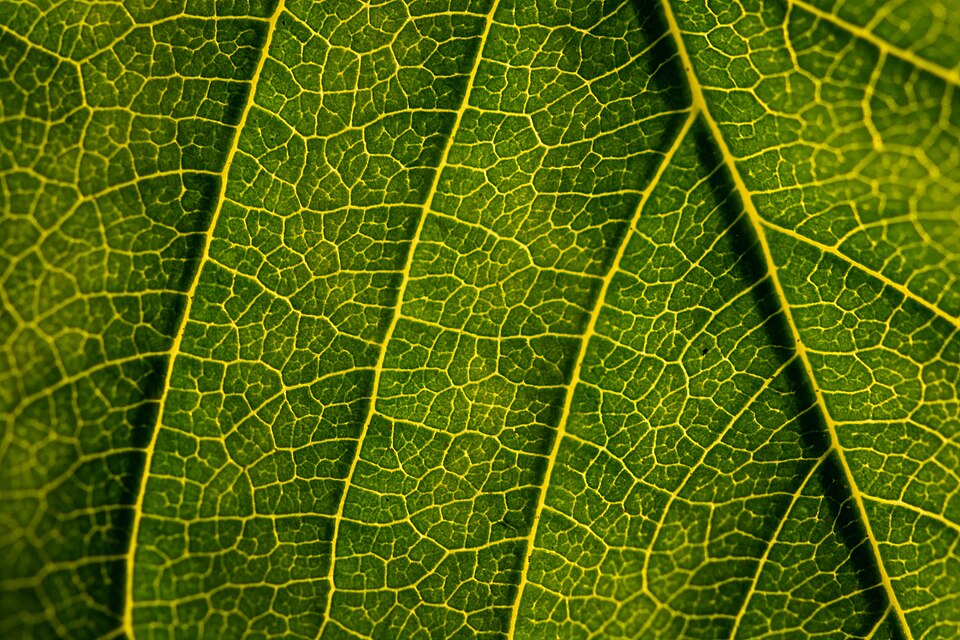
The colour of an object is the light it reflects, not the light it absorbs. Chlorophyll captures energy for photosynthesis by absorbing red and blue-violet wavelengths, which sit at the two ends of the visible spectrum, and it reflects the green wavelengths in the middle. That reflected green light is what gives leaves their colour.
The common misconception is that a green leaf must absorb green light. The opposite is true: it reflects green (using it least) and absorbs red and blue (using them most). When chlorophyll breaks down in autumn, the underlying yellow and orange carotenoids and red anthocyanins show through, changing the leaf colour.
Key facts
- Chlorophyll absorbs most strongly in the red (about 660 nm) and blue-violet (about 430 nm) wavelengths.
- Green light (about 550 nm) is reflected and transmitted, so leaves appear green.
- The colour we perceive is reflected light, not absorbed light.
- In autumn, chlorophyll breaks down and carotenoids and anthocyanins give leaves yellow, orange and red hues.
Study next
Common traps
- Thinking chlorophyll absorbs green light — it reflects green, which is exactly why leaves look green.
- Confusing the colour we see (reflected light) with the colours the pigment absorbs (red and blue) for photosynthesis.
A single-best-answer on leaf colour — link the green appearance to reflection of green light and absorption of red and blue.
Related PYQs
Which one of the following is the process involved in photosynthesis?
- (a) Potential energy is released to form free energy
- (b) Free energy is converted into potential energy and stored
- (c) Food is oxidized to release carbon dioxide and water
- (d) Oxygen is taken in, and carbon dioxide and water vapour are given out
Answer(b) Free energy is converted into potential energy and stored — chlorophyll traps radiant energy and stores it as chemical energy in carbohydrates.
Builds on the same role of chlorophyll — capturing light energy — that explains why a leaf absorbs red and blue and reflects green in this NDA question.
Match List I (Physiological processes) with List II (Cell organelles): I. Photosynthesis II. Mineral uptake III. Respiration IV. Protein Synthesis; A) Plasma membrane B) Chloroplast C) Mitochondria D) Ribosomes
- (a) I-A, II-B, III-C, IV-D
- (b) I-A, II-B, III-D, IV-C
- (c) I-B, II-A, III-C, IV-D
- (d) I-B, II-A, III-D, IV-C
Answer(c) I-B, II-A, III-C, IV-D — photosynthesis occurs in the chloroplast (which holds chlorophyll), mineral uptake at the plasma membrane, respiration in mitochondria, protein synthesis at ribosomes.
Places chlorophyll's home, the chloroplast, in its cellular context — the pigment whose selective absorption of red and blue light this NDA question tests.
Practice
- practice — not a real PYQ
Chlorophyll absorbs light most strongly in which regions of the visible spectrum?
- (a)Green and yellow
- (b)Red and blue
- (c)Green only
- (d)Red only
Answer(b) Red and blue — chlorophyll peaks in the red and blue-violet and reflects green, so leaves look green. - practice — not a real PYQ
In autumn, many leaves turn red or yellow mainly because
- (a)more chlorophyll is produced
- (b)chlorophyll breaks down, revealing carotenoids and anthocyanins
- (c)the leaf absorbs more water
- (d)photosynthesis speeds up
Answer(b) chlorophyll breaks down, revealing carotenoids and anthocyanins — the green pigment fades, so the yellow, orange and red pigments show through.