
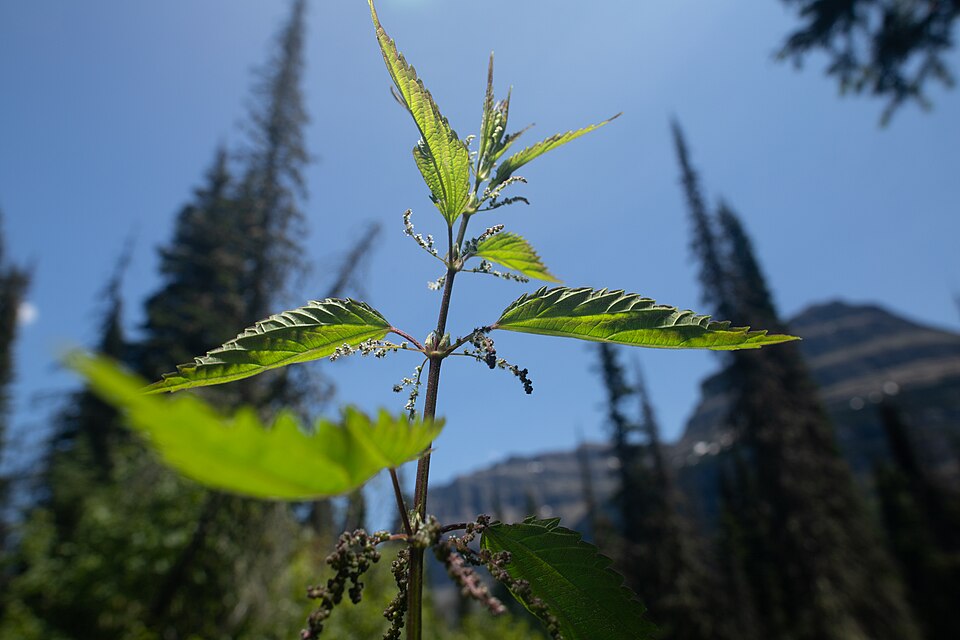
Which one among the following is present in the nettle leaf hairs that causes burning pain?
- (a)Methanoic acid
- (b)Ethanoic acid
- (c)Benzoic acid
- (d)Acetic acid
Answer
Why
Correct — A, methanoic acid. The stinging hairs on a nettle leaf inject methanoic acid (formic acid, HCOOH) into the skin, and it is this acid that produces the characteristic burning, stinging pain. Methanoic acid is the same simple carboxylic acid found in the sting of ants, which is why rubbing on a mild base such as baking soda soothes a nettle sting.
Why the others are wrong
- (b)Ethanoic acid — Ethanoic acid is another name for acetic acid, the vinegar acid; it is not what the nettle injects — that is methanoic (formic) acid.
- (c)Benzoic acid — Benzoic acid is an aromatic acid used as a food preservative; it is not the acid in nettle or ant stings.
- (d)Acetic acid — Acetic acid is the same compound as ethanoic acid in option (b) — both are CH₃COOH, the vinegar acid — so it too is not the nettle's acid.
Concept
Nettle stings, like many insect stings, burn because of an injected acid. The simplest carboxylic acid, methanoic acid (HCOOH), also called formic acid, is the traditional textbook cause; its common name comes from formica, the Latin word for ant. A weak base neutralises the acid and relieves the sting.
Match the pain to the simplest acid. The nettle sting is classically attributed to methanoic (formic) acid — the same acid as in ant stings. The remaining options are either the vinegar acid, listed under both of its names (ethanoic and acetic), or an aromatic preservative (benzoic), none of which the nettle injects.
Key facts
- Methanoic acid (HCOOH) is the simplest carboxylic acid; its common name formic acid derives from the Latin for ant.
- Traditionally the nettle sting and the ant sting are both attributed to formic acid, and a mild base such as baking soda neutralises it and eases the pain.
- Ethanoic acid (option b) and acetic acid (option d) are two names for the very same compound, CH₃COOH — the acid in vinegar.
- Modern analysis shows a nettle sting is actually a mixture that also contains histamine, acetylcholine and serotonin, but formic acid is the answer intended by the exam.
Study next
Common traps
- Being tricked by ethanoic acid and acetic acid being the same compound listed twice.
- Confusing formic (methanoic) acid with acetic (ethanoic) acid.
- Assuming a base would worsen the sting — a mild base actually soothes it.
NDA/UPSC ask which acid is present in ant or nettle stings, or to match common acids with their natural source.
Related PYQs
Assertion (A): Formic acid is a stronger acid than acetic acid. Reason (R): Formic acid is an organic acid.
- (a) Both A and R are true, and R is the correct explanation of A
- (b) Both A and R are true, but R is NOT a correct explanation of A
- (c) A is true, but R is false
- (d) A is false, but R is true
Answer(b) Both A and R are true, but R is NOT a correct explanation of A
A 1998 UPSC prelims assertion–reason item on the same compound, formic (methanoic) acid — it tests that formic acid is a stronger acid than acetic acid, and that being 'organic' is not the reason. A different angle from the nettle-sting fact, but it reinforces formic acid, the acid featured here.
Practice
- practice — not a real PYQ
The acid present in the sting of an ant is
- (a)acetic acid
- (b)methanoic acid
- (c)citric acid
- (d)oxalic acid
Answer(b) methanoic acid — formic acid (HCOOH) is injected by an ant sting, the same acid traditionally linked to nettle. - practice — not a real PYQ
Formic acid is the common name of
- (a)ethanoic acid
- (b)methanoic acid
- (c)benzoic acid
- (d)oxalic acid
Answer(b) methanoic acid — HCOOH is called formic acid, from the Latin word for ant.