
Light of uniform intensity impinges perpendicularly on a totally reflecting surface. If the area of the surface is halved, the radiation force on it will become
- (a)double
- (b)half
- (c)four times
- (d)one fourth
Answer
Why
Correct — B, half. Light carries momentum, so when it strikes a surface it exerts a radiation force. For a totally reflecting surface with light of fixed intensity I striking it perpendicularly, the radiation pressure P = 2I/c is fixed (it depends on the intensity and the speed of light, not on area). The force is pressure times area, F = P × A, so F is directly proportional to the area. Halving the area therefore halves the force.
Why the others are wrong
- (a)double — This inverts the relationship. Force is proportional to area (F = PA), so a smaller area gives a smaller force, not a larger one.
- (c)four times — There is no square dependence here — force scales linearly with area, not with area², so halving the area cannot quadruple the force.
- (d)one fourth — This would require F ∝ A², but the force depends linearly on area, so halving the area gives half (not one-fourth) the force.
Concept
Electromagnetic radiation carries momentum, so it pushes on any surface it hits — this is radiation pressure. For a beam of intensity I hitting a surface at normal incidence, the pressure is I/c if fully absorbed and 2I/c if fully reflected (reflection reverses the photons' momentum, doubling the push). The force on the surface is this pressure multiplied by the illuminated area.
The key is to separate pressure from force. Intensity (power per unit area) is fixed, so the pressure is fixed regardless of how big the surface is; only the total force changes with area. Since F = P × A with P constant, force simply tracks the area — halve the area, halve the force.
Key facts
- Radiation pressure for total reflection at normal incidence: P = 2I/c.
- Radiation force F = P × A, so F ∝ area when intensity is fixed.
- Reflection doubles the pressure compared with full absorption (P = I/c).
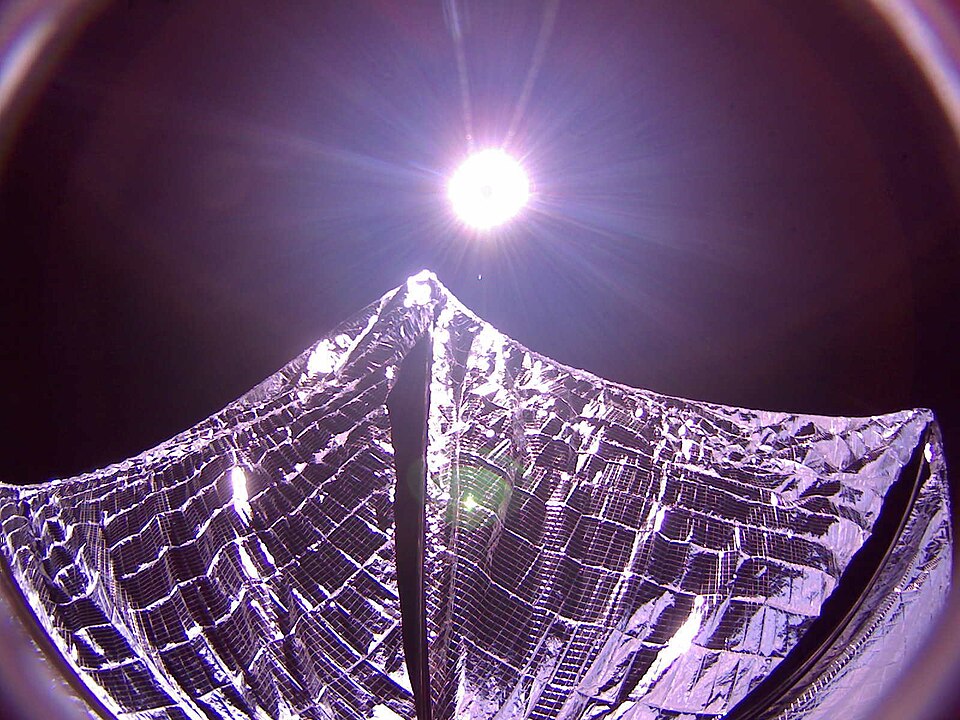
- Solar sails exploit this force to propel spacecraft using sunlight.
Study next
Common traps
- Confusing pressure (fixed by intensity) with force (which depends on area).
- Assuming reflection or a smaller area introduces a square-law dependence — the force is linear in area.
Asked as a proportionality question — recognise F = P × A with P fixed, so force follows the area directly.
Related PYQs
No directly related past PYQ was found.
Practice
- practice — not a real PYQ
For light of a given intensity at normal incidence, the radiation pressure on a perfectly reflecting surface compared with a perfectly absorbing one is
- (a)the same
- (b)half
- (c)double
- (d)four times
Answer(c) double — reflection reverses the photons' momentum, giving P = 2I/c versus I/c for absorption. - practice — not a real PYQ
Radiation pressure exists because light
- (a)has mass at rest
- (b)carries momentum
- (c)is electrically charged
- (d)travels in straight lines
Answer(b) carries momentum — the momentum transferred to a surface produces a force.