
Light rays move in straight lines. But through an optical fibre, they can move in any type of zigzag path because
- (a)the holes through the fibre are extremely fine.
- (b)light rays are absorbed at the entry end and relieved at the exit end of the fibre.
- (c)scattering of light occurs inside the fibre.
- (d)successive total internal reflections occur as a ray moves through the fibre.
Answer
Why
Correct — D, successive total internal reflections occur as a ray moves through the fibre. An optical fibre has a core of higher refractive index surrounded by a cladding of lower refractive index. Light entering the core strikes the core-cladding boundary at an angle greater than the critical angle, so it is totally internally reflected; repeating this along the length keeps the light trapped and lets it follow bends and zigzags instead of a straight line.
Why the others are wrong
- (a)the holes through the fibre are extremely fine. — An optical fibre is a solid glass or plastic strand, not a tube with holes; light is guided by reflection, not by passing through holes.
- (b)light rays are absorbed at the entry end and relieved at the exit end of the fibre. — Light is not absorbed and re-emitted; it travels along the fibre, being reflected internally, without being absorbed.
- (c)scattering of light occurs inside the fibre. — Scattering would spread and weaken the signal (a loss mechanism), not guide it; guidance is by total internal reflection.
Concept
An optical fibre guides light by total internal reflection (TIR). Its higher-index core is wrapped in a lower-index cladding, so light hitting the boundary beyond the critical angle is reflected entirely back into the core. Bouncing this way again and again, the light stays inside even when the fibre bends.
The wrong options describe holes, absorption and scattering. The real reason a light ray can follow a curved fibre is that it keeps meeting the boundary above the critical angle and is totally internally reflected, so it never escapes.
Key facts
- Optical fibres guide light by total internal reflection (TIR).
- The core has a higher refractive index than the surrounding cladding.
- TIR needs light to travel from a denser to a rarer medium and to strike the boundary above the critical angle.
- Fibres are used in high-speed communication and in medical endoscopy.
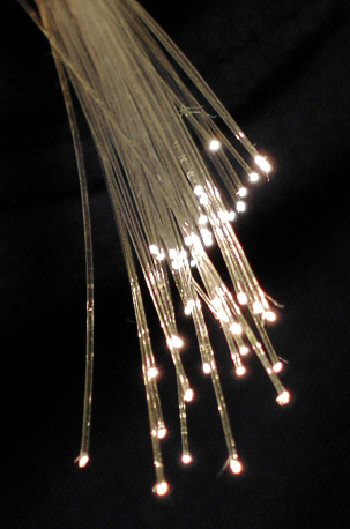
Study next
Common traps
- Answering 'refraction' — the guiding principle is total internal reflection, not ordinary refraction.
- Thinking the fibre is hollow; it is a solid, higher-index core.
Asked by naming the principle behind optical fibres, or the conditions needed for total internal reflection.
Related PYQs
Optical fibre works on the principle of
- (a) total internal reflection
- (b) refraction
- (c) scattering
- (d) interference
Answer(a) total internal reflection
Identical concept — the optical fibre works by total internal reflection, exactly the reason light can follow a zigzag path in this 2019 question.
Practice
- practice — not a real PYQ
Total internal reflection occurs when light travels from a
- (a)rarer to a denser medium at any angle
- (b)denser to a rarer medium at an angle greater than the critical angle
- (c)denser to a rarer medium at any angle
- (d)vacuum into glass
Answer(b) denser to a rarer medium at an angle greater than the critical angle. - practice — not a real PYQ
In an optical fibre, the refractive index of the core compared with the cladding is
- (a)lower
- (b)higher
- (c)equal
- (d)zero
Answer(b) higher — the higher-index core keeps light trapped by total internal reflection.