
Mitochondria are able to produce their own
- (a)Nucleus
- (b)Proteins
- (c)Chloroplasts
- (d)Digestive enzymes
Answer
Why
Correct — B, proteins. Mitochondria are semi-autonomous organelles: they carry their own small circular DNA and their own ribosomes (70S), so they can transcribe and translate some of their genes and make a portion of their own proteins. This genetic independence — a relic of their prokaryotic, endosymbiotic origin — is why mitochondria (and chloroplasts) can synthesise some proteins rather than depending entirely on the nucleus.
Why the others are wrong
- (a)Nucleus — The nucleus is not manufactured by a mitochondrion; a cell's nucleus arises under nuclear and cytoplasmic control during cell division.
- (c)Chloroplasts — Chloroplasts are a separate organelle found in green plant cells; mitochondria do not produce them, although both are semi-autonomous and share an endosymbiotic origin.
- (d)Digestive enzymes — Hydrolytic (digestive) enzymes are packaged by lysosomes; the mitochondrion's role is energy (ATP) production, not intracellular digestion.
Concept
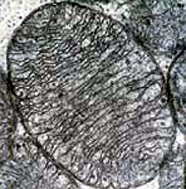
Mitochondria are the site of aerobic respiration and ATP production. Unlike most organelles they possess their own circular DNA and 70S ribosomes, so they can make some of their own proteins. Because of this partial self-sufficiency they are called semi-autonomous organelles.
The clue in the question is 'their own'. Ask which organelle has the machinery — DNA plus ribosomes — to build anything itself. Only mitochondria (and chloroplasts) do, and what that machinery makes is proteins.
Key facts
- Mitochondria contain their own circular DNA and 70S ribosomes.
- They therefore synthesise some of their own proteins and are called semi-autonomous.
- They are the site of aerobic respiration and ATP production — the cell's 'powerhouse'.
- Their genetic machinery reflects an endosymbiotic (prokaryotic) origin, a feature shared with chloroplasts.
Study next
Common traps
- Assuming every protein is made only on cytoplasmic ribosomes — mitochondria and chloroplasts also make some of their own.
- Confusing the mitochondrion (ATP, own DNA) with the lysosome (digestive enzymes).
Asked by naming what mitochondria/chloroplasts can make themselves, or by identifying the organelle (other than the nucleus) that contains DNA.
Related PYQs
Which organelle in the cell, other than nucleus, contains DNA?
- (a) Centriole
- (b) Golgi apparatus
- (c) Lysosome
- (d) Mitochondrion
Answer(d) Mitochondrion
Same concept — mitochondria hold their own DNA (besides the nucleus), which is exactly why they can make some of their own proteins as asked here.
Which of the following organelles have their own DNA and ribosomes?
- (a) Endoplasmic reticulum and Golgi bodies
- (b) Mitochondria and Chloroplast
- (c) Endoplasmic reticulum and cytoskeleton
- (d) Cell wall and nucleolus
Answer(b) Mitochondria and Chloroplast
Directly on point — mitochondria and chloroplasts have their own DNA and ribosomes, which is the reason (as this 2019 question tests) that mitochondria can synthesise some of their own proteins.
Practice
- practice — not a real PYQ
Mitochondria are called semi-autonomous organelles because they
- (a)have only a single membrane
- (b)possess their own DNA and ribosomes
- (c)are found only in plant cells
- (d)contain no enzymes
Answer(b) possess their own DNA and ribosomes, so they can make some of their own proteins. - practice — not a real PYQ
Which organelle, apart from the nucleus, contains DNA?
- (a)Golgi apparatus
- (b)Lysosome
- (c)Mitochondrion
- (d)Free ribosome
Answer(c) Mitochondrion — it carries its own circular DNA.