
Which one of the following sedimentary rocks is organically formed?
- (a)Shale
- (b)Chert
- (c)Halite
- (d)Chalk
Answer
Why
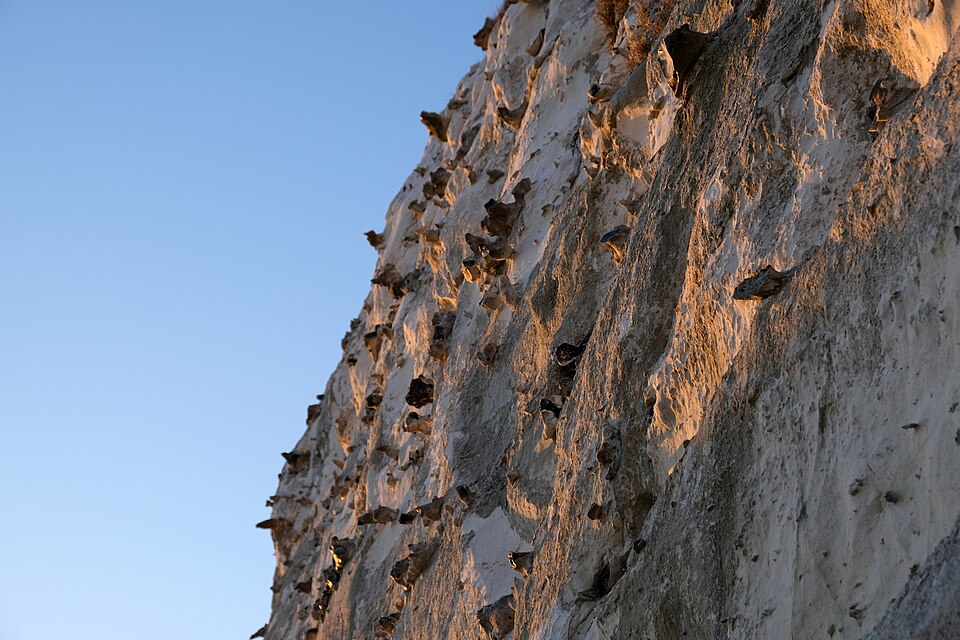
Correct — D, chalk. Chalk is a soft, white variety of limestone built up from the calcareous shells and skeletons of tiny marine organisms, so it is an organically formed sedimentary rock. Shale is mechanically formed from compacted clay, while chert and halite are chemically formed, halite being an evaporite deposit.
Why the others are wrong
- (a)Shale — Shale is a mechanically (clastically) formed sedimentary rock, made of fine clay and silt particles compacted together — not of organic remains.
- (b)Chert — Chert is a chemically formed sedimentary rock of microcrystalline silica precipitated from solution, not built from organisms.
- (c)Halite — Halite (rock salt) is a chemically formed evaporite, deposited when saline water evaporates — an inorganic, chemical origin.
Concept
Sedimentary rocks are grouped by how their sediment accumulates: mechanically (clastic) from rock fragments, chemically from minerals precipitated out of solution, and organically from the remains of living things. Chalk, a fine-grained limestone made largely of the microscopic calcite plates of marine algae and shells, is a classic organically formed rock.
Sort each rock by its mode of formation. Shale is clastic, chert and halite are chemical precipitates, and chalk alone is biological in origin — the accumulated hard parts of marine organisms. The trap is that all four are sedimentary, so the mode of formation, not the class, is the deciding factor.
Key facts
- Sedimentary rocks form mechanically, chemically or organically.
- Chalk is an organically formed limestone made of marine microorganism remains.
- Shale is a mechanically (clastic) formed rock of compacted clay.
- Chert and halite are chemically formed; halite is an evaporite.
Study next
Common traps
- Treating all sedimentary rocks the same — the question turns on organic versus mechanical or chemical origin.
- Reading halite (a chemical evaporite) or shale (clastic) as organic.
You must pick the organically formed rock from a set of sedimentary rocks — link chalk (and coal, limestone) to organic origin, shale to mechanical and halite/chert to chemical.
Related PYQs
Consider the following statements made about the sedimentary rocks: I. Sedimentary rocks are formed at Earth's surface by the hydrological system. II. The formation of sedimentary rocks involves the weathering of pre-existing rocks. III. Sedimentary rocks contain fossils. IV. Sedimentary rocks typically occur in layers. Which of these statements are correct?
- (a) I and II
- (b) I and IV
- (c) II, III and IV
- (d) I, II, III and IV
Answer(d) I, II, III and IV
Same concept — the nature of sedimentary rocks. UPSC tests their general characteristics (layered, fossil-bearing, formed by weathering); this NDA item tests the sub-classification by mode of formation (chalk as organically formed).
Practice
- practice — not a real PYQ
Which one of the following is a chemically formed (evaporite) sedimentary rock?
- (a)Chalk
- (b)Shale
- (c)Halite
- (d)Sandstone
Answer(c) Halite — rock salt deposited by the evaporation of saline water. - practice — not a real PYQ
Coal is an example of a sedimentary rock formed
- (a)mechanically
- (b)chemically
- (c)organically
- (d)by metamorphism
Answer(c) organically — coal forms from the accumulated remains of plants.