
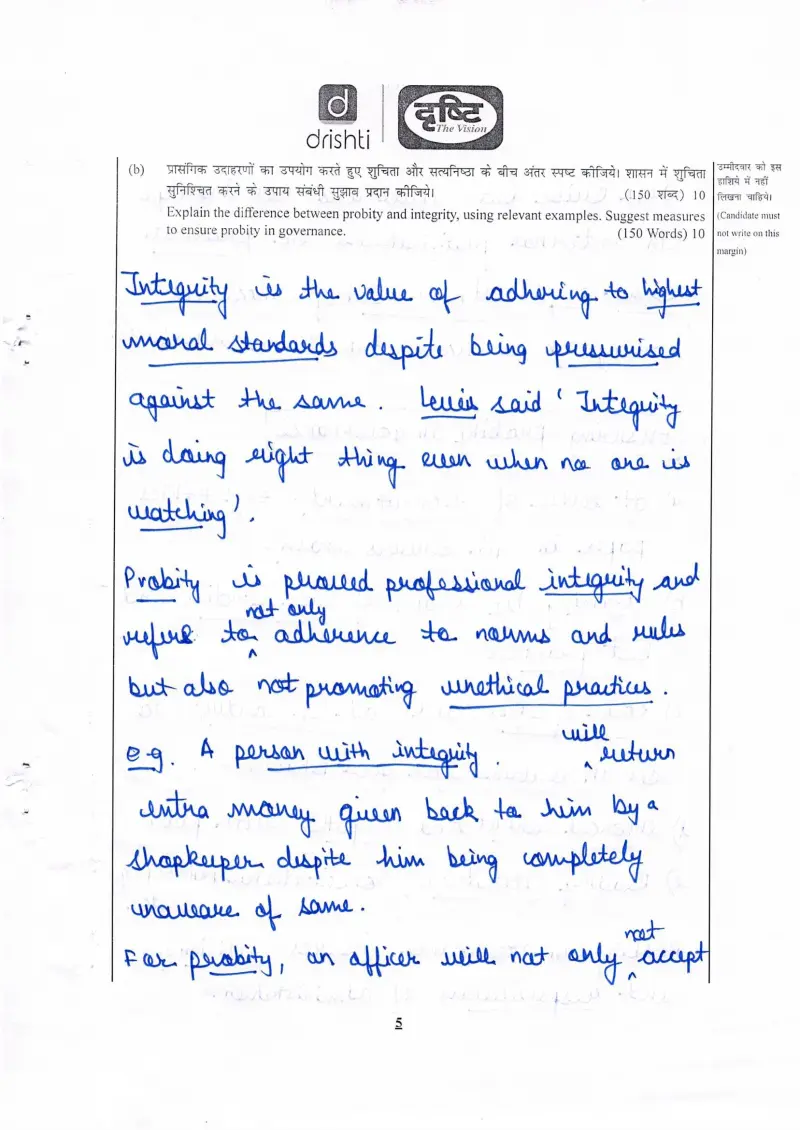
 View answer copy →
Answered a very similar question
Their question: “Difference between probity and integrity with examples; measures to ensure probity in governance (max 10)”
The 2014 PYQ asks what probity is, the difficulties in practising it and how to overcome them; Aakash's probity answer (definition, Satyendra Dubey, Nolan Committee, recruitment-stage measures) maps onto all three demands.
Key learnings from their answer
- ›He doesn't just name thinkers, he pairs them as a debate: on means-ends (Q2a) he sets Gandhi ('both means and ends ought to be pure') against Rawls's 'pure procedural justice' (pure means make ends pure automatically), and backs probity (Q1b) with C.S. Lewis's 'Integrity is doing the right thing even when no one is watching' -> pre-load 2-3 quotable lines per core Ethics theme and deploy them as contrasting positions, not decoration, so the answer reads as reasoned argument.
- ›His examples are concrete, current and verifiable rather than vague: Satyendra Dubey exposing road-contract corruption (probity), T.N. Seshan and the Nolan Committee (ethics in public life), the Rafale/2G/Adarsh cases and RTI Act 2005 (transparency), and India's Vaccine Maitri to Nepal/Sri Lanka/Maldives (vaccine diplomacy) -> stock a small bank of named real-world instances mapped to standard Ethics demands so abstract concepts always land with a specific, factual peg.
What they cited: Satyendra Dubey uncovering corruption in road contracts (probity) · Ethics paper in the Civil Services exam as a recruitment-stage probity measure · Nolan Committee — accountability as a core value; former CEC T.N. Seshan (ethics in public life)
Quotes used: “C.S. Lewis — 'Integrity is doing the right thing even when no one is watching' (cited in Q1b)”