
 View answer copy →
Ravi GangwarRank 616CSE 2023
Answered a closely related question
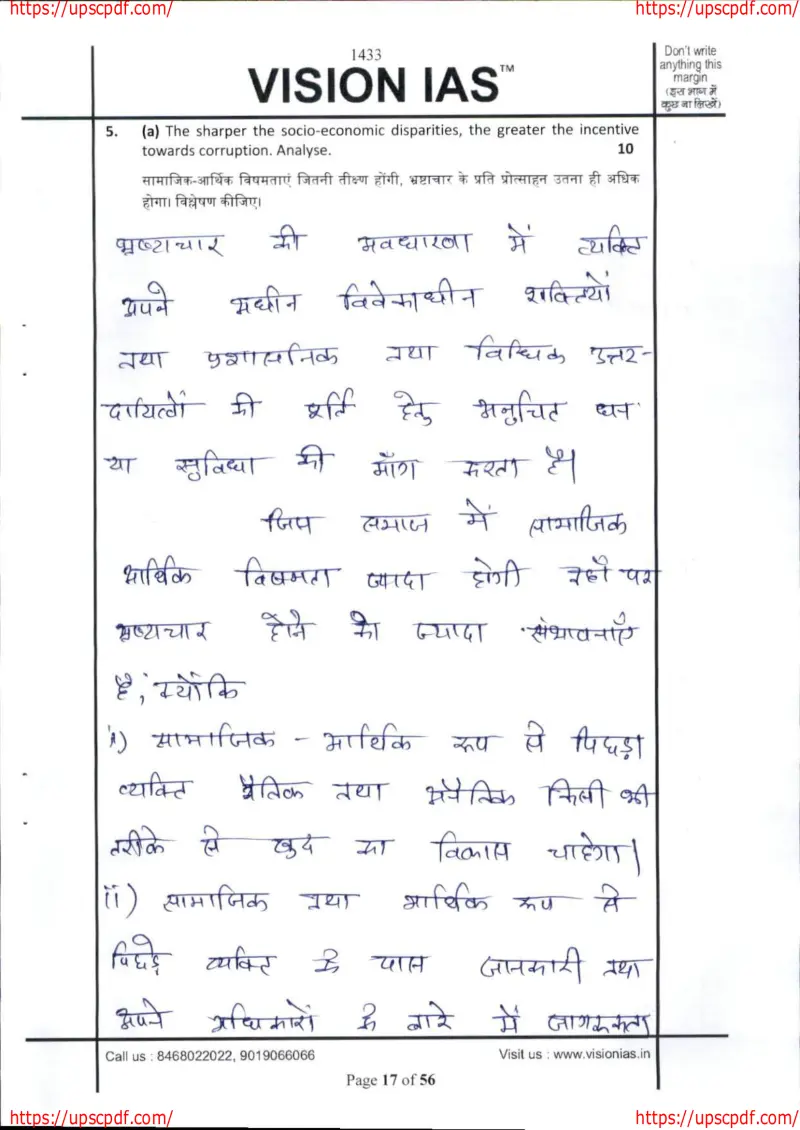
Their question: “(a) socio-economic disparities as corruption incentive (point-wise i-v); (b) Kantian moral worth depends on motive not consequences”
The (a) sub-part on disparity as a corruption driver maps to this PYQ's 'basic causes of corruption' demand, so the topper's point-wise causal analysis transfers directly.
Key learnings from their answer
- ›A consistent answer architecture is held throughout, open with a quote or crisp definition, then break into numbered sub-points (i/ii/iii, a/b/c) with underlined headings like laabh/haaniyaan (merits/demerits) -> a predictable open-then-segment structure makes a prose Ethics answer scannable for the examiner even with zero diagrams (this copy has none).
- ›Every value in Section A is anchored to a NAMED thinker, and Gandhi's 'golden rule = mutual toleration' is further grounded in Jain anekantavada/syadvada (Q1a) rather than left as a bare assertion -> don't just name a concept, tie it to a specific philosopher and reinforce it with a second tradition so the marker sees depth, not a memorized line.