 View answer copy →
Aayushi BansalAIR 7CSE 2024
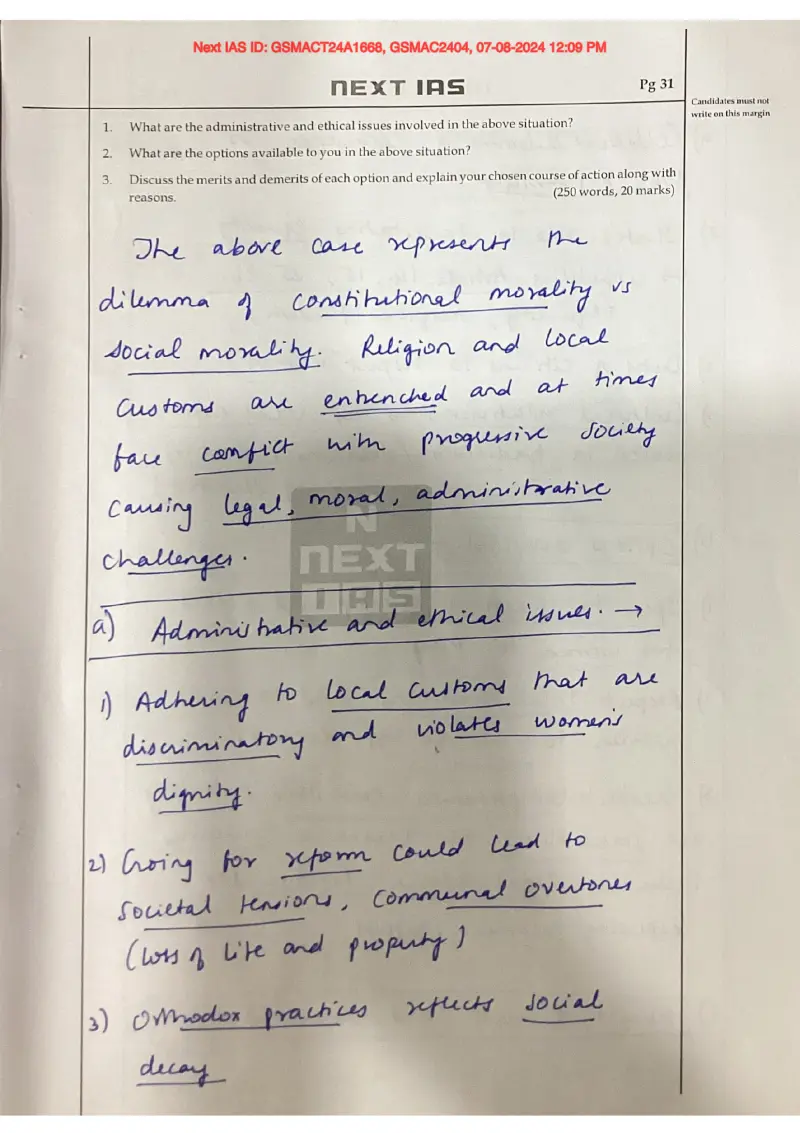
Answered a closely related question
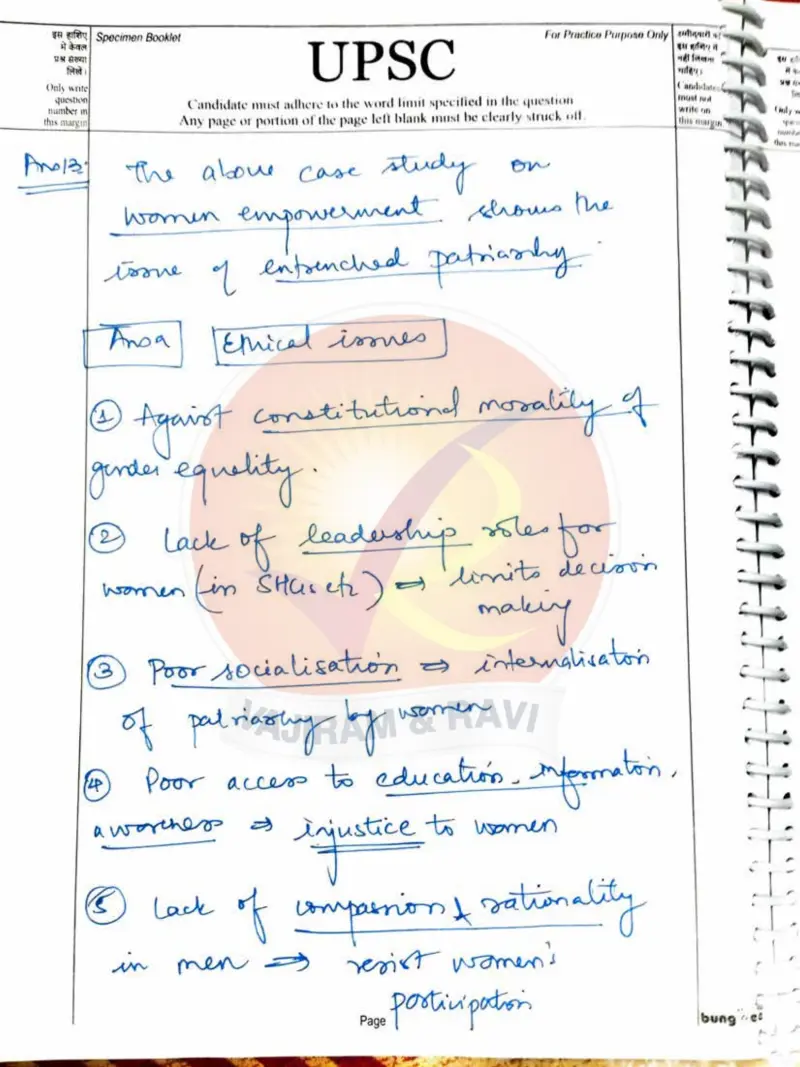
Their question: “Case study (a/b/c): Women's participation in SHGs/village councils; engaging men; institutional/policy changes”
The 2015 case is about overcoming village patriarchal resistance to women stepping out; Aayushi's women's-participation answer (engaging men, moulding patriarchal attitudes, institutional change) transfers directly.
Key learnings from their answer
- ›Her case-study answers follow a fixed, examiner-friendly skeleton: an enumerated 'ethical issues' list first, then stepwise action, then a short-term-vs-long-term justification, and Q12 (Kerala landslides) explicitly splits the cognitive vs affective dimensions. Lesson: a repeatable case-study template (issues -> stakeholders/action -> short- vs long-term) lets you answer all five case studies (Q12,13,15,16,17) fully and consistently under time pressure.
- ›She closes answers on a deliberate value-laden maxim that fits the question, 'Yogakshema' for the welfare-state accountability answer (Q5), 'Vasudhaiva Kutumbakam' for global inequality (Q8), Aristotelian 'eudaimonia' for the AI-policy answer (Q14), 'Nari Shakti' for women's participation (Q13). Lesson: a short, topic-matched maxim as your last line gives Ethics answers a memorable 'signature' ending, but pick one that actually maps to the question, not a stock phrase.
Quotes used: “'Nari Shakti' [Q13]”