 View answer copy →
Kumud MishraRank 69CSE 2024
Answered a very similar question
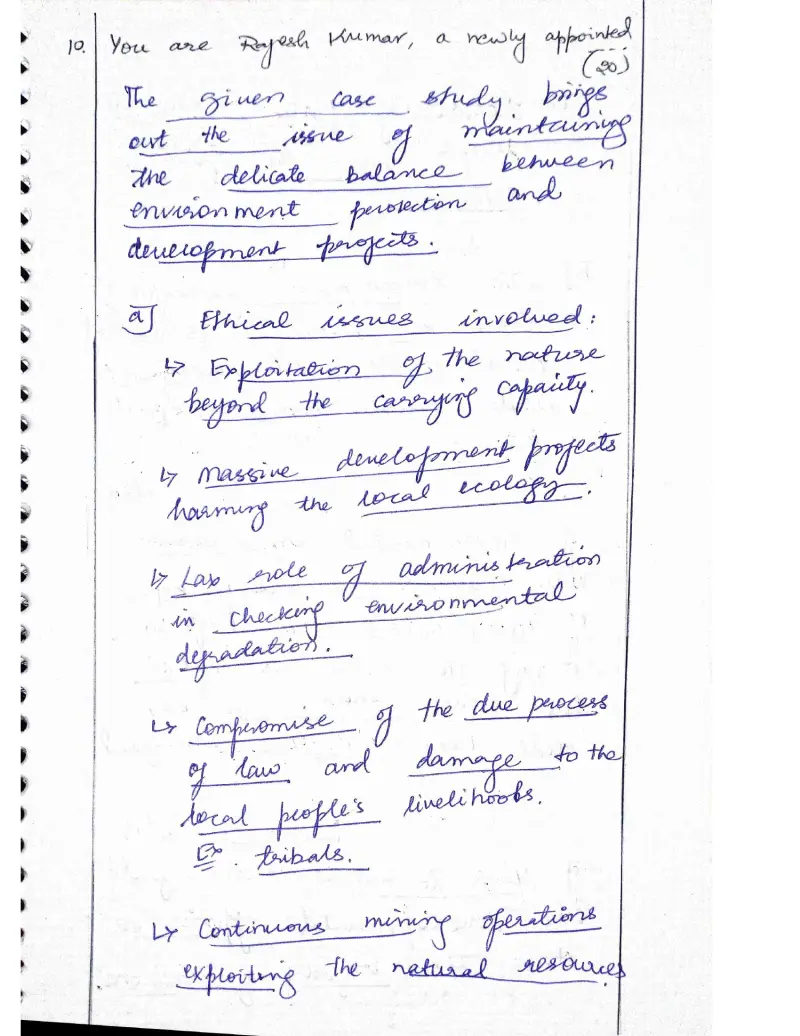
Their question: “Case study — Rajesh Kumar; environment protection vs development projects”
2014 CS1 is the development-vs-environment conflict resolved through sustainable development; the topper's environment case (the 'Prakriti Rakshati Rakshita' value-line and named examples) models exactly this trade-off.
Key learnings from their answer
- ›Nearly every answer closes with a Sanskrit shloka or value-line matched to the topic, 'Vasudhaiva Kutumbakam' (Maha Upanishad) for the global-family question, 'Sarve bhavantu sukhinah', 'Atmano Mokshartham Jagat Hitaya cha', 'Prakriti Rakshati Rakshita' for the environment case, 'Appa Deepo Bhava' -> build a small bank of topic-tagged value-lines so conclusions land with cultural weight rather than a flat summary, but keep the shloka relevant to the specific question (the environment case got the Prakriti line, not a generic one).
- ›Case studies run a tight repeatable template, identify stakeholders, list ethical issues, weigh the realistic options in a two-column Merits/Demerits table (used in Q8 Election Commissioner, Q11 conflict-of-interest, Q12 harassment committee), commit to one clear chosen course, then give a way-forward list -> a visible decision structure with options explicitly weighed in a table shows the examiner your reasoning process, which scores higher than jumping straight to the 'right' answer.