
 View answer copy →
Lovish GargRank 184
Answered a closely related question
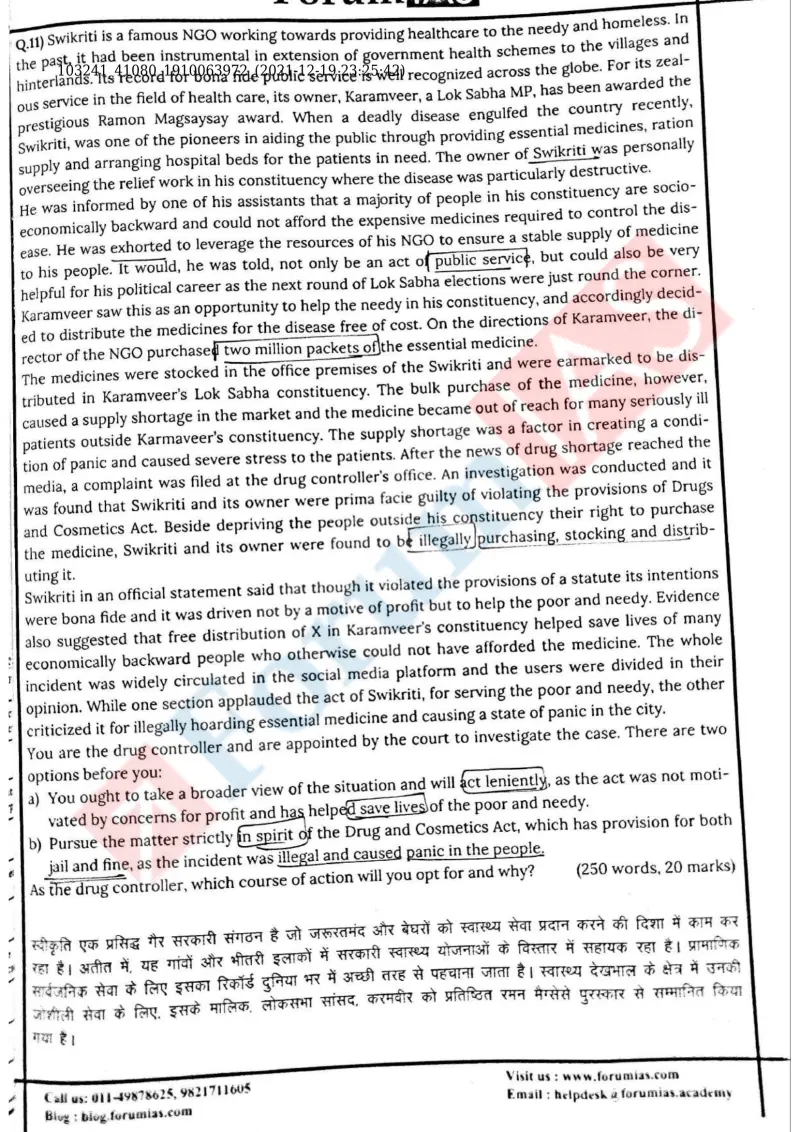
Their question: “Case study: NGO Swikriti/MP Karamveer bulk-buying 2 million medicine packets causing shortage (Drugs & Cosmetics Act violation) - as drug controller, act leniently vs strictly”
2018 Q13 is the regulator's technical-vs-substantial, strict-vs-lenient enforcement dilemma; the topper's drug-controller case (mens rea vs strict liability, options in a merits/demerits table) is the same decision structure.
Key learnings from their answer
- ›For decision-type case studies (Q10 NCB officer Kuldeep pressured to go soft, Q11 drug controller deciding lenient vs strict), each option is weighed in a tidy two-column Merits/Demerits table before a single reasoned 'best course of action' is chosen. -> Don't just assert your decision - lay out the trade-offs of each option side by side so the examiner sees the reasoning, then commit; the visible weighing is what earns the marks, not the verdict.
- ›Ethics and legal vocabulary is deployed precisely, not decoratively - categorical imperative, deontological vs teleological, Kant's 'ends not means', and mens rea vs strict liability (the last directly relevant to Q11's Drugs & Cosmetics Act violation). -> Learn a small set of ethical-theory and legal terms well enough to apply them to the exact fact-pattern in front of you; precise terminology signals a trained ethical mind far more than generic 'right/wrong' talk.
- ›Every Section-B case study (Q7-Q11) opens with a hand-drawn radial 'Stakeholders' web (arrows out of a central box), then branches the dilemmas actor-by-actor before prescribing immediate AND long-term measures - e.g. the Amit/diverted-Covid-vaccine and Niranjanpur poisoned-sacred-lake cases. -> For case studies, map every stakeholder visually first; it forces you to surface conflicting interests you'd otherwise miss and structures the whole answer before you commit to a course of action.