 View answer copy →
Answered a very similar question
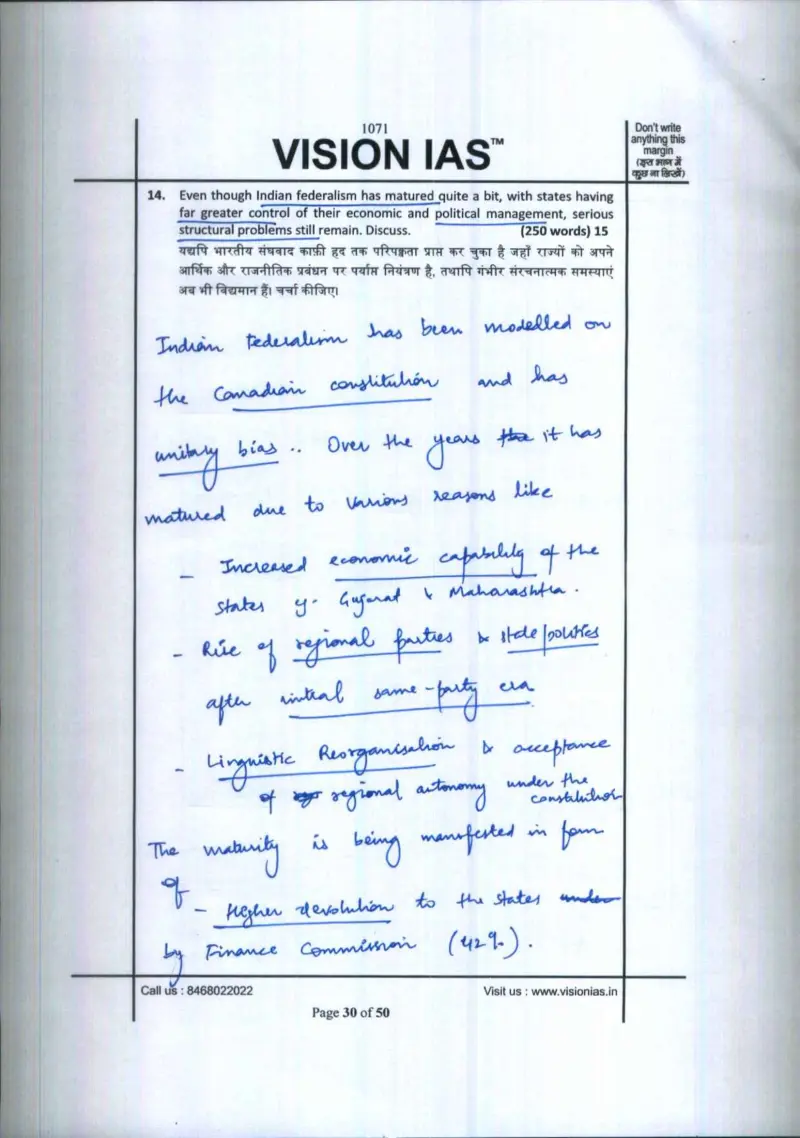
Their question: “Indian federalism — maturity yet remaining structural problems”
The topper's assessment of India's federal maturity and remaining structural problems (devolution, paradiplomacy, Inter-State Council, river disputes) directly informs the PYQ on cooperation, competition and confrontation shaping the federation.
Key learnings from their answer
- ›His conclusions are one coined or borrowed phrase that does the work of a paragraph: he ends the Parliament answer on 'Accountability is the soul of democracy', labels the Finance Commission the 'Balancing Wheel of Indian Federalism', and offers a self-coined 'Organic Federalism' as the way forward in Q14. -> Bank a short, memorable normative line per theme to close on a verdict the examiner remembers, rather than trailing off after the last bullet.
- ›He pins arguments to named cases and committees instead of vague 'experts say': Nagaraj on reservation-in-promotion, Indira Gandhi vs Raj Narain and Vineet Narain on the judiciary, Vishaka, plus NCRWC, the Venkatachaliah Commission and NK Singh's 15th FC. -> Attach a specific case or committee to each major contention, especially for 'critically discuss' polity questions, to signal source-grounded depth.
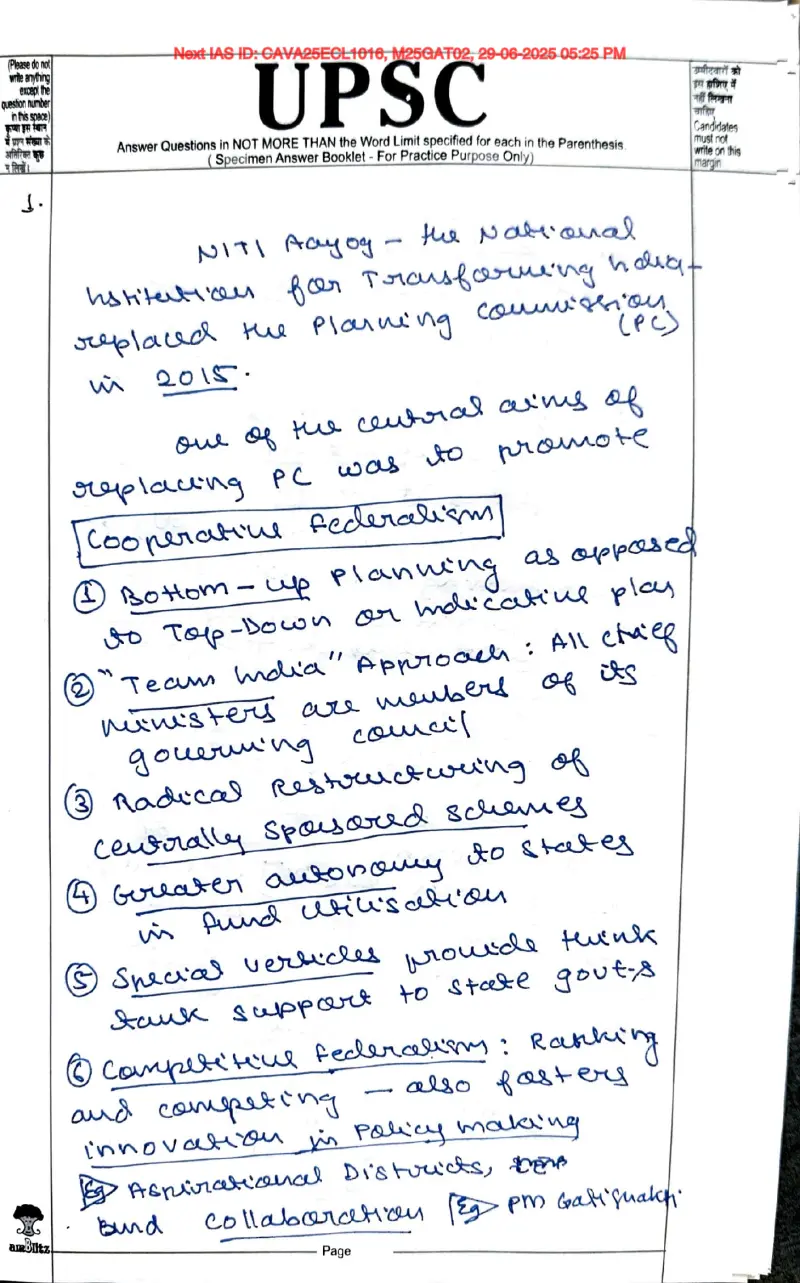
What they cited: Federalism: modelled on Canadian Constitution / unitary bias; ~42% devolution; paradiplomacy (West Bengal-Bangladesh, Kerala-Middle East); NITI Aayog cooperative/competitive federalism; MCOCA; Article 263 Inter-State Council; Venkatachaliah Commission on Governor; inter-state river disputes (Cauvery, Mahadayi, Mahanadi); All India Services; Special Category demand; 'Organic Federalism' as way forward (Q14)