
Match List – I with List – II and select the correct answer using the code given below the lists. List – I (Emperor) A. Babur B. Humayun C. Jahangir D. Shah Jahan List – II (City where Tomb is located) 1. Agra 2. Lahore 3. Delhi 4. Kabul Code :
- (a)A-4, B-3, C-2, D-1
- (b)A-3, B-4, C-2, D-1
- (c)A-3, B-4, C-1, D-2
- (d)A-4, B-3, C-1, D-2
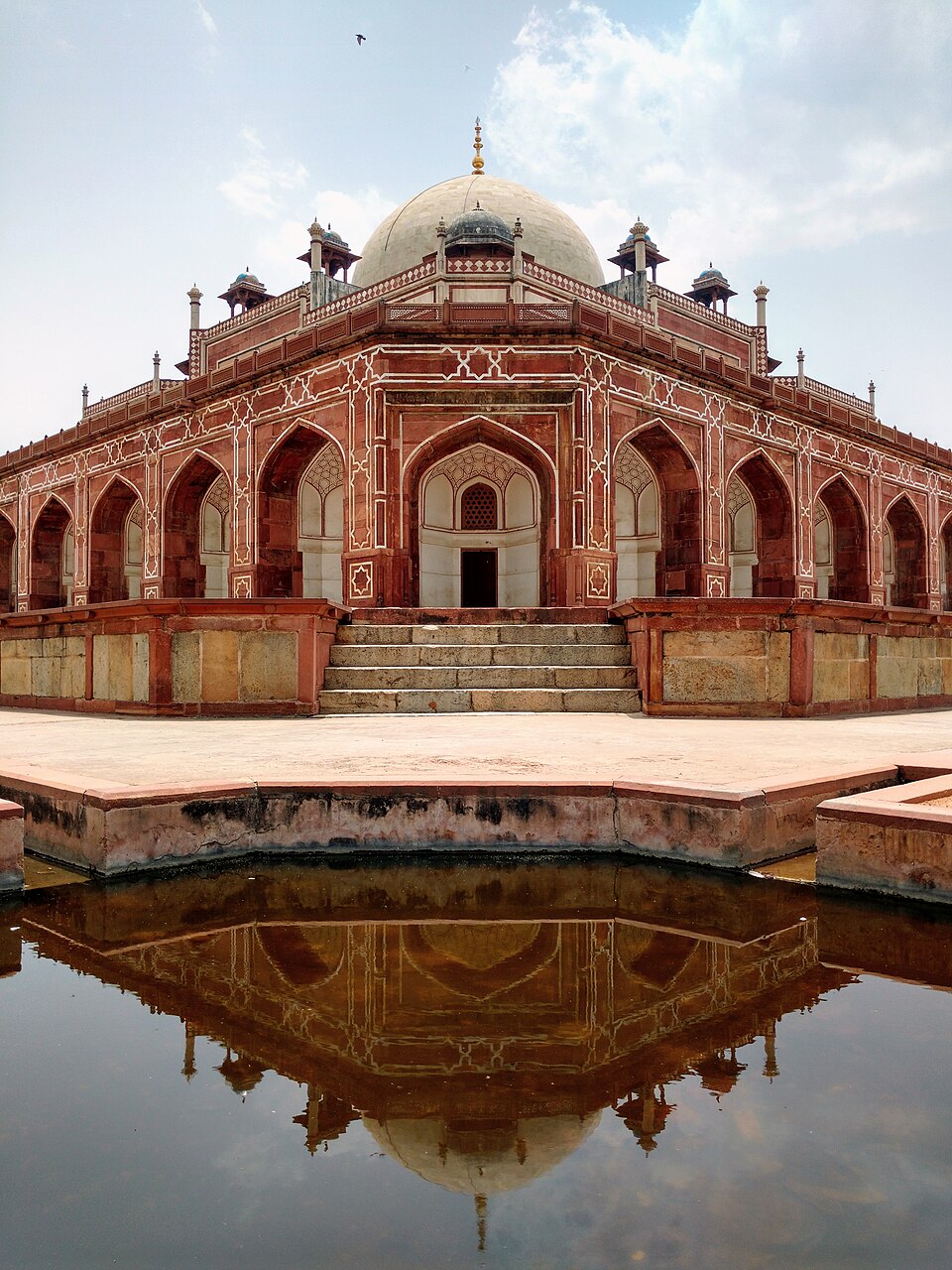
Correct — A, A-4, B-3, C-2, D-1. Babur (A) is buried at KABUL (4): he died at Agra in December 1530 and was buried there at first, but his remains were afterwards carried to Kabul in keeping with his own wish, to the terraced hillside garden known ever since as the Bagh-e-Babur — sources differ on exactly when the transfer was made. Humayun (B) lies at DELHI (3), in Humayun's Tomb at Nizamuddin, commissioned by his widow Hamida Banu Begum and built in the years after his death in 1556; it is the first great garden-tomb of the subcontinent and a UNESCO World Heritage Site since 1993. Jahangir (C) is buried at LAHORE (2), in the tomb at Shahdara Bagh on the bank of the Ravi, completed about a decade after his death in 1627 and traditionally credited to his widow Nur Jahan. Shah Jahan (D) rests at AGRA (1), inside the Taj Mahal beside Mumtaz Mahal — his cenotaph is the one off-centre element in an otherwise perfectly symmetrical building, since the Taj was never designed to hold him. That gives A-4, B-3, C-2, D-1, which is option (a).
- (b)A-3, B-4, C-2, D-1 — It gets Jahangir and Shah Jahan right but swaps the first two emperors, sending Babur to Delhi and Humayun to Kabul. It is the reverse of the truth: Babur is the one whose remains went back to Kabul, while Humayun — who died in Delhi after falling from the steps of his library in the Purana Qila — was buried there.
- (c)A-3, B-4, C-1, D-2 — Every pair is wrong. It swaps Babur with Humayun and also swaps Jahangir with Shah Jahan, putting Jahangir in Agra and Shah Jahan in Lahore. Neither holds: Jahangir's tomb is at Shahdara Bagh in Lahore, and Shah Jahan is interred in the Taj Mahal at Agra.
- (d)A-4, B-3, C-1, D-2 — The tempting near-miss. It places Babur and Humayun correctly and then swaps the last two, assigning Agra to Jahangir and Lahore to Shah Jahan. The confusion usually comes from Agra's other Mughal tombs — Akbar lies at Sikandra just outside Agra, and Itmad-ud-Daulah, who is buried in Agra, was Nur Jahan's father and so Jahangir's father-in-law, not Jahangir himself.
Where each Mughal emperor is buried is a map of where the dynasty's centre of gravity lay in his lifetime. Babur remained a Timurid prince of Central Asia who conquered India late and never settled emotionally into it, so his body went home to Kabul. Humayun, who lost Hindustan and won it back, was buried in Delhi under a Persian-designed dome that set the template for imperial Mughal tomb architecture. Jahangir's court spent long stretches in Lahore and Kashmir, and he was buried at Lahore. Shah Jahan, the greatest builder of the line, ended his life a prisoner in Agra Fort and was laid beside his wife in the mausoleum he had raised for her.
Match-list questions are best solved by fixing the pairs you are certain of and letting them eliminate options. Two anchors settle this one immediately. Shah Jahan is in the Taj Mahal, so D must be Agra (1) — that removes option (c). Humayun's Tomb is famously in Delhi, so B must be 3 — that removes (b) and (c). You are left choosing between (a) and (d), which differ only in Jahangir and Shah Jahan; and since D is already fixed to Agra, C must be Lahore, giving (a). Notice that the paper avoids Akbar altogether — his tomb at Sikandra is in Agra, and including him would have made two emperors point to the same city.
- Babur died at Agra on 26 December 1530 and was buried there first; his remains were later taken to Kabul, to the garden now called Bagh-e-Babur, as he had wished
- Humayun's Tomb, Delhi (Nizamuddin) was commissioned by his widow Hamida Banu Begum after his death in 1556; it is the subcontinent's first monumental charbagh garden-tomb and a UNESCO World Heritage Site (1993), and the acknowledged forerunner of the Taj Mahal
- Jahangir died in 1627; his tomb stands at Shahdara Bagh on the bank of the Ravi at Lahore — a low, domeless structure with four minarets and pietra dura inlay, with the tombs of Nur Jahan and Asaf Khan close by
- Shah Jahan died in 1666 while confined in Agra Fort and was buried in the Taj Mahal beside Mumtaz Mahal; his cenotaph is the single asymmetric feature of the monument
- Two more tombs to keep separate: Akbar's at Sikandra near Agra, and Aurangzeb's plain open grave at Khuldabad near Aurangabad (Chhatrapati Sambhajinagar) in Maharashtra
- Itmad-ud-Daulah's tomb in Agra — the 'Baby Taj', built by Nur Jahan for her father — is a common source of the mistaken belief that Jahangir is buried at Agra
- Assuming that because Babur died in India he must be buried in India — Agra was only his first, temporary burial place
- Sending Jahangir to Agra on the strength of Itmad-ud-Daulah's tomb, which belongs to his father-in-law, or of Akbar's tomb at Sikandra
- Forgetting that Shah Jahan is buried inside the Taj Mahal itself rather than in a separate mausoleum — a plan for a second tomb across the Yamuna was never executed
UPPSC favours the match-list — ruler against city, monument against builder, monument against chronological order — and expects clean recall of a small fixed set of monuments. UPSC usually goes one layer deeper: who commissioned a building, what architectural form it introduced, or where it sits in a sequence, rather than simply which city it stands in.
Which one of the following monuments has a dome which is said to be one of the largest in the world?
- (a) Tomb of Sher Shah, Sasaram
- (b) Jama Masjid, Delhi
- (c) Tomb of Ghiyas-ud-din Tughlaq, Delhi
- (d) Gol Gumbaz, Bijapur
Answer(d) Gol Gumbaz, Bijapur
The same recall, packaged as options rather than as a match list — every choice there is a tomb tied to a city (Sher Shah at Sasaram, Ghiyas-ud-din Tughlaq at Delhi, Gol Gumbaz at Bijapur). Knowing which ruler's tomb stands where is exactly the knowledge this UPPSC match list tests, extended beyond the Mughals.
Consider the following : The arrival of Babur into India led to the 1. Introduction of gunpowder in the subcontinent 2. Introduction of the arch and dome in the region's architecture 3. Establishment of Timurid dynasty in the region Which of the above statements is/are correct?
- (a) 1 and 2 only
- (b) 3 only
- (c) 1 and 3 only
- (d) 1, 2 and 3
Answer(b) 3 only
The reason behind the answer to pair A. The one correct statement there is that Babur's arrival established the Timurid dynasty in the region — and it is precisely that Central Asian, Timurid attachment which explains why Babur's remains were taken back to Kabul instead of staying at Agra where he died.
Arrange the following monuments in a chronological order and select the correct answer from the codes given below : I. Rabia Daurani's Tomb, Aurangabad II. Shershah Suri's Tomb, Sasaram III. Humayun's Tomb, Delhi IV. Atala Mosque, Jaunpur Codes :
- (a) I, II, IV, III
- (b) IV, II, III, I
- (c) II, I, III, IV
- (d) III, IV, II, I
Answer(b) IV, II, III, I
UPPSC working the same set of imperial tombs from the chronological side. Humayun's Tomb at Delhi appears in both papers, alongside Sher Shah Suri's tomb at Sasaram and Rabia Daurani's tomb at Aurangabad — the same short roster of monuments the commission keeps returning to, tested first for date order and here for location.
- practice — not a real PYQ
Humayun's Tomb at Delhi was commissioned by:
- (a)Akbar
- (b)Hamida Banu Begum
- (c)Gulbadan Begum
- (d)Bairam Khan
Answer(b) Hamida Banu Begum — Humayun's widow and Akbar's mother; the tomb is the first great charbagh garden-tomb in India.
- practice — not a real PYQ
Consider the following pairs: Mughal ruler — Place of burial 1. Akbar — Sikandra 2. Aurangzeb — Khuldabad 3. Jahangir — Agra Which of the pairs given above are correctly matched?
- (a)1 and 2 only
- (b)2 and 3 only
- (c)1 and 3 only
- (d)1, 2 and 3
Answer(a) 1 and 2 only — Jahangir is buried at Shahdara Bagh in Lahore, not at Agra.