
Given below are two statements, one is labelled as Assertion (A) and the other as Reason (R). Assertion (A) : Buland Darwaja was constructed at Fatehpur Sikri by the Mughal emperor Akbar. Reason (R) : Akbar built this monument to commemorate the birth of his son Jahangir. Select the correct answer from the code given below :
- (a)Both (A) and (R) are true, but (R) is not the correct explanation of (A)
- (b)(A) is true, but (R) is false
- (c)(A) is false, but (R) is true
- (d)Both (A) and (R) are true and (R) is the correct explanation of (A)
Correct — B, (A) is true but (R) is false. The Assertion holds: the Buland Darwaza — 'the lofty gateway' — is the monumental southern entrance to the Jama Masjid at Fatehpur Sikri, raised by Akbar in red and buff sandstone with white-marble inlay, standing about 54 metres above the ground. The Reason does not hold: the gateway commemorates Akbar's conquest of Gujarat, not the birth of a son. A Persian inscription on it records that victory, and the gateway also carries the celebrated line attributed to Jesus — 'The world is a bridge, pass over it, but build no houses upon it.' The examiner has taken a real association and moved it onto the wrong object. Prince Salim, the future Jahangir, was born at Sikri in 1569, and Akbar did honour that birth at this site — by founding a city there from 1571 and building a religious compound in honour of the Sufi saint Shaikh Salim Chishti, after whom the prince was named. But the gateway itself is a victory monument: the very name Fatehpur, 'city of victory', comes from the Gujarat campaign of 1573. Since (A) stands and (R) falls, option (b) is the only fit. One honest note on dating: sources place the gateway variously in the mid-1570s and around 1601 (the later date being linked to the Deccan campaign) — but no account attaches it to the birth of a prince.
- (a)Both (A) and (R) are true, but (R) is not the correct explanation of (A) — This option needs the Reason to be true and merely unconnected. It is not true at all: the Buland Darwaza was built to mark a military conquest, and its own inscription says so. A false Reason cannot be salvaged by denying the explanation link.
- (c)(A) is false, but (R) is true — This inverts both halves. The Assertion is plainly correct — the Buland Darwaza stands at Fatehpur Sikri and was built by Akbar — and the Reason, which credits the gateway to Jahangir's birth, is the false half.
- (d)Both (A) and (R) are true and (R) is the correct explanation of (A) — The option a candidate reaches for if they carry the loose classroom line 'Akbar built Fatehpur Sikri because Salim was born there' and stretch it to cover every structure in the complex. The city's founding does have a Salim Chishti connection; this particular gateway does not. With the Reason factually wrong, no explanation relation can exist.
Fatehpur Sikri, founded by Akbar in 1571 and used as his capital for about fifteen years, is the fullest surviving statement of early Mughal red-sandstone architecture and has been a UNESCO World Heritage Site since 1986. Within it, the Jama Masjid courtyard holds the white-marble tomb of Shaikh Salim Chishti (1478-1572), and on the south side stands the Buland Darwaza. In Indo-Islamic practice, a monumental gateway of this scale was a political statement as much as an architectural one — it announced conquest, and its inscriptions carried the message. That is why the Buland Darwaza is read as a victory arch for the Gujarat campaign.
Assertion-Reason items are decided by testing the two halves separately, and this one rewards that discipline. Test (A): did Akbar build the Buland Darwaza at Fatehpur Sikri? Yes — settled. Test (R): what does it commemorate? The Gujarat victory of 1573, recorded in its own Persian inscription. The moment (R) fails, the explanation relation is irrelevant and only option (b) survives; you never have to weigh whether one explains the other. The trap works because the reason is a true fact wrongly attached — Salim's birth in 1569 and the saint Salim Chishti genuinely explain why Akbar built AT Sikri, so the sentence reads plausibly until you ask what this specific gateway was for.
- The Buland Darwaza is the southern gateway of the Jama Masjid at Fatehpur Sikri, in red and buff sandstone, about 54 metres high from ground level
- It commemorates Akbar's conquest of Gujarat (1573); a Persian inscription on the gateway records the victory
- It carries the inscription attributed to Jesus: 'The world is a bridge, pass over it, but build no houses upon it'
- Akbar's son Salim — later Jahangir — was born at Sikri in 1569, and Akbar began building a religious compound there in honour of the Chishti saint Shaikh Salim, after whom the prince was named
- Akbar founded the city in 1571; it came to be called Fatehpur Sikri, the 'City of Victory', after the Gujarat campaign of 1573, and was inscribed as a UNESCO World Heritage Site in 1986
- Other structures in the complex include the Ibadat Khana, the Panch Mahal, the Diwan-i-Khas and the white-marble tomb of Salim Chishti inside the Jama Masjid courtyard
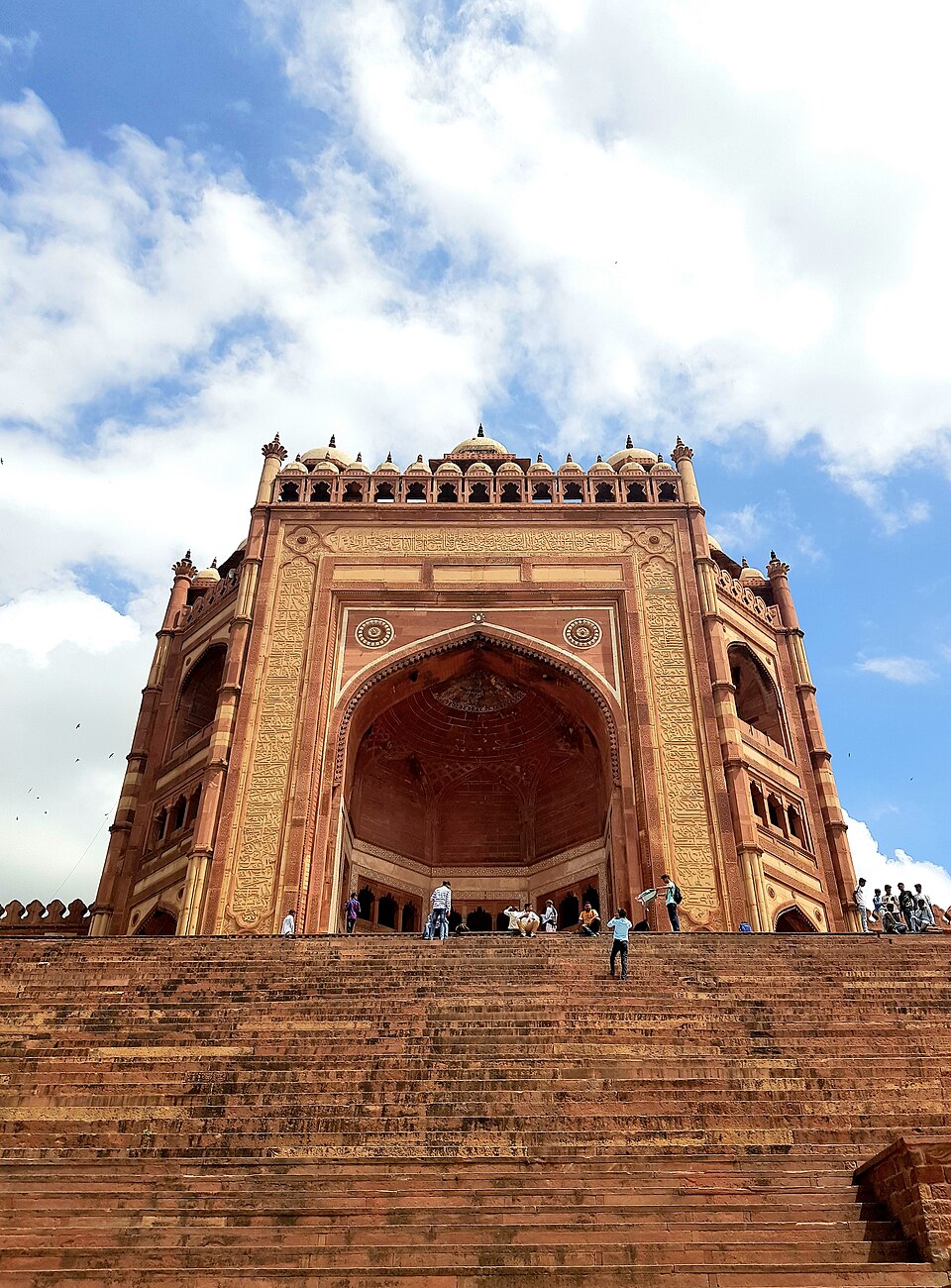
- Extending Fatehpur Sikri's genuine Salim Chishti / Prince Salim association to every individual structure inside the complex
- In assertion-reason items, judging the explanation link before independently checking whether the Reason is even true
- Assuming the Buland Darwaza is of white marble — it is red and buff sandstone with marble inlay; the white marble at Fatehpur Sikri is the tomb of Salim Chishti
UPPSC likes assertion-reason framing on Mughal monuments and on Akbar's administrative and religious measures, usually pairing a true attribution with a wrong motive. UPSC goes at the same material through craft and chronology — which stone, which technique, which monument came first.
With reference to the cultural history of India, consider the following statements: 1. White marble was used in making Buland Darwaza and Khanqah at Fatehpur Sikri. 2. Red sandstone and marble were used in making Bara Imambara and Rumi Darwaza at Lucknow. Which of the statements given above is/are correct?
- (a) 1 only
- (b) 2 only
- (c) Both 1 and 2
- (d) Neither 1 nor 2
Answer(d) Neither 1 nor 2
The same monument, tested on material instead of motive: UPSC's item turns on the Buland Darwaza being red sandstone rather than white marble. Read together, the two questions cover the gateway's builder, its purpose and its fabric.
Ibadat Khana at Fatehpur Sikri was
- (a) the mosque for the use of Royal Family
- (b) Akbar’s private prayer chamber
- (c) the hall in which Akbar held discussions with scholars of various religions
- (d) the room in which the nobles belonging to different religions gathered to discuss religious affairs
Answer(c) the hall in which Akbar held discussions with scholars of various religions
The neighbouring structure in the same complex, and the same skill — knowing what each building at Fatehpur Sikri was actually for, which is precisely what the false Reason in the 2025 item gets wrong.
Arrange the following monuments in a chronological order and select the correct answer from the codes given below : I. Rabia Daurani's Tomb, Aurangabad II. Shershah Suri's Tomb, Sasaram III. Humayun's Tomb, Delhi IV. Atala Mosque, Jaunpur Codes :
- (a) I, II, IV, III
- (b) IV, II, III, I
- (c) II, I, III, IV
- (d) III, IV, II, I
Answer(b) IV, II, III, I
The same commission testing attribution and dating of Indo-Islamic monuments — you can only order Atala Masjid, Sher Shah's tomb, Humayun's tomb and Rabia Daurani's tomb if you know which ruler raised each and when, which is exactly the knowledge the Assertion here depends on.
- practice — not a real PYQ
The Buland Darwaza at Fatehpur Sikri was built to commemorate which of the following?
- (a)Akbar's campaign against Rana Pratap at Haldighati
- (b)Akbar's conquest of Gujarat
- (c)The birth of Prince Salim
- (d)The completion of the Ibadat Khana
Answer(b) Akbar's conquest of Gujarat — the Persian inscription on the gateway records the victory, and the city's very name, Fatehpur ('city of victory'), comes from the same campaign.
- practice — not a real PYQ
Which one of the following pairs about Fatehpur Sikri is correctly matched?
- (a)Buland Darwaza — white marble
- (b)Tomb of Salim Chishti — white marble
- (c)Panch Mahal — lakhauri brick and lime stucco
- (d)Jama Masjid — granite
Answer(b) Tomb of Salim Chishti — white marble. The complex as a whole, including the Buland Darwaza and the Panch Mahal, is built of red sandstone; the saint's tomb in the mosque courtyard is the marble exception.