
Which of the following events took place in the year 1911 ? 1. Partition of Bengal revoked 2. Transfer of capital from Calcutta to Delhi 3. Lucknow pact between Congress and Muslim League Select the correct answer from the code given below : Code :
- (a)1 and 2
- (b)2 and 3
- (c)Only 3
- (d)Only 1
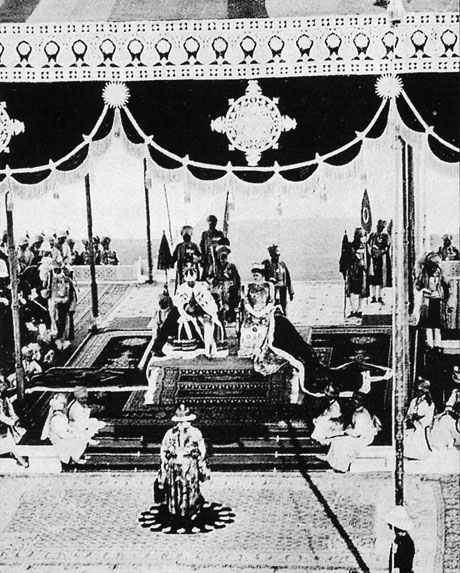
Correct — A, 1 and 2. Statements 1 and 2 are not merely two events that happen to share a year; they were announced in the same breath, from the same dais, on the same afternoon. On 12 December 1911 King George V, seated at the Coronation Durbar at Delhi — the third and last of the imperial durbars and the only one a reigning sovereign attended in person — proclaimed both that Lord Curzon's partition of Bengal was annulled and that the capital of British India would move from Calcutta to Delhi. The partition had been announced in July 1905 and had taken effect on 16 October 1905, splitting off a new province of Eastern Bengal and Assam with its capital at Dacca, and it had provoked six years of Swadeshi and Boycott agitation. The 1911 settlement reunited the Bengali-speaking districts, hived Bihar and Orissa off into a province of their own and returned Assam to a Chief Commissionership, the reorganisation taking effect from 1912. The move of the capital was the other half of the same calculation: concede on Bengal, and simultaneously withdraw the seat of government from Calcutta, which had become the headquarters of nationalist politics, to Delhi, a city the British could present as the historic imperial capital of India. The new city was laid out by Edwin Lutyens and Herbert Baker and was formally inaugurated only in 1931. Statement 3 is the outlier: the Lucknow Pact between the Congress and the Muslim League was concluded in December 1916, five years later, at the Lucknow session where the two bodies met at the same time and the Congress accepted separate electorates and weightage for Muslims. So statements 1 and 2 belong to 1911 and statement 3 does not — option (a). Note, before you mark, that this booklet has moved 'Only 1' to option (d); the answer here is the pair at (a), but the layout is not the one most candidates have drilled.
- (b)2 and 3 — The capital transfer is correctly placed in 1911, but the Lucknow Pact is not — it belongs to December 1916 — and this option also drops the annulment of the partition of Bengal, which was announced at the same Durbar on the very same day as the capital transfer. Since the two 1911 decisions were made in one proclamation, an option that keeps one and discards the other cannot be right. The Lucknow Pact sits in the entirely different context of the First World War years, alongside the Home Rule Leagues of 1916 and the reunion of the Moderates and Extremists at the same Lucknow session.
- (c)Only 3 — This picks the single statement that is false and rejects the two that are true — a complete inversion. The Lucknow Pact of December 1916 is one of the most firmly dated events of the freedom struggle; it was the moment Tilak and Jinnah brought the Congress and the Muslim League to a common demand for constitutional reform, and it has no connection with 1911. Meanwhile both the annulment of the partition and the announcement of the shift of the capital are documented to 12 December 1911.
- (d)Only 1 — The annulment of the partition is correctly placed, but the option wrongly excludes the transfer of the capital, which was announced in the same royal proclamation at the Delhi Durbar on 12 December 1911. The confusion usually comes from a real fact misremembered: the new imperial city was not finished for two decades, and New Delhi was formally inaugurated only on 13 February 1931. The decision and the announcement, however, belong to 1911; only the completion belongs to 1931.
The partition of Bengal and its reversal frame the first mass phase of Indian nationalism. Lord Curzon divided the unwieldy Bengal Presidency in 1905, ostensibly for administrative convenience but in practice along lines that separated a Muslim-majority east from a Hindu-majority west, and the measure detonated the Swadeshi and Boycott movement. Six years of agitation, boycott of British goods, and revolutionary activity in Bengal made the partition politically unsustainable. At the Coronation Durbar of December 1911 the government reversed itself and reunited Bengal on a linguistic basis — and in the same announcement moved the capital away from Calcutta to Delhi, trading a concession on Bengal for a strategic withdrawal from the city where the agitation was strongest.
Chronology questions of this kind are won by holding a small number of anchor dates and hanging everything else on them, rather than by trying to recall an isolated year for each event. Three anchors carry this question. 1905: partition of Bengal announced in July, effective 16 October, followed by Swadeshi and Boycott. 1911: the Delhi Durbar of 12 December, where the partition is annulled and the capital transfer announced — one date, two events, which is exactly why statements 1 and 2 stand or fall together. 1916: the war years, which produced the Home Rule Leagues and the Lucknow Pact, and are separated from 1911 by the outbreak of the First World War in 1914. Once you notice that statements 1 and 2 are two clauses of a single proclamation, the only options that can survive are the ones that keep them together, and just one of the four does. A second habit is worth building for this paper in particular: read the printed option text. Here 'Only 1' has been placed at (d) rather than at (a), and the correct answer is the pair at (a).
- Curzon's partition of Bengal was announced in July 1905 and took effect on 16 October 1905, creating the province of Eastern Bengal and Assam with its capital at Dacca
- At the Coronation Durbar at Delhi on 12 December 1911, King George V announced both the annulment of the partition and the transfer of the capital from Calcutta to Delhi
- The 1911 reorganisation reunited Bengal on linguistic lines, created a separate province of Bihar and Orissa, and restored Assam to a Chief Commissionership, taking effect from 1912
- New Delhi was planned by Edwin Lutyens and Herbert Baker and was formally inaugurated only on 13 February 1931 — the decision belongs to 1911, the completion to 1931
- The Delhi Durbar of 1911 was the third and last of the imperial durbars and the only one attended in person by the reigning sovereign, George V, with Queen Mary
- The Lucknow Pact was concluded in December 1916, when the Congress and the Muslim League held simultaneous sessions at Lucknow and the Congress accepted separate electorates and weightage — Tilak and Jinnah were its principal architects
- Other events of 1911 worth holding: Gopal Krishna Gokhale's Bill for compulsory elementary education, introduced in March, was rejected by the Imperial Legislative Council; Jana Gana Mana was first sung on 27 December at the Calcutta session of the Congress; and Mohun Bagan had won the IFA Shield earlier in the year
- Separating the two 1911 announcements. The annulment of the partition and the transfer of the capital were made in the same royal proclamation on 12 December 1911, so no correct option can accept one and reject the other
- Dating the capital transfer to 1931. That is the year New Delhi was inaugurated; the decision and the announcement belong to 1911
- Sliding the Lucknow Pact towards 1911. It is 1916, on the far side of the outbreak of the First World War
- Marking from the remembered option layout. On this booklet 'Only 1' is at (d), not at (a)
UPPSC returns constantly to the 1905-to-1919 stretch, asking it either as a statement set like this one or as a straight chronology question of the 'which event came last' type, as in 2023. UPSC has asked the same fact from the other end — how long Curzon's partition lasted, and what specifically happened on 16 October 1905 — and likes to make candidates order the Partition, the Lucknow Pact, the Rowlatt Act and the introduction of dyarchy. Holding 1905, 1911, 1916 and 1919 as fixed anchors answers almost all of them.
The Partition of Bengal made by Lord Curzon in 1905 lasted until
- (a) the First World War when Indian leaders decided to support the British and demanded its annulment as a quid pro quo
- (b) King George V abrogated Curzon's Act at the Royal Durbar in Delhi in 1911
- (c) Gandhiji launched his Civil Disobedience Movement
- (d) the Partition of India in 1947
Answer(b) King George V abrogated Curzon's Act at the Royal Durbar in Delhi in 1911
The same fact as the first statement here, asked as a single-option item, and its correct answer names the exact occasion — the Royal Durbar at Delhi in 1911 — that also produced the capital transfer. Anyone who has answered the UPSC item already knows why statements 1 and 2 of the present question have to travel together.
85. What is the correct sequence of the following events? I. The Lucknow Pact II. The Introduction of Dyarchy III. The Rowlatt Act IV. The Partition of Bengal Choose the correct answer from the codes given below:
- (a) I, II, III, IV
- (b) IV, I, III, II
- (c) I, III, II, IV
- (d) IV, III, II, I
Answer(b) IV, I, III, II
Places the Lucknow Pact in the chronology that disposes of statement 3. The sequence runs Partition of Bengal 1905, Lucknow Pact 1916, Rowlatt Act 1919, dyarchy under the Act of 1919 — so the Pact sits a full five years after the Durbar of 1911, on the other side of the outbreak of the war. This is the anchor-date drill the present question rewards.
Assertion (A): The first ever Bill to make primary education compulsory in India was rejected in 1911. Reason (R): Discontent would have increased if every cultivator could read.
- (a) Both A and R are true, and R is the correct explanation of A
- (b) Both A and R are true, but R is NOT a correct explanation of A
- (c) A is true, but R is false
- (d) A is false, but R is true
Answer(a) Both A and R are true, and R is the correct explanation of A
Adds a third genuine event of 1911 to the same year's file — Gokhale's Bill for compulsory elementary education, introduced in March and defeated in the Imperial Legislative Council. It is worth carrying alongside the Durbar because UPPSC's stem asks what happened in 1911 rather than what happened at the Durbar, and a variant of this question could easily substitute the education Bill for one of the present statements.
With reference to the Civil Administration in 1905, which of the statements is/are correct ? 1. Lord Curzon decided to rearrange the provincial boundaries. 2. A new province was constituted, called East Bengal and Assam. Select the correct answer using the codes given below :
- (a) 1 only
- (b) Both 1 and 2
- (c) 2 only
- (d) Neither 1 nor 2
Answer(b) Both 1 and 2
The 1905 half of the story, from the same commission, in the same two-statement format. It fixes what was actually done in 1905 — provincial boundaries redrawn and Eastern Bengal and Assam created — which is exactly what the 1911 proclamation undid. Read the 2019 and 2025 items together and the whole partition episode, beginning and end, is covered.
Which of the following events was the last in chronological order?
- (a) Jallianwala Bagh Massacre
- (b) Moplah Revolt
- (c) Khilafat Movement
- (d) Home Rule Movement
Answer(b) Moplah Revolt
The same commission's other way of testing this period — pure chronology, with no content beyond the dates. Its options span 1916 to 1921, immediately after the years the present question covers, so the two items together demand a continuous timeline from the partition of Bengal through the Durbar of 1911 and the Lucknow Pact of 1916 to the early 1920s.
- practice — not a real PYQ
The announcement of the transfer of the capital of British India from Calcutta to Delhi was made at
- (a)the Delhi Durbar of 1877
- (b)the Delhi Durbar of 1903
- (c)the Coronation Durbar at Delhi in 1911
- (d)the Round Table Conference of 1930
Answer(c) the Coronation Durbar at Delhi in 1911 — King George V announced it on 12 December 1911, in the same proclamation that annulled the partition of Bengal. The 1877 durbar proclaimed Victoria Empress of India and the 1903 durbar marked Edward VII's accession.
- practice — not a real PYQ
Which one of the following correctly describes the outcome of the reversal of the partition of Bengal announced in 1911 ?
- (a)Bengal was reunited on linguistic lines, and Bihar and Orissa were constituted as a separate province
- (b)Bengal was reunited and Assam was merged permanently with it
- (c)Eastern Bengal and Assam was retained but its capital moved from Dacca to Calcutta
- (d)Bengal, Bihar and Orissa were together placed under a single Chief Commissioner
Answer(a) Bengal was reunited on linguistic lines, and Bihar and Orissa were constituted as a separate province — Assam, meanwhile, reverted to a Chief Commissionership, the whole reorganisation taking effect from 1912.