
The book 'Fawaid ul Fawad' is the record of the conversations of Shaikh Nizamuddin Auliya, it was compiled by
- (a)Amir Hassan Sizzi
- (b)Amir Khusro
- (c)Ziauddin Barni
- (d)Hasan Nizami
Correct — A, Amir Hassan Sizzi (Amir Hasan Sijzi Dehlavi). 'Fawa'id al-Fu'ad' ('Morals of the Heart') is a malfuzat — a record of the table-talk and teachings of the Chishti Sufi saint Shaikh Nizamuddin Auliya. It was compiled by his devoted disciple Amir Hasan Sijzi, a poet of Delhi, who noted down the saint's conversations during assemblies between about 1307 and 1322. The work became the model for the malfuzat genre in Indian Sufism.
- (b)Amir Khusro — Wrong — Amir Khusrau was also a celebrated disciple and friend of Nizamuddin Auliya, but he was a poet and musician (Tughlaq Nama, Khamsa, many diwans); he did not compile 'Fawa'id al-Fu'ad'.
- (c)Ziauddin Barni — Wrong — Ziauddin Barani was a historian of the Delhi Sultanate; he wrote 'Tarikh-i-Firuz Shahi' and 'Fatawa-i-Jahandari', not this malfuzat.
- (d)Hasan Nizami — Wrong — Hasan Nizami was the author of 'Taj-ul-Ma'asir', an early history of the Delhi Sultanate; he did not record Nizamuddin Auliya's conversations.
In Indian Sufism a 'malfuzat' is a record of a saint's conversations and teachings, usually written down by a disciple. 'Fawa'id al-Fu'ad' is the classic example: the recorded discourses of the Chishti saint Shaikh Nizamuddin Auliya of Delhi, compiled by his disciple Amir Hasan Sijzi in the early 14th century. It is a key source for the ideas and daily life of the Chishti order.
Both Amir Hasan Sijzi and Amir Khusrau were disciples of Nizamuddin Auliya, which makes option (b) tempting. The discriminator: Khusrau is remembered for poetry and music, while it was Hasan Sijzi who compiled the saint's conversations as 'Fawa'id al-Fu'ad'. Barani and Hasan Nizami are court historians, not recorders of Sufi discourses.
- 'Fawa'id al-Fu'ad' is the malfuzat (recorded conversations) of Shaikh Nizamuddin Auliya.
- It was compiled by his disciple Amir Hasan Sijzi (Amir Hasan Sijzi Dehlavi), c. 1307–1322.
- Nizamuddin Auliya was a leading saint of the Chishti Sufi order at Delhi.
- Amir Khusrau, another disciple, was a poet-musician, not the compiler of this work.
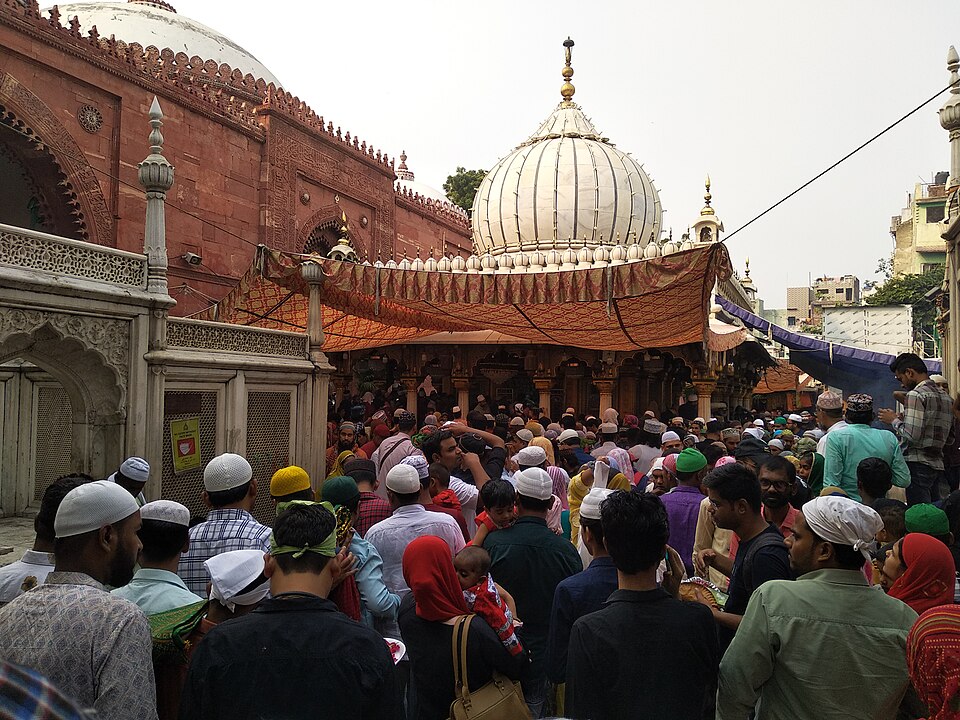
- Confusing Amir Hasan Sijzi (compiler of the malfuzat) with fellow-disciple Amir Khusrau (poet)
- Mixing up malfuzat (Sufi conversations) with the political chronicles of Barani or Hasan Nizami
UPPSC & UPSC ask 'book–author' or 'saint–disciple' pairs — anchor Fawa'id al-Fu'ad = Amir Hasan Sijzi recording Nizamuddin Auliya.
With reference to Sufism in Indian history, consider the following statements: 1. Shaikh Ahmad Sarhandi was a contemporary of Ibrahim Lodi 2. Shaikh Nasiruddin Chirag-i-Dehlavi was a disciple of Shaikh Nizamuddin Auliya 3. Aurangzeb was contemporary of Shaikh Salim Chisti 4. The Qadiri order of Sufis was first introduced in India by Shaikh Niamtullah and Makhdum Muhammad Jilani Which of these statements are correct?
- (a) 1 and 2
- (b) 1 and 3
- (c) 2 and 3
- (d) 2 and 4
Answer(d) 2 and 4
Same concept — the Chishti circle of Shaikh Nizamuddin Auliya. Its correct statement 2 identifies Nasiruddin Chirag-i-Dehlavi as his disciple, the same saint–disciple relationship (Auliya and his followers) that underlies the Fawa'id al-Fu'ad question.
- practice — not a real PYQ
'Fawa'id al-Fu'ad', a record of a Sufi saint's conversations, is associated with which order of Sufism?
- (a)Suhrawardi
- (b)Chishti
- (c)Qadiri
- (d)Naqshbandi
Answer(b) Chishti — it records the discourses of Nizamuddin Auliya, a leading Chishti saint of Delhi. - practice — not a real PYQ
Which of the following was written by Ziauddin Barani?
- (a)Fawa'id al-Fu'ad
- (b)Taj-ul-Ma'asir
- (c)Tarikh-i-Firuz Shahi
- (d)Tughlaq Nama
Answer(c) Tarikh-i-Firuz Shahi — Barani's chronicle of the Delhi Sultanate (he also wrote Fatawa-i-Jahandari).