Match List – I with List – II and select the correct answer using the code given below the lists. List – I (Ruler) A. Mahendraverman First B. Kadungon C. Amoghavarsha First D. Rajaraja First List – II (Dynasty) 1. Rashtrakuta 2. Pallava 3. Chola 4. Pandya Code :
- (a)A-4, B-2, C-3, D-1
- (b)A-2, B-4, C-3, D-1
- (c)A-2, B-4, C-1, D-3
- (d)A-4, B-2, C-1, D-3
Correct — C, A-2, B-4, C-1, D-3 — Mahendravarman I to the Pallavas, Kadungon to the Pandyas, Amoghavarsha I to the Rashtrakutas and Rajaraja I to the Cholas. Mahendravarman I (c. 600-630 CE) was the Pallava king of Kanchi who fought Pulakeshin II of Badami, took the titles Vichitrachitta, Mattavilasa and Gunabhara, wrote the Sanskrit farce Mattavilasa Prahasana, and began the Pallava rock-cut temple tradition — his Mandagapattu inscription boasts of a shrine made without brick, timber, metal or mortar. Kadungon (Kadunkon, usually placed c. 590-620 CE) is the Pandya who revived the dynasty: after the obscure Kalabhra interregnum he restored Pandya rule from Madurai and took the title Pandyadhiraja, a feat recorded in the Velvikudi copper-plate inscription of the later Pandya Parantaka Nedunchadaiyan. Amoghavarsha I (r. c. 814-878 CE) was the sixth Rashtrakuta emperor and the longest-reigning; he moved the capital to Manyakheta, is credited with the Kavirajamarga — the earliest extant literary work in Kannada — and the Sanskrit Prashnottara Ratnamalika, was a devout Jain, and was named by the Arab merchant Sulaiman as one of the four great kings of the world. Rajaraja I (r. 985-1014 CE) was the Chola who built the Rajarajeshvara, now Brihadishvara, temple at Thanjavur and carried Chola arms into northern Sri Lanka. Only option (c) puts all four in the right dynasty.
- (a)A-4, B-2, C-3, D-1 — Wrong on all four pairs — it swaps within both halves at once. It makes Mahendravarman I a Pandya and Kadungon a Pallava, when Mahendravarman is the Pallava of Kanchi and Kadungon the Pandya of Madurai; and it makes Amoghavarsha I a Chola and Rajaraja I a Rashtrakuta, when Amoghavarsha ruled from Manyakheta in the Deccan and Rajaraja from Thanjavur in the Kaveri delta. If any single pair is secure, this option is gone.
- (b)A-2, B-4, C-3, D-1 — Gets the Pallava-Pandya half right and then reverses the other half, sending Amoghavarsha I to the Cholas and Rajaraja I to the Rashtrakutas. Rajaraja I is the best-known Chola of all — the builder of the great Thanjavur temple — and Amoghavarsha I belongs to the Deccan dynasty whose capital was Manyakheta and whose most famous monument is the Kailasa temple at Ellora, begun under his predecessor Krishna I. Two Deccan-versus-Tamil-country kings do not change places.
- (d)A-4, B-2, C-1, D-3 — The mirror image of option (b): it gets Amoghavarsha I to the Rashtrakutas and Rajaraja I to the Cholas, then reverses the first half by making Mahendravarman I a Pandya and Kadungon a Pallava. Mahendravarman I is securely Pallava — he is the patron of the Mandagapattu cave and the author of the Mattavilasa Prahasana — so this option fails on the pair most candidates actually know.
Four dynasties divide the early medieval Deccan and Tamil country between them, and each of these rulers is the standard name attached to one of them. The Pallavas ruled from Kanchi and gave South India its first great stone architecture; Mahendravarman I opened that tradition with rock-cut cave shrines. The Pandyas of Madurai are the oldest of the four as a name but had faded during the Kalabhra interregnum, and Kadungon is the king credited with restoring them. The Rashtrakutas ruled the Deccan from Manyakheta; Amoghavarsha I was their longest-reigning and most cultured emperor. The Cholas rose in the Kaveri delta from the ninth century, and Rajaraja I turned them into an imperial power with a navy, a land survey and the greatest temple of the age at Thanjavur.
Matching questions are cheapest to solve by elimination rather than by knowing all four pairs. Two of these names are unmissable — Rajaraja I is Chola and Mahendravarman I is Pallava — and fixing either one kills two of the four options immediately. Fix Mahendravarman I as Pallava (A-2) and options (a) and (d) die; fix Rajaraja I as Chola (D-3) and options (a) and (b) die. Fix both and only (c) survives, without your ever having to recall who Kadungon was. That is the practical value of knowing a handful of anchor names extremely well: the obscure name in a matching list is usually the one you are meant to arrive at by subtraction. It also helps that each of these dynasties has a distinct capital — Kanchi, Madurai, Manyakheta and Thanjavur — so if you remember capitals rather than kings, the same elimination still works.
- Mahendravarman I, Pallava, c. 600-630 CE, ruled from Kanchi; titles Vichitrachitta, Mattavilasa and Gunabhara; author of the Sanskrit farce Mattavilasa Prahasana; his Mandagapattu inscription records a temple made without brick, timber, metal or mortar, beginning the Pallava rock-cut tradition
- Kadungon, Pandya, usually dated c. 590-620 CE, took the title Pandyadhiraja and is credited with ending Kalabhra rule and reviving the Pandya line from Madurai; the evidence is the Velvikudi copper-plate inscription of the later Pandya Parantaka Nedunchadaiyan
- Amoghavarsha I, Rashtrakuta, r. c. 814-878 CE, moved the capital to Manyakheta; credited with the Kavirajamarga, the earliest extant literary work in Kannada, and the Sanskrit Prashnottara Ratnamalika; a Jain, and called one of the four great kings of the world by the Arab merchant Sulaiman
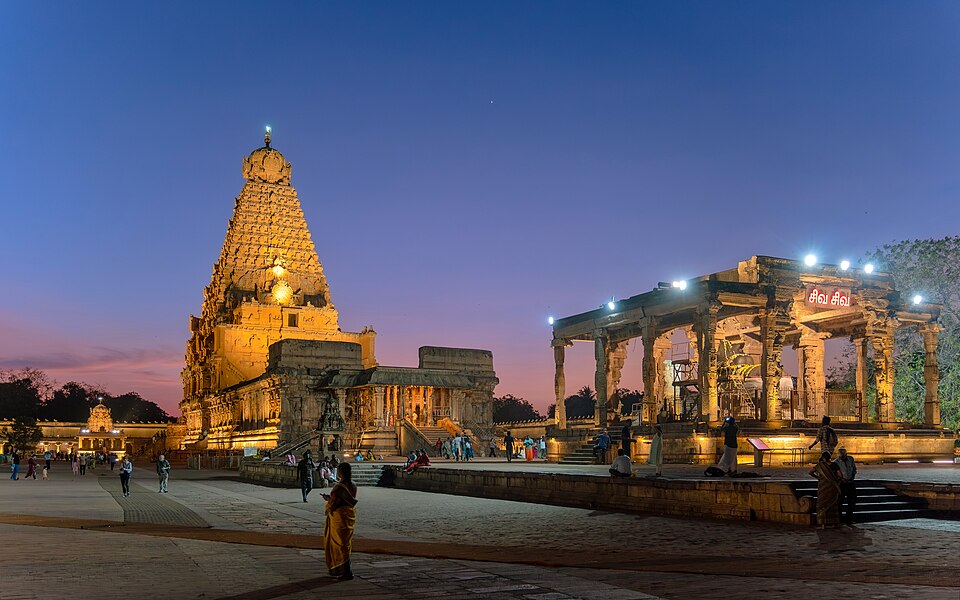
- Rajaraja I, Chola, r. 985-1014 CE, built the Rajarajeshvara (Brihadishvara) temple at Thanjavur and annexed northern Sri Lanka, taking Anuradhapura
- Capitals to memorise together: Pallava — Kanchi; Pandya — Madurai; Rashtrakuta — Manyakheta (Malkhed); Chola — Thanjavur, later Gangaikonda Cholapuram under Rajendra I
- Confusing Mahendravarman I with Narasimhavarman I. Both are Pallavas, but Mahendravarman began the cave temples and lost ground to Pulakeshin II, while his son Narasimhavarman I sacked Vatapi and built at Mamallapuram
- Confusing Rajaraja I with Rajendra I. Rajaraja built Thanjavur and took northern Sri Lanka; his son Rajendra I marched to the Ganga, raided Srivijaya and founded Gangaikonda Cholapuram
- Assuming Amoghavarsha founded the Rashtrakutas. The founder was Dantidurga, around 753 CE; Amoghavarsha I came roughly sixty years later
UPPSC sets South Indian dynasties almost always as a two-column matching item — ruler against dynasty, as here, or dynasty against capital, as it did in 2019. UPSC prefers a single-ruler identification through a title, a monument or a campaign, and has done exactly that with Mahendravarman I's birudas and with the Chola naval expedition to Srivijaya in its 2025 paper.
Who among the following rulers in ancient India had assumed the titles ‘Mattavilasa’, ‘Vichitrachitta’ and ‘Gunabhara’?
- (a) Mahendravarman I
- (b) Simhavishnu
- (c) Narasimhavarman I
- (d) Simhavarman
Answer(a) Mahendravarman I
The same ruler, reached from the other direction. UPPSC hands you the name and asks for the dynasty; UPSC hands you the titles — Mattavilasa, Vichitrachitta, Gunabhara — and asks for the name. Both papers set this in 2025, which is a fair warning that Mahendravarman I is a name worth holding with his epithets attached.
Which one of the Chola kings conquered Ceylon?
- (a) Aditya I
- (b) Rajaraja I
- (c) Rajendra
- (d) Vijayalaya
Answer(b) Rajaraja I
Fixes pair D-3, the anchor that lets you eliminate half the options here. Rajaraja I's naval campaign against Sri Lanka and his temple at Thanjavur are the two facts that make him unmistakably Chola.
Who among the following laid the foundation of Rashtrakuta Empire?
- (a) Amoghavarsha I
- (b) Dantidurga
- (c) Dhruva
- (d) Krishna I
Answer(b) Dantidurga
The Rashtrakuta half of the list, and a direct guard against this card's commonest error. Amoghavarsha I was the dynasty's greatest emperor but not its founder — Dantidurga overthrew the Chalukyas around 753 CE — so knowing both names keeps 'Rashtrakuta' from collapsing into a single face.
Match List – I with List – II and select the correct answer from the codes given below the lists : List – I (Ruling Dynasties) A. Pallava B. Pandya C. Yadava D. Kaktiya List – II (Capitals) 1. Warangal 2. Kanchi 3. Madura 4. Devagiri Codes :
- (a) A-2, B-1, C-4, D-3
- (b) A-2, B-3, C-4, D-1
- (c) A-1, B-2, C-3, D-4
- (d) A-2, B-4, C-3, D-1
Answer(b) A-2, B-3, C-4, D-1
The same four-pair matching format on the same dynasties, but keyed to capitals rather than rulers — Pallava to Kanchi and Pandya to Madura, exactly the two pairs that decide the first half of this 2025 question. Learn the dynasties as ruler-plus-capital bundles and both papers become one piece of preparation.
Given below are two statements, one is labelled as Assertion (A) and the other as Reason (R) : Assertion (A) : We have much more information about Cholas than their predecessors. Reason (R) : The Chola rulers adopted the practice of having inscriptions written on the walls of temples giving a historical narrative of their victories. Select the correct answer from the codes given below.
- (a) Both (A) and (R) are true and (R) is the correct explanation of (A)
- (b) Both (A) and (R) are true but (R) is not the correct explanation of (A)
- (c) (A) is true but (R) is false
- (d) (A) is false but (R) is true
Answer(a) Both (A) and (R) are true and (R) is the correct explanation of (A)
Explains why the Chola pair is the easiest in the list: the Cholas left more inscriptions than any earlier South Indian dynasty, so Rajaraja I is documented in a way Kadungon simply is not. It is also worth noting that this 2020 assertion-reason item uses the standard code, where (a) means R does explain A — the opposite of the 2025 booklet's layout.
- practice — not a real PYQ
The Kavirajamarga, the earliest extant literary work in Kannada, is attributed to which one of the following rulers?
- (a)Dantidurga
- (b)Amoghavarsha I
- (c)Pulakeshin II
- (d)Krishna III
Answer(b) Amoghavarsha I — the Rashtrakuta emperor (r. c. 814-878 CE), who moved the capital to Manyakheta and is also credited with the Sanskrit Prashnottara Ratnamalika.
- practice — not a real PYQ
The inscription at Mandagapattu, which records the excavation of a temple 'without brick, timber, metal or mortar', belongs to the reign of
- (a)Simhavishnu
- (b)Mahendravarman I
- (c)Narasimhavarman I
- (d)Nandivarman II
Answer(b) Mahendravarman I — the Pallava king who began the rock-cut cave-temple tradition in the Tamil country in the early seventh century.