
Given below are two statements, one is labelled as Assertion (A) and the other as Reason (R) : Assertion (A) : We have much more information about Cholas than their predecessors. Reason (R) : The Chola rulers adopted the practice of having inscriptions written on the walls of temples giving a historical narrative of their victories. Select the correct answer from the codes given below.
- (a)Both (A) and (R) are true and (R) is the correct explanation of (A)
- (b)Both (A) and (R) are true but (R) is not the correct explanation of (A)
- (c)(A) is true but (R) is false
- (d)(A) is false but (R) is true
Correct — A, both statements are true and R correctly explains A. We do know far more about the Cholas than about most earlier South Indian dynasties, and the main reason is precisely their prolific epigraphy: Chola kings had long inscriptions engraved on the stone walls of temples recording genealogies, military victories, land grants and even the procedure for electing village assemblies (as in the Uttaramerur inscriptions of Parantaka I). These meykkirti/prasasti records are the principal source for reconstructing Chola history, so R is a direct explanation of A, not just a co-incidental fact.
- (b)Both (A) and (R) are true but (R) is not the correct explanation of (A) — Wrong — R is not an unrelated true fact; the very reason so much Chola information survives is this temple-wall inscription habit, so R does explain A.
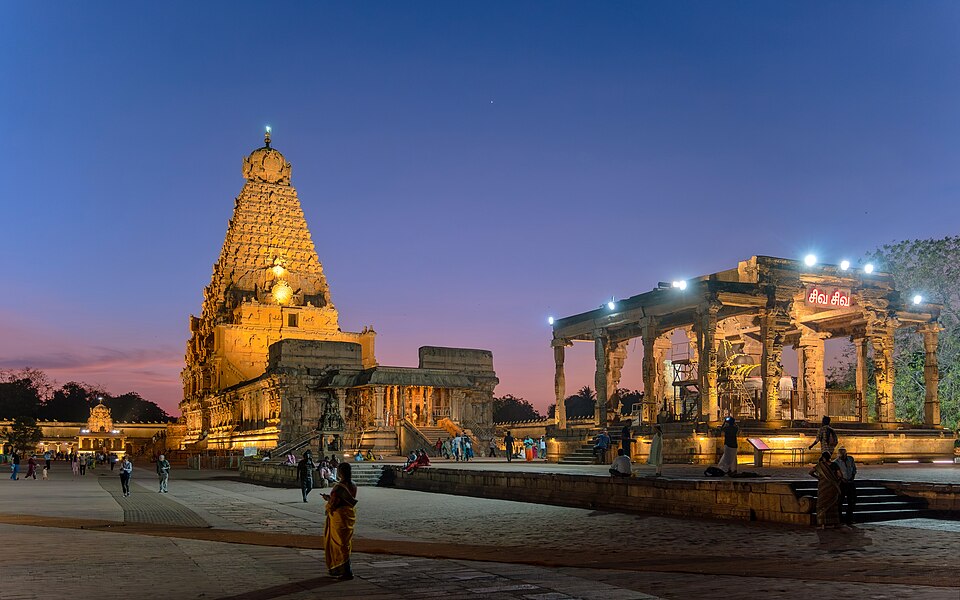
- (c)(A) is true but (R) is false — Wrong — R is factually true: the Cholas really did engrave historical narratives on temple walls (e.g., the Brihadisvara temple at Thanjavur, the Uttaramerur inscriptions).
- (d)(A) is false but (R) is true — Wrong — A is true: the rich epigraphic record makes the Cholas one of the best-documented dynasties of early-medieval South India.
Inscriptions (epigraphy) are among the most reliable primary sources for early-medieval Indian history. The Cholas (c. 850–1279 CE) were exceptionally prolific: thousands of their inscriptions survive on temple walls, opening with a eulogy (meykkirti) of the king's conquests and then recording administrative and economic detail. This abundance is why historians can reconstruct Chola polity, land relations and village government so fully.
In an Assertion–Reason item both parts can be true yet unrelated; here you must judge whether the inscription habit actually causes our fuller knowledge. It does — the temple-wall records are literally the evidence historians use — so the answer is the strongest option, (a), not the 'both true but unrelated' trap (b).
- Chola inscriptions were engraved on temple walls, opening with a meykkirti (eulogy of victories)
- The Brihadisvara temple at Thanjavur, built by Rajaraja I, carries extensive royal inscriptions
- The Uttaramerur inscriptions record the election rules of the village sabha under Parantaka I
- Epigraphy is the chief primary source for Chola administration, land grants and local self-government
- Choosing (b) — treating R as a true-but-unrelated fact when it is actually the cause
- Confusing Chola temple-wall inscriptions with Ashokan rock/pillar edicts
UPPSC/UPSC frame this as Assertion–Reason or as 'which source tells us most about the Cholas' — remember epigraphy is the answer.
- practice — not a real PYQ
The Uttaramerur inscriptions of the Chola period are especially valuable for information about
- (a)the village assembly (sabha) and its election procedure
- (b)Chola naval expeditions to Southeast Asia
- (c)the construction of the Brihadisvara temple
- (d)trade with the Roman Empire
Answer(a) the village assembly (sabha) and its election procedure — a landmark record of local self-government. - practice — not a real PYQ
The temple whose walls carry extensive inscriptions of the Chola ruler Rajaraja I is the
- (a)Brihadisvara temple, Thanjavur
- (b)Kailasa temple, Ellora
- (c)Sun temple, Konark
- (d)Lingaraja temple, Bhubaneswar
Answer(a) Brihadisvara temple, Thanjavur — built by Rajaraja I, a key source of Chola epigraphy.