
With reference to the “Pirul Lao – Paise Pao” campaign, which of the following statements is/are correct ? 1. This is related to reduce forest fires and to provide a source of income to villagers. 2. The Chief Minister of Uttarakhand launched this campaign. Select the correct answer from the codes given below :
- (a)Only 2
- (b)Neither 1 nor 2
- (c)Only 1
- (d)Both 1 and 2
Correct — D, Both 1 and 2. 'Pirul' is the local name in the Uttarakhand hills for the fallen needles of the chir pine, and the campaign's rhyming slogan — bring the pine needles, take the money — states its own logic. Statement 1 is therefore correct on both halves. Pine needles are resinous and burn easily, and the thick dry mat they form on the forest floor is the fuel that carries Uttarakhand's spring fires through chir forests; paying villagers to lift that mat removes fuel from the forest and puts cash into hill households at the same time. The rate announced was Rs 50 per kilogram, backed by a corpus of about Rs 50 crore, with the collection routed through the state Pollution Control Board and the payment credited online into the collector's own bank account so that the money does not leak on the way. Statement 2 is correct too: this was a Chief Minister's campaign, launched by Uttarakhand's Chief Minister Pushkar Singh Dhami on 8 May 2024, from Rudraprayag — that is, in the middle of the fire season, which is when the pine litter matters most. Both statements standing, the key marks (d). One point of spelling, since the paper is a booklet reproduction: the campaign is 'Pirul Lao – Paise Pao', and a typed version in circulation misspells it 'Piral'. The booklet's spelling is the correct one.
- (a)Only 2 — Drops statement 1, which is the campaign's whole design. It is not an income scheme that happens to involve forests, nor a fire-control scheme that happens to pay people — the two objectives are deliberately joined, because the pine needles that villagers are paid to collect are exactly the fuel load that feeds forest fires.
- (b)Neither 1 nor 2 — Rejects both statements when both are correct. The campaign's purpose (cutting forest fires while giving hill villagers an income) and its author (the Chief Minister of Uttarakhand, Pushkar Singh Dhami, in May 2024) are both accurately stated in the question.
- (c)Only 1 — Accepts the purpose but denies the launcher. 'Pirul Lao – Paise Pao' was launched by the Chief Minister of Uttarakhand from Rudraprayag on 8 May 2024; it is a state government campaign, not a central scheme and not a forest-department circular.
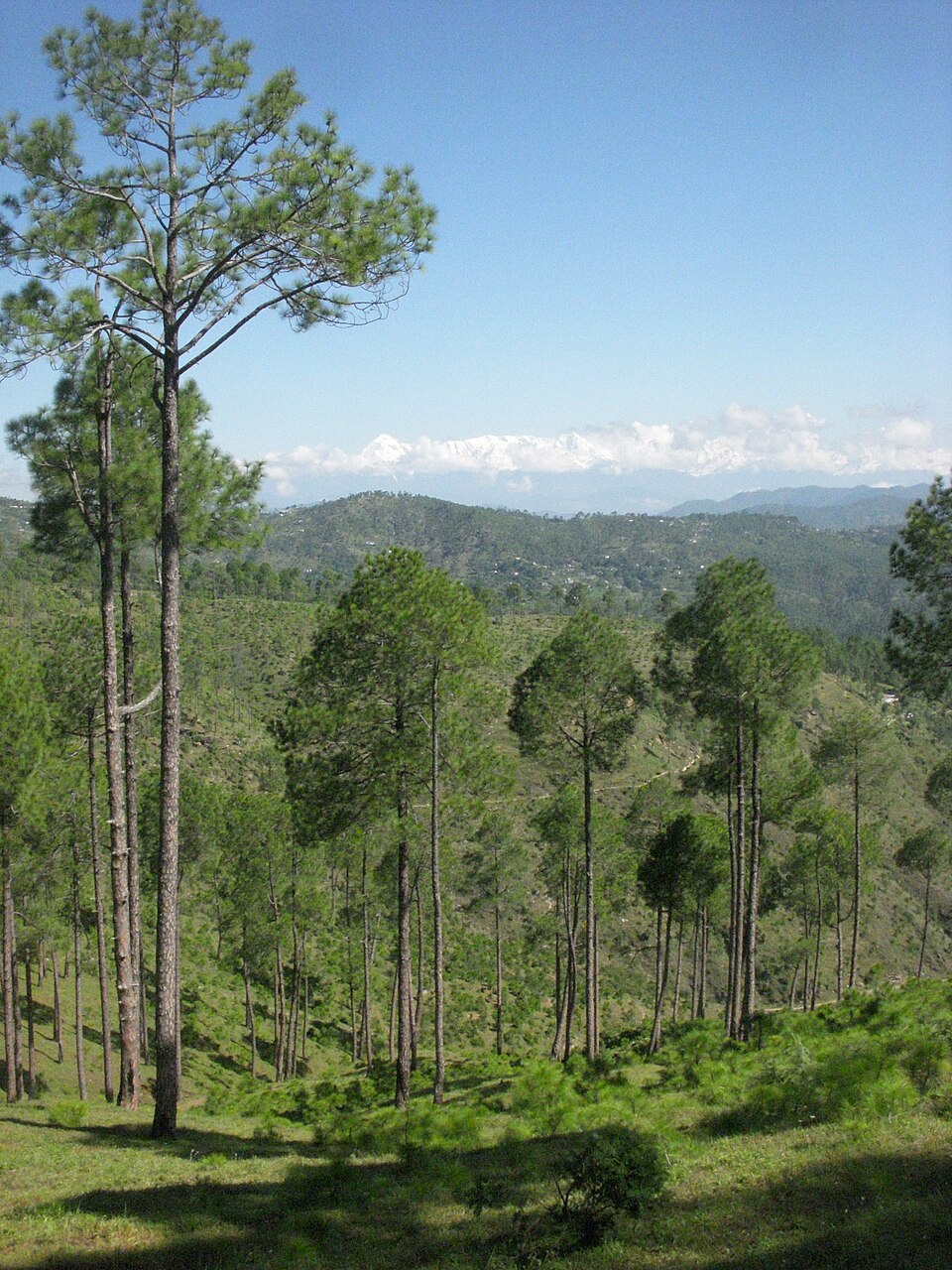
Chir pine, Pinus roxburghii, dominates a wide belt of the Uttarakhand Himalaya at roughly 1,000 to 2,000 metres, and it sheds long, resinous needles that build a dense, slow-rotting mat on the forest floor. That mat is the reason the state's fire season, running through the dry months before the monsoon, spreads so readily: the needles ignite easily and carry flame along the ground. They also suppress the undergrowth and seedlings that would otherwise regenerate the forest, which is part of why the spread of chir pine into ground once held by banj oak worries ecologists. 'Pirul Lao – Paise Pao' treats that litter as a resource rather than a nuisance — pine needles can be pressed into briquettes and pellets, fed to small gasifiers for power, composted or worked into handicrafts — and pays villagers to remove it.
The examiner has written a question in which both statements are true, which is rarer than students expect and therefore unsettling. The instinct to hunt for a planted error will push a candidate towards 'Only 1' or 'Only 2'; the discipline is to test each statement against what the scheme's name and design actually claim. Here the name itself carries statement 1 — pirul for money — and the campaign was a Chief Minister's launch, which is how state schemes of this kind are almost always announced. The deeper reason to remember this item is that it is a neat example of a policy that pays for an ecosystem service: instead of spending only on fighting fires after they start, the state pays for the removal of the fuel before they start, and the payment doubles as a rural livelihood in a region with few cash-earning options. Expect the same logic to reappear in questions on forest-fire management, biomass energy and community forestry.
- 'Pirul Lao – Paise Pao' was launched by Uttarakhand Chief Minister Pushkar Singh Dhami on 8 May 2024 from Rudraprayag, to reduce forest fires and give hill villagers a source of income.
- 'Pirul' is the local name for the fallen needles of the chir pine (Pinus roxburghii); collected needles are bought at Rs 50 per kilogram, backed by a corpus of about Rs 50 crore, with collection routed through the state Pollution Control Board and payment credited online to the collector's bank account.
- Pine needles are highly inflammable because of their resin content and form a thick mat on the forest floor, making them a leading carrier of Uttarakhand's chir-pine forest fires during the pre-monsoon dry season.
- Collected needles are used as biomass — briquettes and pellets, fuel for small gasifier units, compost and handicrafts — so the campaign converts a fire hazard into a raw material.
- Reading 'pirul' as a plant or a place. It is the local term for chir-pine needles, and the campaign is named after the material, not a species or a district.
- Assuming a scheme with a Hindi slogan must be a central government scheme. This one is a Uttarakhand state campaign, launched by the Chief Minister.
- Expecting every two-statement item to hide a false statement. Here both are true, and hunting for an error is what pushes candidates into 'Only 1' or 'Only 2'.
UPPSC asks state schemes by pairing what the scheme does with who launched it, and expects both to be verified. UPSC approaches the same ground scientifically — what biomass residue can be converted into, what gases its burning releases, or how forest fires interact with regeneration.
Biomass gasification is considered to be one of the sustainable solutions to the power crisis in India. In this context, which of the following statements is/are correct? 1. Coconut shells, groundnut shells and rice husk can be used in biomass gasification. 2. The combustible gases generated from biomass gasification consist of hydrogen and carbon-dioxide only. 3. The combustible gases generated from biomass gasification can be used for direct heat generation but not in internal combustion engines. Select the correct answer using the codes given below :
- (a) 1 only
- (b) 2 and 3 only
- (c) 1 and 3 only
- (d) 1, 2 and 3
Answer(a) 1 only
The technology that gives collected pine needles a market — biomass gasification of residues such as shells and husks. The Uttarakhand campaign works only because pirul can be briquetted or gasified, which is precisely the feedstock-and-producer-gas ground UPSC tested here.
Consider the following: 1. Carbon monoxide 2. Methane 3. Ozone 4. Sulphur dioxide Which of the above are released into atmosphere due to the burning of crop/biomass residue?
- (a) 1 and 2 only
- (b) 2, 3 and 4 only
- (c) 1 and 4 only
- (d) 1, 2, 3 and 4
Answer(d) 1, 2, 3 and 4
The other side of the same coin: what happens when biomass residue is burnt in the open rather than collected. Reading the two together explains why a state would rather pay villagers to carry the needles out of the forest than let them burn where they lie.
- practice — not a real PYQ
The 'Pirul Lao – Paise Pao' campaign is associated with which State, and with the collection of what material?
- (a)Himachal Pradesh — deodar cones
- (b)Uttarakhand — chir pine needles
- (c)Sikkim — cardamom husk
- (d)Arunachal Pradesh — bamboo shoots
Answer(b) Uttarakhand — chir pine needles. 'Pirul' is the local name for the fallen needles of Pinus roxburghii; the campaign, launched in May 2024, pays villagers Rs 50 per kilogram to collect them, cutting the forest-floor fuel load that spreads fires.
- practice — not a real PYQ
Removing pine needle litter from chir pine forests is advocated primarily because the litter
- (a)is toxic to grazing cattle and causes disease in hill livestock
- (b)is highly inflammable and forms a mat that spreads ground fires, while also suppressing regeneration
- (c)attracts locust swarms during the pre-monsoon months
- (d)raises the soil nitrogen content to levels that kill the pine trees themselves
Answer(b) it is highly inflammable and forms a mat that spreads ground fires, while also suppressing regeneration. The resinous needles ignite easily and carry flame along the forest floor; the same mat smothers undergrowth and seedlings.