
Given below are two statements, one is labelled as Assertion (A) and the other as Reason (R). Assertion (A) : Red soil denotes the second largest soil group of India. Reason (R) : Red soil surrounds the black soil in the south, east and north directions. Select the correct answer from the codes given below :
- (a)Both (A) and (R) are true and (R) is the correct explanation of (A).
- (b)(A) is false, but (R) is true.
- (c)Both (A) and (R) are true, but (R) is not the correct explanation of (A).
- (d)(A) is true, but (R) is false.
Correct — C, Both (A) and (R) are true, but (R) is not the correct explanation of (A). The Assertion is true: in the standard eight-fold grouping of Indian soils, the alluvial soils of the Indo-Gangetic–Brahmaputra plains and the coastal deltas cover the largest area, and the red soils of the Peninsula come next, ahead of the black (regur) soils — which is exactly what 'second largest soil group' means. The Reason is also true, and is a standard textbook description: the black-soil belt sits on the Deccan Trap lava, and because the Western Ghats and the Arabian Sea close it off on the west, the red soils of the crystalline Peninsula can only ring it on its south (Tamil Nadu, southern Karnataka), east (Telangana, Andhra Pradesh, Odisha, Chhattisgarh) and north (eastern Madhya Pradesh, Bundelkhand, Jharkhand). But the second statement does not cause the first. R is a statement about where red soils lie relative to another soil group; A is a statement about how much of India they cover. Red soils rank second because they blanket the whole Archaean granite–gneiss–schist shield of Peninsular India, a geological province far larger than the fringe that happens to abut the lava plateau. A soil could perfectly well surround the black-soil region on three sides and still be a minor group by area. Both true, no causal link — which is precisely code (c).
- (a)Both (A) and (R) are true and (R) is the correct explanation of (A). — This is the trap, and it catches most candidates: both sentences are true and both are about red soil, so the eye reads them as connected. They are not. Position relative to the black-soil belt cannot explain areal rank. The rank follows from the extent of the Archaean crystalline basement on which red soils develop, not from the boundary they share with the Deccan Trap.
- (b)(A) is false, but (R) is true. — The Assertion is not false. Red soils are conventionally placed second by area among India's major soil groups, behind the alluvial soils; the group that candidates wrongly promote to second place is the black soil, which is in fact smaller in extent.
- (d)(A) is true, but (R) is false. — The Reason is not false either. 'Red soils surround the black soils on the south, east and north' is the standard geographical description of the Peninsular soil pattern — the west side is missing only because the Deccan Trap runs up to the Western Ghats and the Konkan coast, where laterite and coastal soils take over.
Red soils are the in-situ weathering product of the ancient crystalline and metamorphic rocks — granite, gneiss and schist of Archaean age — that make up the basement of Peninsular India. Their colour comes from a coating of ferric (iron) oxide on the soil particles rather than from an unusually high total iron content; the same material looks yellow where the iron oxide is hydrated. They are typically porous, friable and light-textured, low in nitrogen, phosphorus and humus, and respond strongly to irrigation and fertiliser. Because the crystalline shield is so extensive, red soils form a broad belt through Tamil Nadu, Karnataka, Telangana, Andhra Pradesh, Chhattisgarh, Odisha, Jharkhand, eastern Madhya Pradesh and the Bundelkhand fringe of southern Uttar Pradesh.
Assertion–Reason items are decided in two steps: first test each sentence for truth, then test whether the second sentence actually causes the first. Here both sentences survive step one, so the whole question turns on step two — and 'they lie next to each other' is a spatial fact, not an explanation of size. The reason red soils outrank black soils in area is geological: the Deccan Trap basalt that produces regur covers one large but bounded lava province in west-central India, while the granite–gneiss terrain that produces red soil underlies most of the rest of the Peninsula. Note also why the Reason lists only three directions: to the west of the black-soil belt lie the Western Ghats, the Konkan laterites and the Arabian Sea, so there is no red-soil flank on that side.
- Order by area among India's major soil groups: alluvial soils first, red soils second, black (regur) soils next — the exact percentages differ from text to text, so learn the ranking rather than a figure.
- Red soils develop on Archaean granite, gneiss and schist; the red hue is due to ferric oxide coating the particles, and the same soil appears yellow in its hydrated form.
- Black soils are confined to the Deccan Trap basalt of Maharashtra, western Madhya Pradesh, Gujarat's Saurashtra, and parts of Karnataka, Telangana and Andhra Pradesh; they are clayey, moisture-retentive and crack widely on drying.
- The black-soil belt is bounded on the west by the Western Ghats and the Arabian Sea, which is why red soils can flank it only on the south, east and north.
- Red soils are poor in nitrogen, phosphorus, humus and lime but are not infertile — with irrigation and fertiliser they carry millets, groundnut, pulses, potato and, on the better loams, rice and cotton.
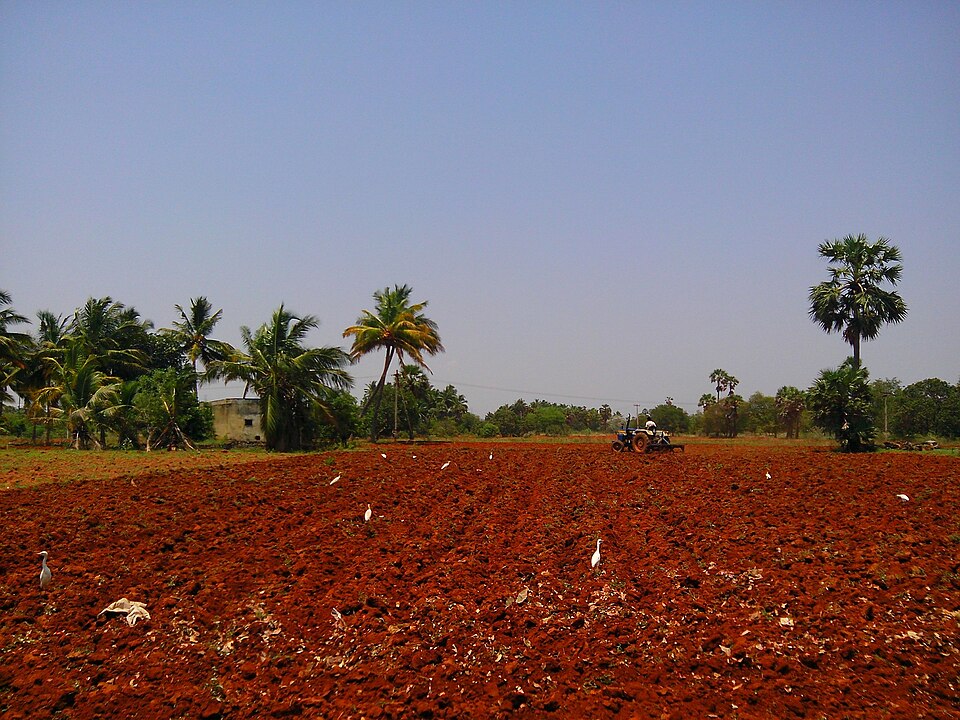
- Answering (a) because both sentences are true and sound related — Assertion–Reason questions punish exactly this reflex; adjacency is never an explanation of extent.
- Promoting black soil to 'second largest' because it is the most talked-about Indian soil; it ranks behind red soil in area.
- Believing the red colour proves a high iron content — it is the ferric-oxide coating in the oxidised state that colours the soil, and the same soil turns yellow when hydrated.
UPPSC likes Indian soils in Assertion–Reason and 'which statement is correct' form, testing parent rock, colour, chemistry and regional spread; UPSC prefers statement-based items linking a soil's properties to the crops it supports.
When you travel in certain parts of India, you will notice red soil. What is the main reason for this colour?
- (a) Abundance of magnesium
- (b) Accumulated humus
- (c) Presence of ferric oxides
- (d) Abundance of phosphates
Answer(c) Presence of ferric oxides
The same soil group, asked from the chemistry side — why red soil is red, which is the fact that underpins the Assertion in this UPPSC item.
The black cotton soil of India has been formed due to the weathering of
- (a) brown forest soil
- (b) fissure volcanic rock
- (c) granite and achist
- (d) shale and limestone
Answer(b) fissure volcanic rock
The other half of the Reason — black soil is tied to the Deccan Trap lava, which is exactly why it occupies one bounded province and is ringed by red soils on three sides.
Which of the following statements is correct about laterite soil? (1) This soil is developed in areas with high temperature and heavy rainfall. (2) It is poor in iron oxide and aluminium. Select the correct answer using the code given below – Code -
- (a) Only 2
- (b) Neither 1 nor 2
- (c) Both 1 and 2
- (d) Only 1
Answer(d) Only 1
UPPSC returning to the same Indian-soils chapter the very previous year — there the test is laterite's formation and iron/aluminium content, here it is red soil's rank and position.
- practice — not a real PYQ
The red soils of Peninsular India have developed mainly by the weathering of which of the following parent rocks?
- (a)Basaltic lava of the Deccan Trap
- (b)Archaean granite, gneiss and schist
- (c)River-borne alluvium
- (d)Marine sedimentary limestone
Answer(b) Archaean granite, gneiss and schist — the crystalline basement of the Peninsula; Deccan Trap basalt yields the black regur soil instead.
- practice — not a real PYQ
A farmer describes his field as deep, clayey and highly moisture-retentive, developing wide cracks in the dry season so that it is said to plough itself. Which soil group is this?
- (a)Red soil
- (b)Black (regur) soil
- (c)Laterite soil
- (d)Arid/desert soil
Answer(b) Black (regur) soil — the swelling clays of the Deccan Trap soils shrink and crack on drying, which is why regur is called self-ploughing.