
Which of the following statements is correct about laterite soil? 1. This soil is developed in areas with high temperature and heavy rainfall. 2. It is poor in iron oxide and aluminium. Select the correct answer using the code given below:
- (a)Only 2
- (b)Neither 1 nor 2
- (c)Both 1 and 2
- (d)Only 1
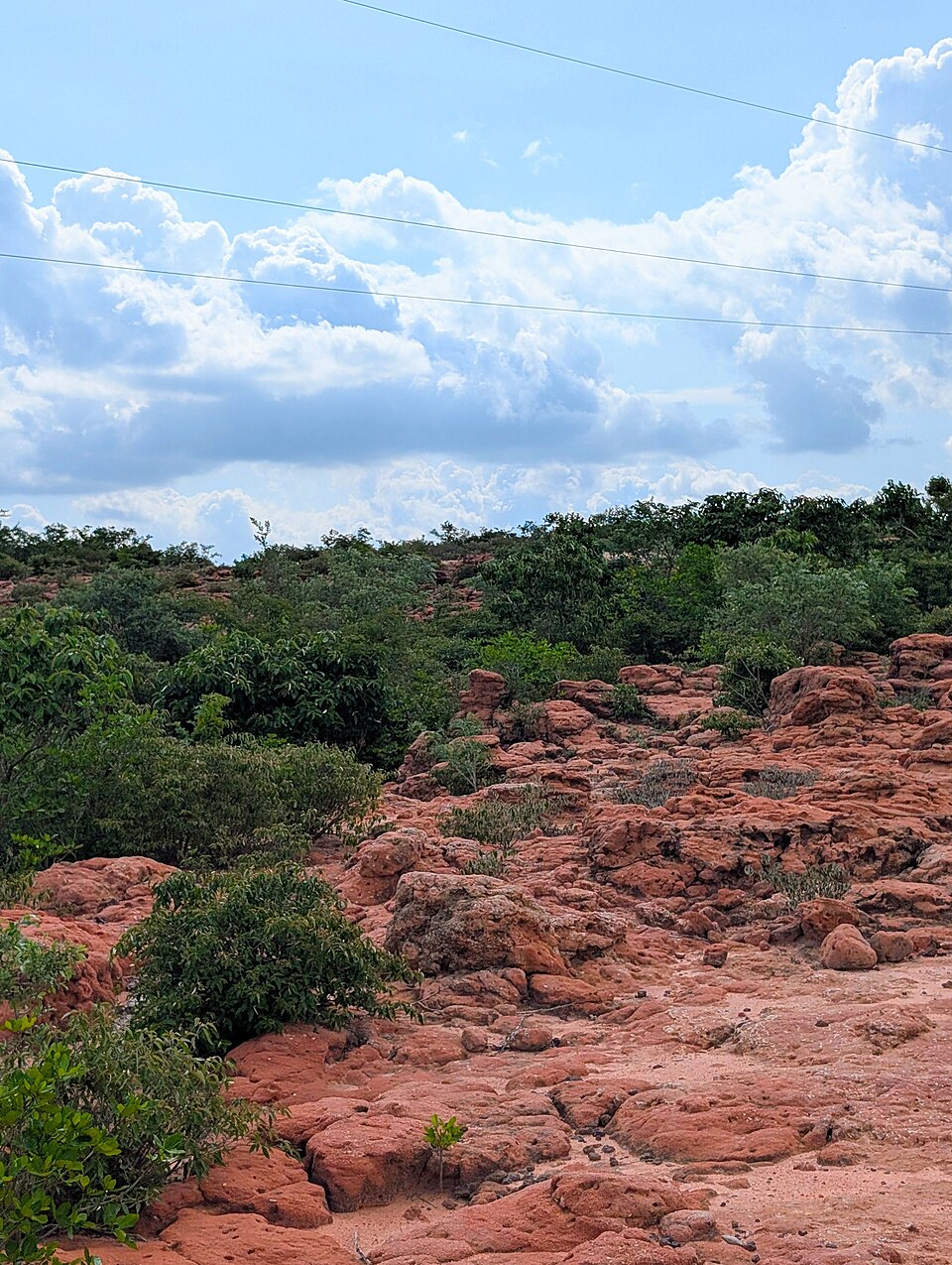
Correct — D, Only 1. Laterite soil forms under conditions of high temperature and heavy (seasonal) rainfall in humid tropical and monsoon regions, where intense leaching washes away silica and bases and alternating wet-and-dry spells harden the residue — so statement 1 is correct. Statement 2 is the reverse of the truth: laterite is RICH in iron oxide and aluminium (alumina), not poor. Leaching strips out silica and soluble bases and leaves behind residual oxides of iron and aluminium, which give the soil its characteristic red-to-brick colour (hence 'later' = brick). Because only statement 1 holds, the answer is 'Only 1'.
- (a)Only 2 — Statement 2 is false — laterite is rich, not poor, in iron oxide and aluminium; and statement 1 is actually the correct one.
- (b)Neither 1 nor 2 — Statement 1 is correct (high temperature + heavy rainfall), so 'neither' is wrong.
- (c)Both 1 and 2 — Statement 2 is false, so 'both' cannot be correct; laterite is high, not low, in Fe and Al oxides.
Laterite soil is a product of intense chemical weathering (laterisation) in hot, wet tropical climates with a marked wet-dry alternation. Heavy leaching removes silica and soluble bases while leaving a residue enriched in iron and aluminium oxides — the opposite of statement 2. This makes laterite red, acidic, low in nitrogen, phosphate, potash and organic matter, and prone to hardening on exposure (it was historically cut into bricks). In India it occurs on the Western Ghats summits, the Eastern Ghats, and parts of Karnataka, Kerala, Maharashtra, Odisha and the Northeast.
This is a classic 'trap the composition' question. Statement 1 restates the standard formation condition and is safe. The whole question turns on statement 2, which inverts a well-known fact: leaching leaves Fe and Al oxides behind, so laterite is RICH in them, not poor. Spotting that single inversion converts a 'Both correct' guess into the right 'Only 1'.
- Forms by laterisation — intense leaching under high temperature and heavy seasonal rainfall.
- RICH in iron and aluminium oxides (residual); POOR in silica, bases, nitrogen, phosphate, potash and humus.
- Red-to-brick colour from iron oxides; hardens irreversibly on exposure — used as building blocks.
- Supports plantation crops that tolerate poor soils — tea, coffee, cashew, tapioca — after manuring.
- Believing laterite is poor in iron and aluminium — it is rich in both (the leaching residue).
- Confusing laterite (leached, low fertility) with black regur soil (moisture-retentive, cotton-growing).
- Assuming heavy rainfall alone makes laterite — the wet-dry ALTERNATION and high temperature are essential.
UPPSC/UPSC test soils by pairing a correct formation condition with a false composition/fertility claim — verify each statement's chemistry independently rather than trusting the pairing.
Which of the following statements regarding laterite soils of India are correct? 1. They are generally red in colour. 2. They are rich in nitrogen and potash. 3. They are well-developed in Rajasthan and UP. 4. Tapioca and cashew nuts grow well on these soils.
- (a) 1, 2 and 3
- (b) 2, 3 and 4
- (c) 1 and 4
- (d) 2 and 3 only
Answer(c) 1 and 4 — laterite is red and suits tapioca/cashew; it is poor (not rich) in nitrogen/potash and not found in arid Rajasthan.
Same soil, same trap — UPSC also tested laterite by planting a false fertility/composition claim (rich in nitrogen and potash) against its true red colour and crop suitability.
- practice — not a real PYQ
Laterite soil is generally rich in which of the following?
- (a)Nitrogen and humus
- (b)Iron and aluminium oxides
- (c)Silica and lime
- (d)Phosphate and potash
Answer(b) Iron and aluminium oxides — the residue left after silica and bases are leached out. - practice — not a real PYQ
Which climatic condition is essential for the formation of laterite soil?
- (a)Cold and dry climate
- (b)High temperature with alternating wet and dry seasons
- (c)Temperate climate with even rainfall
- (d)Arid climate with sparse rainfall
Answer(b) High temperature with alternating wet and dry seasons — driving intense leaching (laterisation).