
Consider the following statements with reference to the Workers and Peasants Party : 1. The Workers and Peasants Party was formed in 1927 and was given the form of an All India Organisation. 2. The objective of this party was to work within the Congress so that it could be made a more revolution inclined party and an organisation of the common people. Which of the above statements is/are correct ?
- (a)Both 1 and 2
- (b)Neither 1 nor 2
- (c)Only 1
- (d)Only 2
Correct — D, Only 2. Statement 2 is the standard textbook description of what the Workers' and Peasants' Parties were for. Because the Communist Party had been crippled by the Kanpur (Cawnpore) Bolshevik Conspiracy Case of 1924 and could not function openly, communists and other radicals built these parties as a legal, open platform that would operate INSIDE the Indian National Congress — the aim being to push the Congress towards a more radical, revolutionary programme and to turn it from a body of the educated middle class into an organisation resting on workers and peasants. They took Congress membership, got their people elected to the All India Congress Committee, and were among those who pressed the complete-independence resolution at the Madras Congress of 1927. Statement 1 fails on both of its limbs. The parent body was not founded in 1927: it began as the Labour Swaraj Party of the Indian National Congress on 1 November 1925 in Bengal and was renamed the Workers' and Peasants' Party of Bengal on 6 February 1926. And it did not take all-India form in 1927 either — 1927 saw only the Bombay unit (January 1927), with Punjab's Kirti Kisan Party following in September 1928 and units in the United Provinces in October 1928; the ALL-INDIA Workers' and Peasants' Party was constituted only at Calcutta on 22–24 December 1928, alongside the Calcutta session of the Congress. So statement 1 is wrong twice over and only statement 2 stands.
- (a)Both 1 and 2 — This accepts statement 1, whose dates do not hold. The Bengal parent body dates from November 1925 (as the Labour Swaraj Party) and February 1926 (renamed the Workers' and Peasants' Party of Bengal), and the all-India organisation was formed only in December 1928. 1927 is the year of the Bombay unit alone.
- (b)Neither 1 nor 2 — This rejects statement 2, which is accurate. Working within the Congress in order to radicalise it and give it a worker-and-peasant base was the WPP's declared strategy — it is exactly why the party carried the name 'Workers and Peasants' while its members simultaneously held Congress membership, instead of standing outside as a rival party.
- (c)Only 1 — This inverts the verdicts. It endorses the dated claim, which is the one that fails, and rejects the strategic description, which is the one that holds. If you can rule out 1927 as the founding year, this option goes with it.
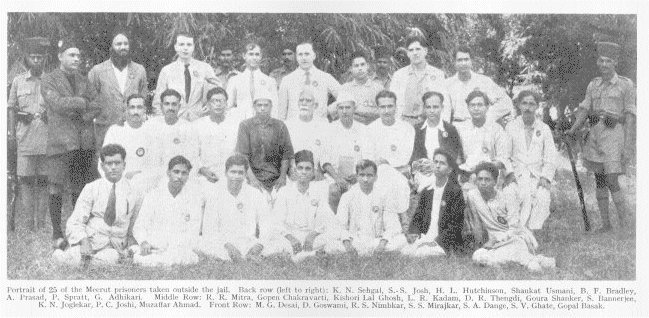
After the Kanpur Bolshevik Conspiracy Case of 1924 the communists in India could not operate as an open party, so from 1925 they built provincial 'Workers' and Peasants' Parties' as legal fronts. These bodies did two things at once: they organised trade unions and peasant associations, and they worked inside the Indian National Congress as an organised left wing, arguing for complete independence, for a social and economic programme, and for a mass base of workers and peasants rather than lawyers and landholders. The strategy ran out in 1928–29. The Sixth Congress of the Communist International (1928) turned against communist collaboration with 'national-reformist' bourgeois parties, and the mass arrests of 20 March 1929 that opened the Meerut Conspiracy Case swept up most of the WPP leadership, ending the experiment.
This is a one-date question dressed up as a two-statement question. Statement 2 is a description of strategy and reads exactly like the standard account, so a candidate who has read the chapter will accept it without difficulty. Everything therefore turns on statement 1, and the examiner has planted a plausible year: 1927 IS a real WPP date — it is when the Bombay unit was formed — but it is neither the founding year of the movement (1925/1926, in Bengal) nor the year of the all-India body (December 1928). When a statement bundles two claims like this, check both; a statement that is right about one thing and wrong about another is still wrong.
- The first of these bodies was the Labour Swaraj Party of the Indian National Congress, founded in Bengal on 1 November 1925, and renamed the Workers' and Peasants' Party of Bengal on 6 February 1926 at the All Bengal Praja Conference at Krishnagar. Its weekly paper was 'Langal' ('The Plough'), later 'Ganavani'.
- Provincial units followed in stages — Bombay in January 1927, the Kirti Kisan Party in Punjab in September 1928 at Lyallpur, and units in the United Provinces in October 1928.
- The all-India Workers' and Peasants' Party was constituted only at Calcutta on 22–24 December 1928, timed with the Calcutta session of the Congress — which is why 'formed in 1927 and given all-India form' is doubly wrong.
- The WPPs functioned as the open, legal platform of the communists after the Kanpur (Cawnpore) Bolshevik Conspiracy Case of 1924; they worked inside the Congress from 1925 to 1929, placed members on the All India Congress Committee, and backed the complete-independence resolution at the Madras Congress of 1927.
- The arrests of 20 March 1929, which opened the Meerut Conspiracy Case, effectively dissolved the party — reinforced by the Sixth Comintern Congress's 1928 line against collaboration with bourgeois nationalist parties.
- Reading 1927 as the founding year because the Bombay unit was set up in January 1927. The Bengal parent body dates from 1925–26 and the all-India body only from December 1928.
- Treating the Workers' and Peasants' Party as a rival to the Congress. It was deliberately built to operate inside the Congress — which is precisely what statement 2 says and why statement 2 is correct.
- Confusing the Workers' and Peasants' Party (1925–29) with the Congress Socialist Party (1934) or with the Kisan Sabha movement; all three worked with or within the Congress, but in different decades and with different programmes.
UPPSC likes two-statement items on the 1920s left in which one statement is a safe description of aims and the other hides a single wrong date, so the whole question turns on the year; UPSC has preferred to test the same territory through personalities and cases — who led the Tashkent group in 1920, or what the Congress Socialist Party did and did not stand for.
In October 1920, who of the following headed a group of Indians gathered at Tashkent to set up a communist party of India?
- (a) H.K. Sarkar
- (b) P.C. Joshi
- (c) M.C. Chagla
- (d) M.N. Roy
Answer(d) M.N. Roy
The beginning of the same story — the Tashkent group of 1920 is the communist current that, once driven underground by the Kanpur case of 1924, resurfaced as the open Workers' and Peasants' Parties this UPPSC question asks about.
With reference to Congress Socialist Party, consider the following statements: 1. It advocated the boycott of British goods and evasion of taxes. 2. It wanted to establish the dictatorship of proletariat. 3. It advocated separate electorate for minorities and oppressed classes. Which of the statements given above is/are correct?
- (a) 1 and 2 only
- (b) 3 only
- (c) 1, 2 and 3
- (d) None
Answer(d) None
The same strategy one decade later — the Congress Socialist Party of 1934 also chose to work for a radical programme from INSIDE the Congress rather than against it, which is exactly what statement 2 of this UPPSC question asserts about the Workers' and Peasants' Party.
Who among the following was NOT an early member of the 'Naujawan-Sabha' formed in 1926 A.D.?
- (a) Bhagat Singh
- (b) Yaspal
- (c) Chhabil Das
- (d) Ambika Chakravarti
Answer(d) Ambika Chakravarti
The other radical organisation of exactly the same moment — the Naujawan Bharat Sabha (1926) and the Workers' and Peasants' Parties (1925–28) were the two open, legal bodies through which the post-1924 left tried to give the national movement a mass and radical base.
In 1918, the United Provinces Kisan Sabha was formed by which of the following leaders?
- (a) Pt. Jawaharlal Nehru
- (b) Baba Ramchandra
- (c) Swami Sahjanand Saraswati
- (d) Indra Narayan Dwivedi
Answer(d) Indra Narayan Dwivedi
The peasant half of the same idea, and a UPPSC favourite — organising kisans into a body linked to the Congress was already under way in the United Provinces from 1918, which is the tradition the 'Peasants' in the Workers' and Peasants' Party was reaching for.
- practice — not a real PYQ
The Workers' and Peasants' Party of Bengal, renamed in February 1926, had been founded in November 1925 under which name ?
- (a)The Labour Swaraj Party
- (b)The Kirti Kisan Party
- (c)The Naujawan Bharat Sabha
- (d)The Congress Socialist Party
Answer(a) The Labour Swaraj Party — founded in Bengal on 1 November 1925 and renamed the Workers' and Peasants' Party of Bengal on 6 February 1926. The Kirti Kisan Party was the Punjab unit of 1928, the Naujawan Bharat Sabha was Bhagat Singh's youth organisation of 1926, and the Congress Socialist Party came only in 1934.
- practice — not a real PYQ
Which one of the following most directly brought the activities of the Workers' and Peasants' Party to an end ?
- (a)The Kanpur Bolshevik Conspiracy Case, 1924
- (b)The arrests of March 1929 that opened the Meerut Conspiracy Case
- (c)The Lahore Conspiracy Case, 1929–31
- (d)The Chittagong Armoury Raid, 1930
Answer(b) The arrests of March 1929 that opened the Meerut Conspiracy Case — they removed most of the WPP leadership. The 1924 Kanpur case is what pushed the communists to build the WPPs in the first place; the Lahore case concerned Bhagat Singh and the HSRA, and the Chittagong raid was Surya Sen's.