
Which country has natural arsenic water contamination ?
- (a)Bangladesh
- (b)Pakistan
- (c)Sri Lanka
- (d)Bhutan
Correct — A, Bangladesh. Bangladesh is the archetypal case of natural arsenic contamination of groundwater, and the one the World Health Organization has described as the largest mass poisoning of a population in history. The mechanism is geological, not industrial: from the 1970s millions of shallow tube wells were sunk across the country, on excellent public-health advice, to get people off microbially contaminated surface water that was killing children with diarrhoeal disease. Those wells tapped young alluvial sediments of the Ganges-Brahmaputra delta in which arsenic is bound to iron oxyhydroxides, and in the oxygen-poor conditions of the aquifer that iron is reduced and the arsenic released into solution. Routine water testing at the time simply did not include arsenic, so the problem went unnoticed until it was identified in 1993 and drew international attention from 1995. One honest qualification the question does not make: Bangladesh is the best-known and worst-documented case, not the only affected country in this list's region — the Indus plain of Pakistan is also seriously arsenic-affected, and so are West Bengal, parts of Bihar and stretches of the Ganga plain in Uttar Pradesh. What makes (a) the answer is that Bangladesh is the case defined by natural arsenic contamination in the literature and in every textbook treatment of the subject.
- (b)Pakistan — The one distractor a careful student can argue with, and it deserves an honest answer rather than a flat denial: arsenic above WHO limits has in fact been documented widely in Pakistan's Indus plain aquifers. But the question is reaching for the country whose arsenic crisis defines the subject, and that is unambiguously Bangladesh — identified in 1993, quantified across the whole country, and the case on which the WHO guidance and the global literature are built.
- (c)Sri Lanka — Sri Lanka is not among the countries recorded for natural arsenic contamination of groundwater. Its widely reported drinking-water health problem is of a different kind — chronic kidney disease of unknown aetiology in the dry-zone farming districts — and it is not attributed to naturally occurring arsenic in aquifers.
- (d)Bhutan — Bhutan is a Himalayan country of hard rock and steep gradients, supplied largely from surface streams and springs rather than from deep alluvial aquifers. It has no equivalent of the delta sediments that release arsenic, and it does not appear in the record of arsenic-affected countries.
Geogenic contamination means a pollutant that comes out of the rock and sediment itself rather than from a factory or a farm. Arsenic in the Ganges-Brahmaputra-Meghna delta is the standard example: arsenic-bearing minerals eroded from the Himalaya were deposited with the delta sediments and adsorbed onto iron oxyhydroxide coatings on the sand grains. Where the aquifer is reducing — starved of oxygen because buried organic matter is being consumed by bacteria — those iron coatings dissolve and the arsenic they held goes into the water. This is why the contamination is patchy well by well, why deeper and older aquifers are often safer than shallow Holocene ones, and why the problem cannot be solved by stopping any discharge. Fluoride in Rajasthan and Andhra Pradesh and uranium in parts of Punjab are the other Indian examples of the same geogenic class.
The reasoning shortcut is geological rather than political: ask which of the four countries sits on a large, young, water-logged alluvial plain. Bangladesh is almost entirely delta; Pakistan has the Indus plain; Sri Lanka and Bhutan have neither. That already narrows the question to (a) and (b), and between those two the examiner is asking for the case that made the subject famous. The trap for a well-read candidate is the opposite of the usual one — knowing too much about Pakistan and hesitating. In the exam, take the archetype. The public-health lesson underneath is worth carrying into mains: the tube-well programme was a genuine success against waterborne infection, and the arsenic crisis was the unintended consequence of solving one problem without testing for another.
- Arsenic contamination of Bangladesh's groundwater was identified in 1993 and drew international attention from 1995; WHO has described it as the largest mass poisoning of a population in history.
- The source is natural — arsenic released by reductive dissolution of iron oxyhydroxides in young alluvial aquifers, not industrial discharge.
- WHO's provisional guideline value for arsenic in drinking water is 10 micrograms per litre; Bangladesh's national standard is 50 micrograms per litre.
- Chronic exposure causes arsenicosis — skin keratosis and melanosis, Blackfoot disease, and cancers of the skin, bladder and lung.
- The same delta and floodplain geology affects West Bengal, several districts of Bihar and parts of the Ganga plain in Uttar Pradesh, and Pakistan's Indus plain.
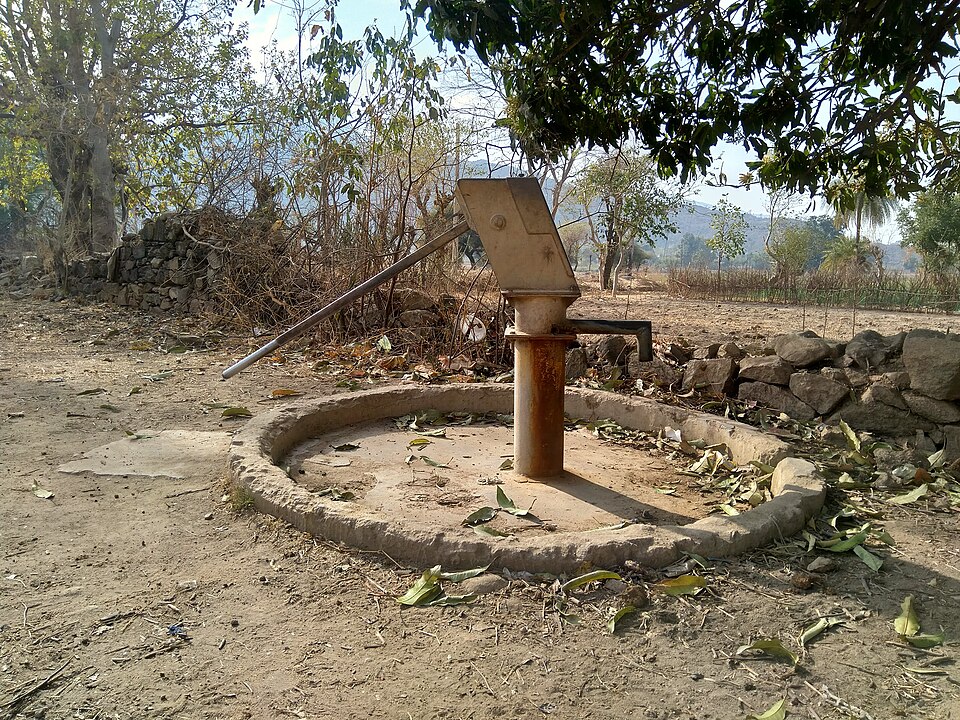
- Assuming arsenic contamination must be industrial in origin; in the delta it is released from the sediment itself
- Believing Bangladesh is the only affected country — Pakistan, and India's own Ganga plain, are affected too, which is why the question asks for the defining case
- Confusing arsenic with fluoride: fluoride excess causes dental and skeletal fluorosis and is a problem of arid hard-rock terrain, not of young deltaic aquifers
UPPSC asks this as a one-line 'which country / which pollutant' recall. UPSC prefers a multi-item list — which of the following can be found as pollutants in drinking water in parts of India — so learn arsenic, fluoride and uranium together with the regions each affects, and be able to say why the contamination is natural.
Which of the following can be found as pollutants in the drinking water in some parts of India? 1. Arsenic 2. Sorbitol 3. Fluoride 4. Formaldehyde 5. Uranium Select the correct answer using the codes given below.
- (a) 1 and 3 only
- (b) 2, 4 and 5 only
- (c) 1, 3 and 5 only
- (d) 1, 2, 3, 4 and 5
Answer(c) 1, 3 and 5 only
The same geogenic-contaminant concept applied to India instead of Bangladesh. Arsenic, fluoride and uranium are the three that genuinely occur in Indian drinking water; sorbitol and formaldehyde are the invented ones. Learn the three together and both questions fall.
'Blue baby syndrome' is due to the presence of which of the following in the blood ?
- (a) Haemoglobin
- (b) Methemoglobin
- (c) Lead
- (d) Nitrate
Answer(b) Methemoglobin
The neighbouring idea — a chemical contaminant of drinking water and the specific disease it produces. Nitrate gives blue baby syndrome, arsenic gives arsenicosis and fluoride gives fluorosis; UPPSC works steadily through that contaminant-to-disease list.
- practice — not a real PYQ
The natural arsenic contamination of groundwater in the Ganges-Brahmaputra delta is primarily caused by
- (a)discharge of untreated effluent from tanneries and dyeing units
- (b)release of arsenic from iron oxyhydroxides in the aquifer sediments under reducing conditions
- (c)excessive use of arsenic-based pesticides on paddy fields
- (d)seawater intrusion into coastal aquifers
Answer(b) release of arsenic from iron oxyhydroxides in the aquifer sediments under reducing conditions — the contamination is geogenic, which is why it cannot be stopped by controlling any discharge.
- practice — not a real PYQ
Consider the following statements about arsenic in drinking water: 1. WHO's provisional guideline value for arsenic in drinking water is 10 micrograms per litre. 2. Long-term exposure to arsenic causes skin keratosis and melanosis. Which of the statements given above is/are correct?
- (a)Both 1 and 2
- (b)Only 1
- (c)Neither 1 nor 2
- (d)Only 2
Answer(a) Both 1 and 2 — the WHO provisional guideline value is 10 micrograms per litre, and keratosis and melanosis are the classic dermatological signs of chronic arsenicosis.