
Who was the founder of 'Satyashodhak Samaj' having its primary emphasis on the seeking of truth ?
- (a)M. G. Ranade
- (b)Raja Ram Mohan Roy
- (c)Tarabai Shinde
- (d)Jyotiba Phule
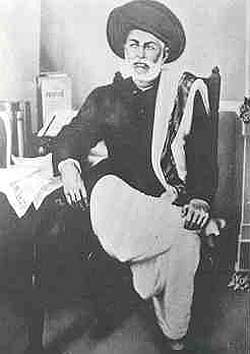
Correct — D, Jyotiba Phule. Jyotirao Govindrao Phule founded the Satyashodhak Samaj — literally the Truth-Seekers' Society, which is what the question's phrase 'emphasis on the seeking of truth' is translating — at Pune on 24 September 1873. Its programme was the rights of Shudras, Dalits and women: it attacked caste hierarchy and idolatry, and it made a point of conducting marriages and other ceremonies without Brahmin priests, on the argument that no intermediary is needed between a person and the truth. The founding sits inside a life of consistent work in the same direction — with Savitribai Phule he opened a school for girls at Bhide Wada, Pune, in 1848, opened a home for widows and a centre against infanticide in 1863, and campaigned for widow remarriage; his book Gulamgiri, 'Slavery', also of 1873, was dedicated to the American abolitionists. The title 'Mahatma' was conferred on him in 1888. B. R. Ambedkar later named Phule as one of his three gurus, with the Buddha and Kabir.
- (a)M. G. Ranade — Ranade was a reformer in the same city and the same decades, which is what makes him the strongest distractor, but his institutions were different ones — the Prarthana Samaj, the Poona Sarvajanik Sabha, and the National Social Conference founded in 1887 to carry on social-reform debate that the Indian National Congress had decided to keep off its own agenda. He worked for reform from within the upper-caste reformist tradition; Phule's Samaj was built by and for those outside it.
- (b)Raja Ram Mohan Roy — Wrong organisation, wrong city and wrong generation. Ram Mohan Roy founded the Brahmo Samaj at Calcutta in 1828 and is remembered above all for the campaign that led to the abolition of sati in 1829. He died in 1833, forty years before the Satyashodhak Samaj was founded.
- (c)Tarabai Shinde — Tarabai Shinde belongs to the same Maharashtrian reform current and is a major figure in her own right — her Stri Purush Tulana of 1882 is among the earliest modern feminist tracts written in an Indian language — but she was not the founder. The Samaj was founded in 1873, nine years before that book appeared.
The Satyashodhak Samaj marks a shift in nineteenth-century Indian social reform. The earlier bodies — the Brahmo Samaj in Bengal, the Prarthana Samaj in western India — were led by educated upper-caste men seeking to purify religion and remove specific evils such as sati, child marriage and the ban on widow remarriage. Phule's Samaj started from a different place: that caste itself was the injustice, that the lower castes and women should lead their own emancipation, and that priestly mediation could simply be dispensed with. That is why it organised priest-free marriages, ran schools, and drew its membership largely from non-Brahmin cultivating castes. Its line continues through the non-Brahmin politics of western and southern India and into Ambedkar's work.
All four names on this list are genuine reform figures, so the elimination has to run on organisation and date rather than on general reputation. Fix three anchors and the question becomes automatic: Brahmo Samaj — Ram Mohan Roy — Calcutta — 1828; Prarthana Samaj — founded by Atmaram Pandurang at Bombay in 1867, with Ranade its best-known later figure — and the National Social Conference — Ranade — 1887; Satyashodhak Samaj — Phule — Pune — 1873. Tarabai Shinde is then placed by her book rather than by an institution. The deeper distinction worth carrying into mains is between reform aimed at practices within the existing social order and reform aimed at the order itself: Ranade represents the first, Phule the second.
- Jyotirao Govindrao Phule (1827-1890) founded the Satyashodhak Samaj at Pune on 24 September 1873.
- The Samaj worked for the rights of Shudras, Dalits and women, opposed caste hierarchy and idolatry, and rejected the need for Brahmin priests at ceremonies.
- Phule's Gulamgiri ('Slavery'), 1873, was dedicated to the American abolitionists; the title 'Mahatma' was conferred on him in 1888.
- With Savitribai Phule he opened a school for girls at Bhide Wada, Pune, in 1848, and a home for widows and centre against infanticide in 1863, and campaigned for widow remarriage.
- B. R. Ambedkar counted Phule as one of his three gurus, alongside the Buddha and Kabir.
- Pairing the wrong Samaj with the wrong founder; Brahmo, Prarthana, Arya and Satyashodhak are four different bodies with four different founders and cities
- Assuming any reformer active in Maharashtra at the time was part of the Satyashodhak Samaj's founding
- Confusing Jyotiba Phule with Savitribai Phule when a question specifies the founder of the Samaj
UPPSC asks this as a direct founder-to-organisation recall or inside a match list of reformers and their bodies. UPSC prefers the surrounding context — why the National Social Conference was formed separately from the Congress, or who was behind a particular reform newspaper — so learn each reformer with an organisation, a city, a publication and a date attached.
During Indian freedom struggle, the National Social Conference was formed. What was the reason for its formation?
- (a) Different social reform groups or organizations of Bengal region united to form a single body to discuss the issues of larger interest and to prepare petitions/representations to the government
- (b) Indian National Congress did not want to include social reforms in its deliberations and decided to form a separate body for such a purpose
- (c) Behramji Malabari and M. G. Ranade decided to bring together all the social reform groups of the country under one organization
- (d) None of the statements (a), (b) and (c) given above is correct in this context
Answer(b) Indian National Congress did not want to include social reforms in its deliberations and decided to form a separate body for such a purpose
Places the distractor at option (a) of this card. Ranade's vehicle was the National Social Conference of 1887 and the Prarthana Samaj, not the Satyashodhak Samaj — and the contrast is instructive, since the Conference was a reform forum attached to the Congress elite while Phule's Samaj was built outside it.
Consider the following statements with reference to the Justice Party : 1. The Justice Party opposed Congress by calling it a Brahmin dominated organisation. 2. It claimed the same communal representation for non-Brahmins as the Morley-Minto reforms had given to Muslims. Which of the above statements is/are correct ?
- (a) Both 1 and 2
- (b) Neither 1 nor 2
- (c) Only 1
- (d) Only 2
Answer(a) Both 1 and 2
Where the Satyashodhak current leads next. Phule's Samaj made non-Brahmin self-assertion a social movement in the 1870s; the Justice Party carried the same claim into electoral politics in the twentieth century, demanding communal representation for non-Brahmins.
In the contexts of Indian history, which of the following statement/s is/are correct regarding Vaikom Satyagraha? 1. It was a satyagraha againsts untouchability and caste discrimination. 2. Mahatma Gandhi participated in this Satyagraha. Select the correct answer using the codes given below. Codes:
- (a) 1 only
- (b) 2 only
- (c) Both 1 and 2
- (d) Neither 1 nor 2
Answer(c) Both 1 and 2
The same anti-caste project fifty years on and a thousand kilometres south, this time as direct action over temple-road access rather than as a society. Both are asked by UPPSC as staples of the social-reform section.
- practice — not a real PYQ
Consider the following pairs of reform organisation and founder: 1. Brahmo Samaj — Raja Ram Mohan Roy 2. Prarthana Samaj — M. G. Ranade 3. Satyashodhak Samaj — Jyotiba Phule Which of the pairs given above are correctly matched?
- (a)1 and 2 only
- (b)2 and 3 only
- (c)1 and 3 only
- (d)1, 2 and 3
Answer(c) 1 and 3 only — Brahmo Samaj was founded by Raja Ram Mohan Roy at Calcutta in 1828 and Satyashodhak Samaj by Jyotiba Phule at Pune in 1873, so both are correctly matched. Pair 2 is the trap: the Prarthana Samaj was founded at Bombay on 31 March 1867 by Atmaram Pandurang. M. G. Ranade joined afterwards and became its best-known figure, which is why he is so often mis-remembered as its founder.
- practice — not a real PYQ
Which of the following was a distinctive practice of the Satyashodhak Samaj?
- (a)Conducting marriages and ceremonies without Brahmin priests
- (b)Campaigning for the restoration of Vedic ritual and the authority of the Vedas
- (c)Seeking separate electorates for the depressed classes
- (d)Organising monastic orders for social service
Answer(a) Conducting marriages and ceremonies without Brahmin priests — the Samaj held that no priestly intermediary was needed, which followed directly from its rejection of caste hierarchy.