
Keibul Lamjao National Park is located in which lake ?
- (a)Dal
- (b)Kolleru
- (c)Loktak
- (d)Wular
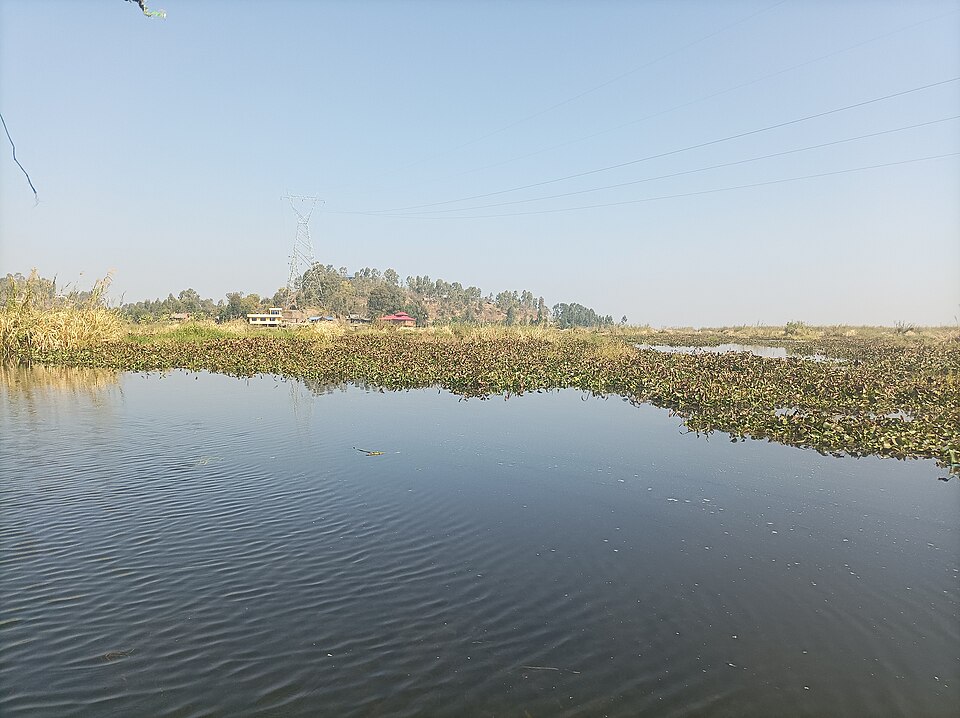
Correct — C, Loktak. Keibul Lamjao National Park lies on Loktak Lake in Manipur, and it is not merely beside the lake — it floats on it. The park sits on a phumdi, one of the thick mats of vegetation, soil and decomposing organic matter that drift on Loktak's surface; the phumdi carrying the park covers roughly 40 square kilometres, which makes Keibul Lamjao the only floating national park in the world. Its reason for existing is the sangai (Rucervus eldii eldii), the brow-antlered 'dancing deer' that is Manipur's State animal and is found in the wild nowhere else on earth; the deer's splayed hooves are adapted to walking on the spongy, unstable phumdi surface. Loktak itself is the largest freshwater lake in North-East India, was designated a Ramsar site on 23 March 1990, and was placed on the Montreux Record on 16 June 1993 — the Ramsar list of wetlands where ecological character has changed or is likely to change, largely because the Ithai barrage altered the lake's water regime and the phumdis' natural cycle of grounding and refloating.
- (a)Dal — Dal Lake is in Srinagar, Jammu and Kashmir. It is famous for its houseboats and its floating vegetable gardens, which makes it a tempting swap for a 'floating' answer — but there is no national park on it, and it is nowhere near Manipur.
- (b)Kolleru — Kolleru Lake lies in Andhra Pradesh, in the low country between the Krishna and Godavari deltas. It is a major waterbird habitat and a Ramsar site, protected as a wildlife sanctuary rather than a national park, and it has no phumdis and no sangai.
- (d)Wular — Wular Lake is in Jammu and Kashmir, fed by the Jhelum, and is one of the largest freshwater lakes in the subcontinent and a Ramsar site — but no national park is located on it. The distractor works only if you remember 'big freshwater lake' without remembering where.
A phumdi is a floating island: a heterogeneous mass of vegetation, soil and organic matter at various stages of decay that drifts on the water surface, thick enough in places to bear the weight of large mammals and even human dwellings. Loktak is the classic phumdi lake. Because the phumdi rises and falls with the water level and periodically grounds itself on the lake bed to take up nutrients, anything that fixes the water level — such as a barrage — thins the phumdis over time and degrades the habitat they support.
The question is a single-fact recall, but the useful way to hold it is as a cluster: Manipur → Loktak → phumdi → Keibul Lamjao → sangai. Every one of those five terms has appeared in a State PSC or UPSC paper, and they are all recovered together. Note also that the Imphal valley in which Loktak sits is itself a lacustrine plain — an old lake floor filled with sediment, of which Loktak is the surviving remnant — so the lake and the landform are one story.
- Keibul Lamjao National Park sits on a phumdi of about 40 sq km on Loktak Lake and is the world's only floating national park.
- The sangai (Rucervus eldii eldii), the brow-antlered deer, is Manipur's State animal and survives in the wild only here.
- Loktak is the largest freshwater lake in North-East India and was designated a Ramsar site on 23 March 1990.
- Loktak was added to the Montreux Record on 16 June 1993, marking a wetland whose ecological character has changed or is likely to change.
- Answering 'Dal' because both lakes are associated with floating things. Dal has floating gardens; Loktak has phumdis and a national park.
- Confusing the protection status — Kolleru is a wildlife sanctuary, Keibul Lamjao is a national park; the two are different categories under the Wild Life (Protection) Act, 1972.
- Treating the sangai as merely rare. It is endemic to this one habitat, which is the whole justification for the park.
Loktak and Keibul Lamjao are among the most heavily recycled facts in Indian geography and ecology: UPSC has asked the park by its 'floating swamp' description and Loktak inside a wrong-pair set, while UPPSC has asked it as a lake-to-State match and now as a direct question.
Which of the following National Parks is unique in being a swamp with floating vegetation that supports a rich biodiversity?
- (a) Bhitarkanika National Park
- (b) Keibul Lamjao National Park
- (c) Keoladeo Ghana National Park
- (d) Sultanpur National Park
Answer(b) Keibul Lamjao National Park
The mirror image of this question. UPSC describes the floating swamp and asks for the park; UPPSC names the park and asks for the lake. One fact — Keibul Lamjao floats on phumdis on Loktak — answers both.
Consider the following pairs: 1. Nokrek Biosphere Reserve : Garo Hills 2. Loktak Lake : Barail Range 3. Namdapha National Park : Dafla Hills Which of the above pairs is/are correctly matched?
- (a) 1 only
- (b) 2 and 3 only
- (c) 1, 2 and 3
- (d) None
Answer(a) 1 only
Loktak used as a wrong pair: UPSC attaches it to the Barail Range of Assam to see who knows it is in Manipur. Between this and the 2015 item, UPSC has tested both halves of what UPPSC asks here — where Loktak is, and what sits on it.
Match List – I with List – II and select the correct answer using the codes given below the lists : List – I (Lake) A. Sala Lake B. Badkhal Lake C. Loktak Lake D. Kaliveli Lake List – II (Location) 1. Arunachal Pradesh 2. Haryana 3. Manipur 4. Tamil Nadu Codes :
- (a) A-1, B-2, C-3, D-4
- (b) A-2, B-1, C-3, D-4
- (c) A-1, B-3, C-2, D-4
- (d) A-1, B-4, C-2, D-3
Answer(a) A-1, B-2, C-3, D-4
The commission's own earlier use of Loktak, there as one of four lakes to be matched to their States. Two years later it asked what sits on the lake instead — the same knowledge, one level deeper.
'Imphal Basin' surrounded by Manipur hills is a fine example of
- (a) Lacustrine plain
- (b) Loess plain
- (c) Glacial plain
- (d) Alluvial plain
Answer(a) Lacustrine plain
The landform half of the same story: the Imphal valley is an old lake floor filled with sediment, and Loktak is what remains of that lake. Learn the basin and the lake together and both UPPSC items are secured.
- practice — not a real PYQ
The term 'phumdi', associated with Loktak Lake, refers to
- (a)A traditional fishing net used in Manipur
- (b)A floating mass of vegetation, soil and organic matter
- (c)A seasonal flood channel of the Imphal river
- (d)A terraced field cultivated on the lake shore
Answer(b) A floating mass of vegetation, soil and organic matter — thick enough to carry the 40 sq km on which Keibul Lamjao National Park stands.
- practice — not a real PYQ
Loktak Lake was placed on the Montreux Record. What does inclusion in the Montreux Record signify?
- (a)The wetland has been declared a World Heritage Site
- (b)The wetland's ecological character has changed, is changing or is likely to change
- (c)The wetland has been removed from the Ramsar list
- (d)The wetland is protected exclusively for migratory birds
Answer(b) The wetland's ecological character has changed, is changing or is likely to change — the Montreux Record is a register of Ramsar sites needing priority conservation attention. Loktak was added on 16 June 1993.