
Given below are two statements, one is labelled as Assertion (A) and the other as Reason (R). Assertion (A) : During the 20th century, poverty and poor people have become the subject of our concern and duty. Reason (R) : Strategically there was lack of targeted actions due to which this issue got momentum. Select the correct answer from the code given below : Code :
- (a)(A) is true but (R) is false
- (b)Both (A) and (R) are true and (R) is the correct explanation of (A)
- (c)(A) is false but (R) is true
- (d)Both (A) and (R) are true but (R) is not the correct explanation of (A)
Correct — B, Both (A) and (R) are true and (R) is the correct explanation of (A). Read this paper's assertion-reason code first, because not one of the four letters carries the meaning candidates expect. In UPPSC 2022 Paper-I, (a) is '(A) is true but (R) is false', (b) is 'Both (A) and (R) are true and (R) is the correct explanation of (A)', (c) is '(A) is false but (R) is true', and (d) is 'Both (A) and (R) are true but (R) is not the correct explanation of (A)'. The full-agreement answer that normally sits at (a) sits at (b) throughout this paper, and the 'true but not the explanation' answer that normally sits at (b) has moved to (d). Now the honest part, and this card will not pretend otherwise: neither statement in this item contains a proposition that can be checked against a source. 'Poverty and poor people have become the subject of our concern and duty' is an evaluative statement about public attitudes, not a fact with a date, a number or an authority behind it; and 'strategically there was lack of targeted actions due to which this issue got momentum' asserts a causal reading of that history in language that does not resolve to any specific policy, period or country. There is no document to consult that would confirm or refute either one, and no standard textbook formulation that the sentences reproduce. The official key marks (b), which reads the pair as: the twentieth century did make poverty a matter of public concern and duty, and it did so precisely because the absence of deliberate, targeted action left the problem visible and unaddressed until it forced itself onto the agenda. That reading is defensible, but it is an interpretation rather than a verifiable finding. Take the key. The reliable takeaway from this question is not the proposition but the code — that in this paper full agreement is (b) and not (a).
- (a)(A) is true but (R) is false — This choice requires you to declare the Reason positively false. Given how loosely the Reason is worded — no country, no period, no named policy — there is nothing in it that can be shown to be false, so the key does not read it this way.
- (c)(A) is false but (R) is true — This choice denies the Assertion. The one part of this item that does correspond to the documented record is the Assertion: the twentieth century is exactly when poverty moved from private charity to public survey, measurement and state duty, from Charles Booth's London survey onward. It is not the statement to reject.
- (d)Both (A) and (R) are true but (R) is not the correct explanation of (A) — This is the nearest miss, and in this paper it occupies the slot that usually holds the full-agreement answer, so a candidate working from habit can land here by accident. It accepts both statements but severs the causal link between them; the key instead treats the lack of targeted action as the very thing that gave the issue momentum, and so marks (b).
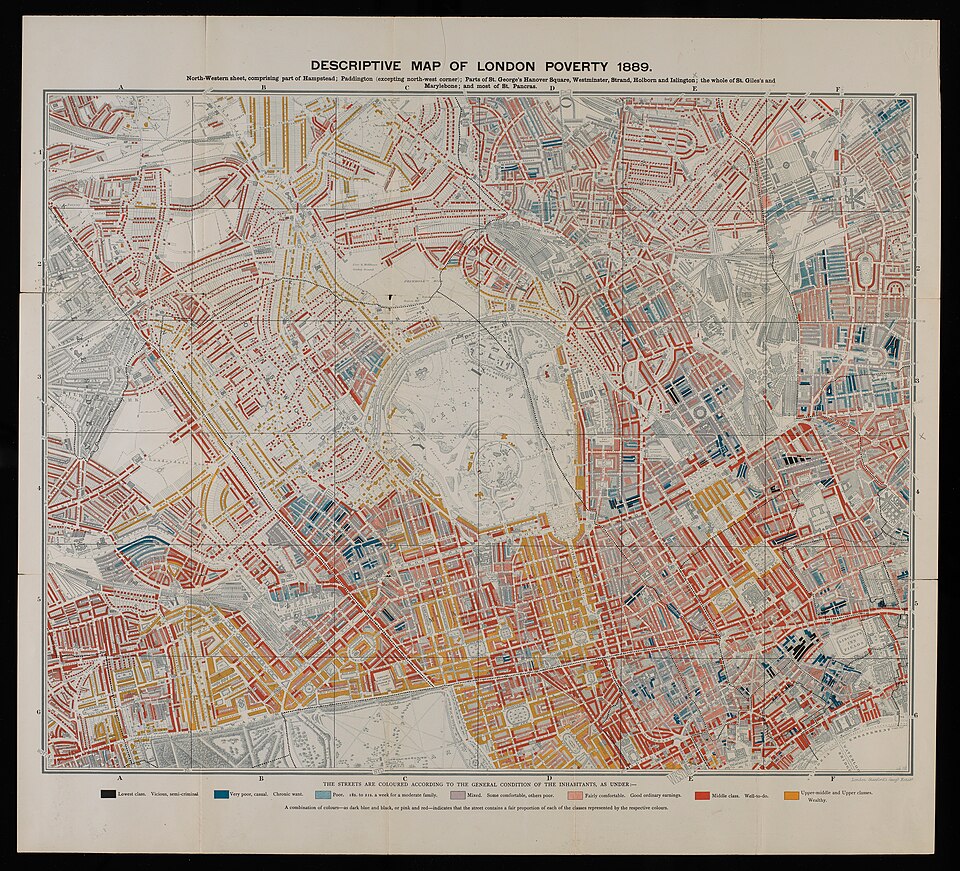
The checkable history behind this item is the twentieth-century shift in how poverty was treated: from a private moral failing addressed by charity, to a measurable social condition that governments were expected to survey and act on. Charles Booth's survey of London, the first volume of which appeared in 1889, is the usual starting point — he found roughly 35 per cent of the East End living in abject poverty, a far higher figure than he had expected, and argued that poverty was shaped by religion, education and administration rather than by individual character. From there the century built an apparatus for defining and counting the poor: poverty lines, official surveys, targeted anti-poverty programmes, and eventually international indices. The UNDP's Human Development Report introduced the Human Poverty Index in 1997 and replaced it with the global Multidimensional Poverty Index in 2010, which counts overlapping deprivations in health, education and standard of living at the household level rather than averaging across a country.
Treat this question in two separate parts, because only one of them is learnable. The learnable part is the code. UPPSC 2022 rotates the assertion-reason options so that (b) means full agreement and (d) means 'both true but unrelated'; a candidate who reads the option text rather than reaching for the remembered position of (a) is safe on all seven assertion-reason items in this paper. The other part — the substance — is a pair of general propositions about attitudes and causation, with no name, date or figure to test. When an assertion-reason item is worded that abstractly, the examiner is usually looking for agreement rather than for a fine discrimination, and there is no honest analytical route to a different conclusion. Do not spend time in the hall trying to falsify a sentence that contains nothing falsifiable.
- Charles Booth's 'Life and Labour of the People in London' — first volume 1889, expanded to nine volumes in 1892-97 and seventeen in 1902-03 — found about 35 per cent of the East End in abject poverty and treated poverty as a product of social conditions rather than individual failing.
- Oscar Lewis advanced the opposing 'culture of poverty' thesis in works such as Five Families (1959) and La Vida (1966), arguing that the very poor develop a self-perpetuating sub-culture — a reading widely criticised for locating the cause inside the poor themselves.
- The UNDP's Human Development Report introduced the Human Poverty Index in 1997 and replaced it with the global Multidimensional Poverty Index in 2010.
- The Multidimensional Poverty Index measures deprivation across three dimensions — health, education and standard of living — and counts how many deprivations a household suffers at once, rather than averaging across a country.
- This particular item contains no verifiable proposition. Both statements are general claims about attitudes and causation with no date, country, policy or authority attached, so the answer rests on the official key rather than on any source.
- Answering (a) out of habit because it is where 'both true and R explains A' normally sits. In UPPSC 2022 Paper-I that answer is at (b), and (a) means '(A) is true but (R) is false'.
- Trying to falsify a statement that is not falsifiable. When both halves of an assertion-reason item are abstract value statements with no date or authority, hunting for an error wastes time that other questions will pay for.
- Assuming that 'both statements true' automatically means the Reason explains the Assertion. In this paper that distinction separates (b) from (d), and it is the whole point of the item type.
UPPSC sets a block of assertion-reason items in every Paper-I and shuffles the meaning of the four letters from year to year, so the first job is always to read the option text rather than recall a position. UPSC has largely retired the classic A-R format in Prelims in favour of Statement-I / Statement-II pairs, which test the same 'is the second statement the explanation of the first' judgement under a different label.
Assertion (A): Though India’s national income has gone up several fold since 1947, there has been no marked improvement in the per capita income level. Reason (R): Sizeable proportion of the population of India is still living below the poverty line. In the context of the above two statements which one of the following is correct?
- (a) Both A and R are true and R is the correct explanation of A
- (b) Both A and R are true but R is not a correct explanation of A
- (c) A is true but R is false
- (d) A is false but R is true
Answer(b) Both A and R are true but R is not a correct explanation of A
The same judgement on the same theme — an assertion-reason pair about poverty where the whole question is whether the second statement explains the first. Note that UPSC printed the options in the standard order, which is exactly what UPPSC 2022 has scrambled.
Persons below the poverty line in India are classified as such based on whether
- (a) they are entitled to a minimum prescribed food basket
- (b) they get work for a prescribed minimum number of days in a year
- (c) they belong to agricultural labourer household and the scheduled caste/tribe social group
- (d) their daily wages fall below the prescribed minimum wages
Answer(a) they are entitled to a minimum prescribed food basket
The concrete counterpart to this abstract item — how the twentieth-century concern with poverty was actually operationalised in India, through a calorie-based consumption line rather than through wages or social group.
The idea of 'Cultural Poverty' was given by
- (a) Oscar Lewis
- (b) Gunnar Myrdal
- (c) Aashish Bose
- (d) Amartya Sen
Answer(a) Oscar Lewis
The twentieth-century debate that this Assertion gestures at, in its testable form — Lewis's culture-of-poverty thesis is the best-known rival to the view that poverty is produced by social conditions and public inaction.
Which of the following is/are the type/s of poverty? (1) Absolute poverty (2) Relative poverty (3) Subjective poverty (4) Functional poverty Choose the correct answer using the code given below -
- (a) Only 3 and 4
- (b) Only 1, 2 and 3
- (c) Only 1 and 2
- (d) Only 1 and 4
Answer(b) Only 1, 2 and 3
Shows how UPPSC normally tests this area when it wants a checkable answer — the standard typology of poverty, rather than a general proposition about public concern.
- practice — not a real PYQ
The idea of the 'culture of poverty' — that the very poor develop a self-perpetuating sub-culture — is associated with
- (a)Gunnar Myrdal
- (b)Oscar Lewis
- (c)Amartya Sen
- (d)Charles Booth
Answer(b) Oscar Lewis — the American anthropologist advanced it in Five Families (1959) and La Vida (1966), on fieldwork among poor Mexican and Puerto Rican families.
- practice — not a real PYQ
The global Multidimensional Poverty Index published in the Human Development Report measures deprivation across which three dimensions?
- (a)Income, employment and housing
- (b)Health, education and standard of living
- (c)Health, income and sanitation
- (d)Education, nutrition and life expectancy
Answer(b) Health, education and standard of living — the MPI replaced the Human Poverty Index in 2010 and counts overlapping household-level deprivations across these three dimensions.