
Who is the record holder for single longest space flight by 'NASA' astronaut abroad the International Space Station ?
- (a)Pyotr Dubrov
- (b)Mark Vande Hei
- (c)Anton Sheaplerov
- (d)None of the above
Correct — B, Mark Vande Hei. As of the June-2022 exam, Vande Hei held the record for the longest single spaceflight by a NASA astronaut: 355 days aboard the International Space Station, launched on Soyuz MS-18 on 9 April 2021 and landed on Soyuz MS-19 on 30 March 2022, about ten weeks before this paper was written. That broke Scott Kelly's American record of 340 days, set on the year-long mission of 2015-16. One honest update for a student reading this today: the record has since moved on — Frank Rubio returned in September 2023 after 371 days, and it is his figure that now stands as the NASA record. Note also what the question does not say: the longest single spaceflight by anyone remains Valeri Polyakov's 437 days aboard Mir in 1994-95. The qualifier 'by a NASA astronaut' is doing real work in this stem.
- (a)Pyotr Dubrov — The sharpest distractor in the paper. Dubrov launched on the same Soyuz as Vande Hei and stayed the same 355 days, so his flight duration is identical — but he is a Roscosmos cosmonaut, not a NASA astronaut, and the question asks specifically for the NASA record. Same mission, same days, wrong agency.
- (c)Anton Sheaplerov — Anton Shkaplerov, spelt here in a garbled form, is the Roscosmos cosmonaut who commanded Soyuz MS-19 and returned to Earth alongside Vande Hei in March 2022. He is in the option set because his name appeared in the same news coverage, not because he held any duration record.
- (d)None of the above — There is a correct name in the list, so the escape option fails. 'None of the above' is worth a second's thought only when every named option is demonstrably wrong; here one of them — Vande Hei — is exactly right.
Long-duration spaceflight records are always quoted with two qualifiers, and questions are built on candidates ignoring them. The first is whether the record is for a single continuous flight or for cumulative time across a career. The second is the agency or nationality: 'longest by a NASA astronaut' is a different record from 'longest by any human'. Missions of this length exist because agencies need data on how the body responds to prolonged microgravity — bone density loss, muscle atrophy, fluid shifts, vision changes and radiation dose — before crewed flights to Mars become feasible. Vande Hei's flight, and Scott Kelly's before it, were run partly for that research value.
This item can be reasoned through without recalling the news at all. Three names are offered; two of them, Dubrov and Shkaplerov, are Russian cosmonauts flying for Roscosmos, and the question asks for a NASA astronaut. That leaves Vande Hei as the only candidate who can satisfy the stem, and it makes 'none of the above' unnecessary. The deeper lesson is about how current-affairs questions age. This one was set on a record barely ten weeks old that has since been broken twice over in significance — Rubio's 371 days in 2023 — so the durable takeaway is not the number but the structure: which agency, single flight or cumulative, and who holds the all-time human record.
- Mark Vande Hei spent 355 days aboard the ISS — launched Soyuz MS-18 on 9 April 2021, landed Soyuz MS-19 on 30 March 2022
- That set the record for the longest single spaceflight by a NASA astronaut as it stood at the June-2022 exam
- It broke Scott Kelly's American record of 340 days, set on the ISS year-long mission of 2015-16
- Pyotr Dubrov flew the same 355 days on the same mission but is a Roscosmos cosmonaut, not a NASA astronaut
- Since then: Frank Rubio returned in September 2023 after 371 days, and now holds the NASA record
- The longest single spaceflight by any human remains Valeri Polyakov's 437 days aboard the Mir station in 1994-95
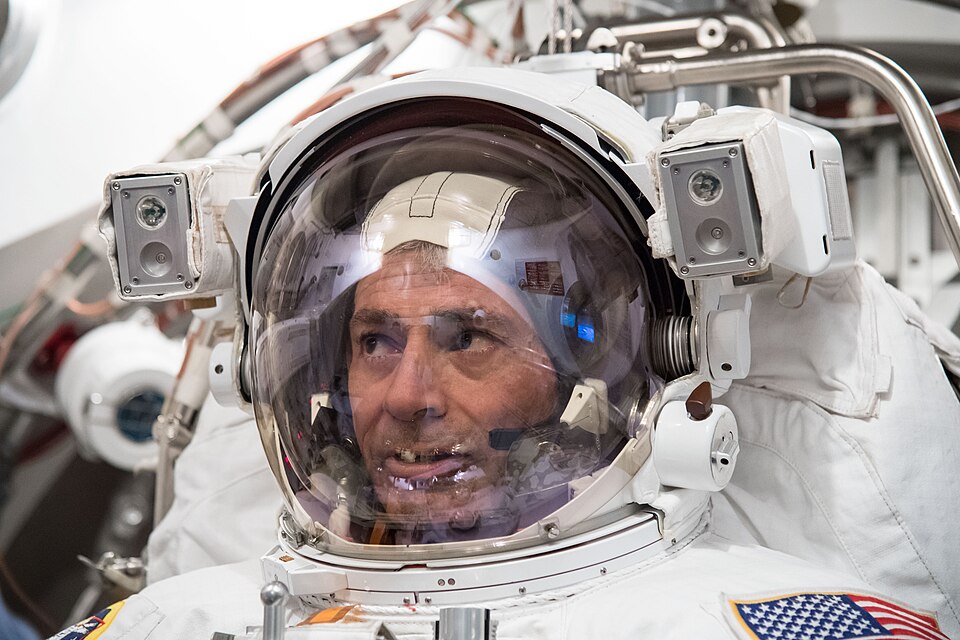
- Ignoring the agency qualifier — Dubrov logged the same 355 days but flies for Roscosmos, so he cannot hold a NASA record
- Confusing the single-flight record with the cumulative career record, and either with the all-time human record of 437 days
- Treating a current-affairs record as permanent; this one was broken in September 2023
UPPSC asks space current affairs as 'who holds the record' or as a person-to-achievement match, usually within a year of the event. UPSC asks the science and the institution instead — what a mission was for, which agencies partner on it, what a technology does — so pair the headline name with the reason the mission existed.
Which of the following statements are true about the Indian-born woman astronaut Kalpana Chawla? I. She was born in Karnal. II. She flew on board the shuttle flight STS-87. III. She was trained at the Kennedy Space Centre. IV. She did a space-walk to retrieve the Spartan Satellite. Select the correct answer using the codes given below:
- (a) I and II
- (b) II and III
- (c) I, II and III
- (d) I, II and IV
Answer(c) I, II and III
The same kind of item — a NASA astronaut's mission details tested statement by statement — and the same trap. Its false statement credits Chawla with a spacewalk another crew member performed, exactly as this 2022 question credits a record to the crewmate who shares the mission but not the agency.
Match List-I with List-II and choose the correct answer using the codes given below the lists : List-I (Person) A. Gopi Thotakura B. Dipa Karmakar C. Aroh Barjatya D. Dev Patel List-II (Reason) 1. First Indian Gymnast to win Gold at Asian Championship 2. Indian born NASA scientist who led the team to study solar ecliptic impact on ionosphere 3. First Indian Space Tourist 4. British actor who made his directorial debut with thriller "Monkey Man" Codes :
- (a) A-4, B-1, C-2, D-3
- (b) A-3, B-1, C-2, D-4
- (c) A-3, B-2, C-1, D-4
- (d) A-2, B-1, C-3, D-4
Answer(b) A-3, B-1, C-2, D-4
The same current-affairs habit two papers later — a named individual tied to a single recent achievement, with two of the four drawn from spaceflight. UPPSC returns to this format every year, so track the year's handful of space names with what exactly each one did.
- practice — not a real PYQ
The longest single spaceflight by any human being was completed aboard which space station?
- (a)Skylab
- (b)Mir
- (c)International Space Station
- (d)Tiangong
Answer(b) Mir — Valeri Polyakov spent 437 days aboard Mir in 1994-95, still the longest single spaceflight by anyone; the NASA record of 355 days, and later 371, was set aboard the ISS.
- practice — not a real PYQ
Which NASA astronaut surpassed Mark Vande Hei's mark for the longest single spaceflight by an American, returning to Earth in September 2023?
- (a)Scott Kelly
- (b)Christina Koch
- (c)Frank Rubio
- (d)Sunita Williams
Answer(c) Frank Rubio — his stay ran to 371 days, extended after his Soyuz return craft developed a coolant leak; Scott Kelly's 340 days was the record Vande Hei himself had broken.