
Dudhwa National Park is situated in which of the following districts of Uttar Pradesh ?
- (a)Lakhimpur Kheri
- (b)Sitapur
- (c)Bahraich
- (d)Pilibhit
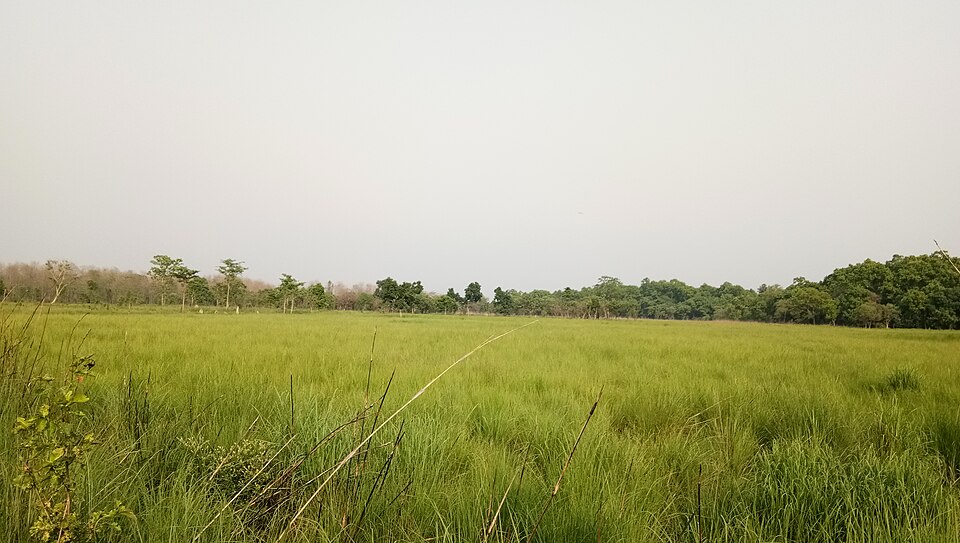
Correct — A, Lakhimpur Kheri. Dudhwa National Park lies in Lakhimpur Kheri district, in the Terai belt along the Indo-Nepal border in the north of Uttar Pradesh. It began as a sanctuary in 1958 and was notified a national park in January 1977, largely through the long campaign of the conservationist Billy Arjan Singh, with a core of about 490 square kilometres and a buffer of roughly 190. It is the only national park in Uttar Pradesh, and it is best known for two mammals: the swamp deer or barasingha, of which it holds one of India's largest populations, and the greater one-horned rhinoceros, reintroduced there in 1984. The three wrong options are all real protected-area districts, which is what makes the question worth doing carefully.
- (b)Sitapur — Sitapur adjoins the Terai belt and lies immediately south of Lakhimpur Kheri, but it has no national park. It is in the list purely as a neighbouring district — the cheapest kind of distractor, and the one to eliminate first.
- (c)Bahraich — The best trap in the set. Bahraich holds Katarniaghat Wildlife Sanctuary, which has been part of the Dudhwa Tiger Reserve since 2000. So Bahraich is inside the tiger reserve — but the national park itself is not there. The question asks for the park, not the reserve, and the two have different boundaries.
- (d)Pilibhit — Pilibhit has its own protected area, the Pilibhit Tiger Reserve, notified in 2014 — a separate reserve in the same Terai landscape, not part of Dudhwa. Having a tiger reserve is not the same as having the national park.
A national park and a tiger reserve are different legal creatures, and this question turns on the difference. A national park is notified under the Wild Life (Protection) Act, 1972, with fixed boundaries and no grazing or private rights inside. A tiger reserve is constituted under Project Tiger and can stitch together several existing protected areas — one or more national parks plus wildlife sanctuaries — into a single core-and-buffer management unit spread across districts. Dudhwa Tiger Reserve, constituted in 1987-88, is exactly such a composite: Dudhwa National Park and Kishanpur Wildlife Sanctuary at the start, with Katarniaghat Wildlife Sanctuary added in 2000.
The trap is Bahraich, and it works on a candidate who has learnt 'Dudhwa Tiger Reserve' rather than 'Dudhwa National Park'. Katarniaghat, in Bahraich, is genuinely part of the tiger reserve, so a student who remembers the reserve's spread will find Bahraich defensible. The discipline is to read which unit the question names. The same discipline eliminates Pilibhit: it is a tiger reserve of its own in the same Terai belt, not a piece of Dudhwa. Sitapur is filler. The one thing to fix in memory is the pairing Dudhwa — Lakhimpur Kheri, the only district in Uttar Pradesh that contains a national park.
- Dudhwa National Park is in Lakhimpur Kheri district, Uttar Pradesh, in the Terai on the Indo-Nepal border
- Declared a sanctuary in 1958 and notified a national park in January 1977; core about 490 sq km with a roughly 190 sq km buffer
- It is the only national park in Uttar Pradesh, which also has about twenty-five wildlife sanctuaries
- Dudhwa Tiger Reserve was constituted in 1987-88 from Dudhwa National Park and Kishanpur Wildlife Sanctuary; Katarniaghat Wildlife Sanctuary, in Bahraich, was added in 2000
- Dudhwa is known for the swamp deer (barasingha) and for the greater one-horned rhinoceros, reintroduced there in 1984
- Pilibhit Tiger Reserve, notified in 2014, is a separate reserve in the same Terai landscape
- Answering with a district that belongs to the tiger reserve rather than to the national park — Bahraich holds Katarniaghat, which is inside Dudhwa Tiger Reserve but outside the park
- Treating Pilibhit as part of Dudhwa; it is a separate tiger reserve notified in 2014
- Mixing up Dudhwa's swamp deer with the hard-ground subspecies of barasingha, which survives in Kanha, not in the Terai
UPPSC asks Uttar Pradesh protected areas as bare location questions — which district holds which park or sanctuary — and occasionally as a match-the-list of sanctuary against district. UPSC almost never asks the district; it asks which species a protected area is known for, which river runs through it, or which pairs of protected area and state are correctly matched.
Match List – I with List – II and select the correct answer using the code given below the lists: List – I (National Park / Wildlife Sanctuary) A. Chandra Prabha B. Karera C. Jaisamand D. Nahargarh List – II (Nearby Town) 1. Jaipur 2. Jhansi 3. Agra 4. Varanasi 5. Udaipur Code: A B C D
- (a) 4 1 5 2
- (b) 5 2 1 3
- (c) 4 3 1 2
- (d) 5 1 3 2
Answer(c) 4 3 1 2
The same underlying skill — placing a protected area on the map — asked as a four-way match. Its first item is Chandra Prabha in Uttar Pradesh, the other UP sanctuary the commissions keep returning to.
Which one of the following protected areas is well-known for the conservation of a sub-species of the Indian swamp deer (Barasingha) that thrives well on hard ground and is exclusively graminivorous 2
- (a) Kanha National Park
- (b) Manas National Park
- (c) Mudumalai Wildlife Sanctuary
- (d) Tal Chhapar Wildlife Sanctuary
Answer(a) Kanha National Park
Dudhwa's signature species, asked from the other end. Dudhwa holds the wetland swamp deer of the Terai; the hard-ground subspecies of the same animal survives only in Kanha — a distinction UPSC has tested and UPPSC has not.
Chandraprabha Wildlife Sanctuary is situated in which district of Uttar Pradesh?
- (a) Chandauli
- (b) Baharaich
- (c) Sonbhadra
- (d) Lakhimpur Khiri
Answer(a) Chandauli
The same question, one year later, with the answers reshuffled — and note that Lakhimpur Kheri and Bahraich both reappear as options there. UPPSC recycles this small pool of protected-area districts, so learning all of them together pays twice.
Match List - I with List - II and select the correct answer from the code given below the lists. List - I (National Park / Wildlife Sanctuary) A. Dachingam B. Keoladeo C. Kanha D. Periyar List - II (State / Union Territory) 1. Madhya Pradesh 2. Rajasthan 3. Kerala 4. Jammu and Kashmir
- (a) A-4, B-2, C-3, D-1
- (b) A-2, B-4, C-3, D-1
- (c) A-2, B-4, C-1, D-3
- (d) A-4, B-2, C-1, D-3
Answer(d) A-4, B-2, C-1, D-3
The national-level version of the same recall: park matched to its state rather than to its district. Prepare the national list and the Uttar Pradesh list in one sitting, because UPPSC draws from both.
- practice — not a real PYQ
Dudhwa Tiger Reserve of Uttar Pradesh comprises Dudhwa National Park together with which of the following?
- (a)Kishanpur and Katarniaghat Wildlife Sanctuaries
- (b)Chandraprabha and Ranipur Wildlife Sanctuaries
- (c)The National Chambal Sanctuary
- (d)Pilibhit Tiger Reserve
Answer(a) Kishanpur and Katarniaghat Wildlife Sanctuaries — Dudhwa Tiger Reserve was constituted in 1987-88 from Dudhwa National Park and Kishanpur Wildlife Sanctuary, with Katarniaghat, in Bahraich, added in 2000.
- practice — not a real PYQ
The greater one-horned rhinoceros was reintroduced in Dudhwa National Park in which year?
- (a)1977
- (b)1984
- (c)1996
- (d)2005
Answer(b) 1984 — rhinos were brought back to Dudhwa in 1984, seven years after the park was notified in January 1977, restoring a species that had been lost from the Uttar Pradesh Terai.