
Match List – I with List – II and select the correct answer from the code given below the lists. List – I (Persons) A. D. K. Karve B. J. E. D. Bethune C. Ishwar Chandra Vidyasagar D. B. M. Malabari List – II (Associated works/Posts) 1. Establishment of Girls School in Calcutta 2. Secretary, Widow Re- marriage Association 3. Starting a crusade against child marriage 4. Principal of Sanskrit College in Calcutta Code :
- (a)A-2, B-1, C-4, D-3
- (b)A-1, B-2, C-3, D-4
- (c)A-1, B-2, C-4, D-3
- (d)A-2, B-1, C-3, D-4
Correct — A, A-2, B-1, C-4, D-3. The sound way into this match is through the two pairings that are beyond dispute, because they eliminate every other option without needing the two shakier ones. First, B-1: John Elliot Drinkwater Bethune founded the Calcutta Female School in 1849, funded by Dakshinaranjan Mukherjee, which opened with twenty-one girls at his Baitakkhana house and had about eighty the following year; the government took it over in 1856 and renamed it after Bethune in 1862-63, and it survives as Bethune School and Bethune College. That kills options (b) and (c), both of which put Bethune at 2. Second, D-3: Behramji Merwanji Malabari (1853-1912), the Parsi reformer and journalist of Bombay, is the man of the anti-child-marriage crusade — he circulated his 'Notes on Infant Marriage and Enforced Widowhood' to some four thousand leading figures in August 1884, publicised the Rukhmabai case of 1885 through his paper the Indian Spectator, and his campaign fed into the Criminal Law Amendment Act of 1885 and the Age of Consent Act of 1891. That kills option (d), which puts Malabari at 4. Only (a) survives, which is what the official key marks. On the two remaining pairs, be honest about what the record supports. D. K. Karve was unquestionably the leading western-Indian worker for widow remarriage — he himself married a widow, opened a home for widows at Hingne near Pune in 1896, a women's school there in 1907, and founded SNDT Women's University in 1916 — and Indian-history writing describes him as secretary of the Poona widow-remarriage association from 1893; the exact English title 'Secretary, Widow Re-marriage Association' printed in List-II could not be confirmed word-for-word, so treat it as the paper's rendering of that role. For Vidyasagar, the documented record has him joining Sanskrit College, Calcutta, as Assistant Secretary in 1846 and leaving in 1849; the principalship from 1851 is standard in Indian textbooks but is not attested in the source consulted here, so it is taught but not independently confirmed. Neither hedge changes the answer, because the elimination above never rests on either of them.
- (b)A-1, B-2, C-3, D-4 — It inverts the two safest pairings at once. It hands the Calcutta girls' school to Karve, who worked in western India and whose women's institutions were at Hingne near Pune, and it makes Bethune — an Englishman on the Governor-General's Council who died in 1851 — the office-bearer of a widow-remarriage association. It also makes Malabari, a Bombay Parsi journalist, principal of the Sanskrit College in Calcutta.
- (c)A-1, B-2, C-4, D-3 — It gets Vidyasagar and Malabari right but still swaps the first two, giving Karve the Calcutta girls' school and Bethune the widow-remarriage post. The school of 1849 in Calcutta was Bethune's own foundation and carries his name to this day, so B-1 is fixed and this option cannot stand.
- (d)A-2, B-1, C-3, D-4 — The near-miss, and the option the paper is really testing against: it gets A-2 and B-1 right but swaps C and D. It would make Vidyasagar the leader of the anti-child-marriage crusade and Malabari the principal of Sanskrit College. Malabari was a Parsi journalist and poet in Bombay with no connection to a Sanskrit college in Calcutta, while the crusade against child marriage that culminated in the Age of Consent Act, 1891 is Malabari's, not Vidyasagar's.
Nineteenth-century Indian social reform ran along two related tracks — women's education and the reform of marriage — and the four names in List-I sit at different points on that grid. J. E. D. Bethune was an English official who founded the Calcutta Female School in 1849 and so belongs to the education track in Bengal. Ishwar Chandra Vidyasagar belongs to both tracks in Bengal: he was a Sanskrit scholar and educationist attached to Sanskrit College, and the driving force behind the Hindu Widows' Remarriage Act of 1856, which he secured by petitioning the Legislative Council against a counter-petition carrying nearly four times as many signatures. Dhondo Keshav Karve carried the same two causes into western India a generation later, building institutions for widows and for women's education at Hingne near Pune and founding SNDT Women's University in 1916. Behramji Malabari, a Parsi journalist in Bombay, worked on the marriage track through publicity and legislation, campaigning against infant marriage and enforced widowhood.
The trap here is deliberately built around Vidyasagar, because he genuinely belongs to more than one item in List-II: he was closely associated with the Bethune school in Calcutta — UPSC has itself asked that he was Secretary of the Hindu Female School which became the Bethune Female School — and he is the great name in widow remarriage. If you go looking for 'the man of the Calcutta girls' school' or 'the man of widow remarriage', you will find Vidyasagar and mismatch the list. The paper resolves this by putting Bethune himself in List-I, which fixes B-1, and by leaving the Sanskrit College post as the only item that is about a college appointment rather than a movement. Work the elimination in that order — Bethune to the school, Malabari to child marriage — and the remaining two fall into place without your having to adjudicate the overlapping claims.
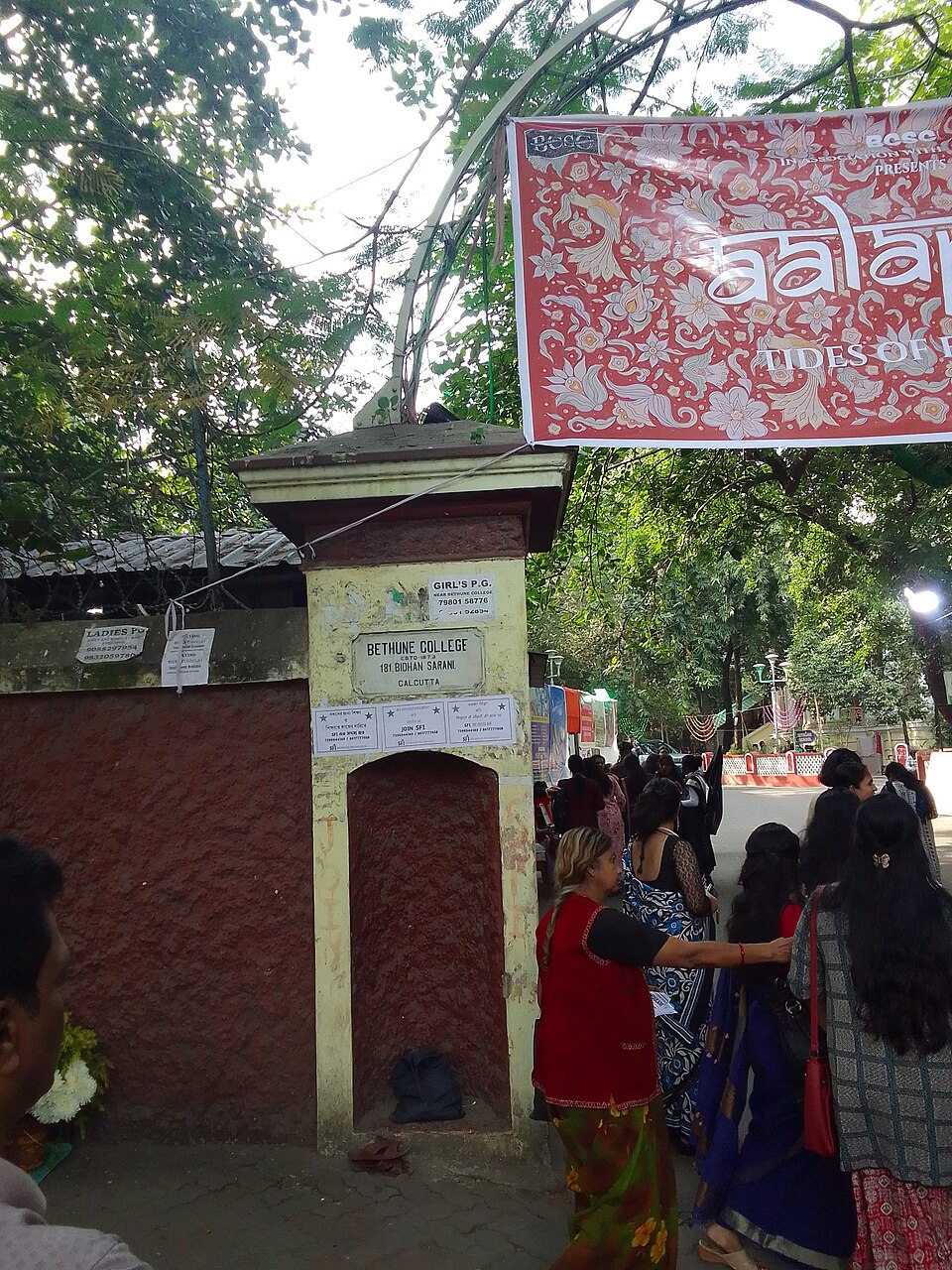
- J. E. D. Bethune founded the Calcutta Female School in 1849 with Dakshinaranjan Mukherjee's support; it began with twenty-one girls, was taken over by the government in 1856 and renamed after him in 1862-63, becoming Bethune School and Bethune College.
- Behramji Merwanji Malabari (1853-1912) circulated 'Notes on Infant Marriage and Enforced Widowhood' to about four thousand leading figures in August 1884 and publicised the Rukhmabai case of 1885 through the Indian Spectator; his campaign fed the Criminal Law Amendment Act, 1885 and the Age of Consent Act, 1891.
- Ishwar Chandra Vidyasagar's unambiguous achievement is the Hindu Widows' Remarriage Act, 1856, secured through his petition to the Legislative Council and finalised under Lord Dalhousie despite a much larger counter-petition; he joined Sanskrit College, Calcutta as Assistant Secretary in 1846 and the principalship credited to him from 1851 is standard in textbooks but is not independently attested here.
- D. K. Karve advocated and practised widow remarriage, opened a home for widows at Hingne near Pune in 1896 and a women's school there in 1907, and founded SNDT Women's University in 1916; Indian-history writing describes him as secretary of the Poona widow-remarriage association from 1893, though the exact English title printed in List-II could not be confirmed word-for-word.
- The Age of Consent Act, 1891 raised the age of consent for girls and was opposed by a section of nationalist opinion as interference in religious custom — the political fault line that made Malabari's campaign so contentious.
- Assigning the Calcutta girls' school to Vidyasagar. He was central to the Hindu Female School that became the Bethune Female School, but when Bethune himself is one of the options the school belongs to him.
- Giving Vidyasagar the anti-child-marriage crusade because he is the famous social reformer of the four. That campaign is Malabari's and leads to the Age of Consent Act, 1891.
- Confusing the Poona widow-remarriage work of D. K. Karve with the Bengal widow-remarriage campaign of Vidyasagar — both are real, a generation and a region apart.
Both examinations work this area as reformer-to-work matching or as statement pairs — who founded what, whose campaign produced which Act, who edited which paper. UPPSC favours the four-item match with a code; UPSC increasingly quotes a passage or a description and asks whom it refers to.
Who among the following was associated as Secretary with Hindu Female School which later came to be known as Bethune Female School?
- (a) Annie Besant
- (b) Debendranath Tagore
- (c) Ishwar Chandra Vidyasagar
- (d) Sarojini Naidu
Answer(c) Ishwar Chandra Vidyasagar
The very overlap that makes this match tricky — Vidyasagar was secretary of the school Bethune founded, so 'Calcutta girls' school' can point to either man depending on who else is in the list.
Consider the following statements : 1. Ishwar Chandra Vidyasagar founded the Bethune School at Calcutta with the main aim of encouraging education for women. 2. Bankim Chandra Chattopadhyay was the first graduate of the Calcutta University. 3. Keshav Chandra Sen’s campaign against Sati led to the enactment of a law to ban Sati by the then Governor General. Which of the statements given above is/are correct?
- (a) 1 only
- (b) 1 and 2
- (c) 2 and 3
- (d) 1, 2 and 3
Answer(b) 1 and 2
The same Bethune School association tested from Vidyasagar's side, and a reminder that examiners treat him as a prime mover of that school even though it bears Bethune's name.
With reference to the Age of Consent Act, 1891 consider the following statements : 1. It was Behramji Malabari, a Parsi reformer from Bombay, who advocated for this legislation. 2. The Act was supported by the extremist wing led by Bal Gangadhar Tilak. Which of the above statements is/are correct ?
- (a) Only 2
- (b) Neither 1 nor 2
- (c) Only 1
- (d) Both 1 and 2
Answer(c) Only 1
Confirms pair D-3 from the other direction — Malabari as the man behind the anti-child-marriage legislation, and the political opposition his campaign provoked.
- practice — not a real PYQ
The Age of Consent Act, 1891 owed most to the sustained public campaign of
- (a)Ishwar Chandra Vidyasagar
- (b)Behramji Merwanji Malabari
- (c)Dhondo Keshav Karve
- (d)Keshab Chandra Sen
Answer(b) Behramji Merwanji Malabari — his 'Notes on Infant Marriage and Enforced Widowhood' (1884) and the publicity he gave the Rukhmabai case drove the legislation.
- practice — not a real PYQ
Which one of the following institutions was founded by Dhondo Keshav Karve?
- (a)Bethune College, Calcutta
- (b)Sharada Sadan, Bombay
- (c)SNDT Women's University
- (d)Fergusson College, Pune
Answer(c) SNDT Women's University — founded in 1916, after his widows' home at Hingne (1896) and the school for women there (1907).