
A sample of any of the following substances disappears after sometime when exposed to air like camphor, naphthalene or dry ice. This phenomenon is called
- (a)Sublimation
- (b)Evaporation
- (c)Diffusion
- (d)Radiation
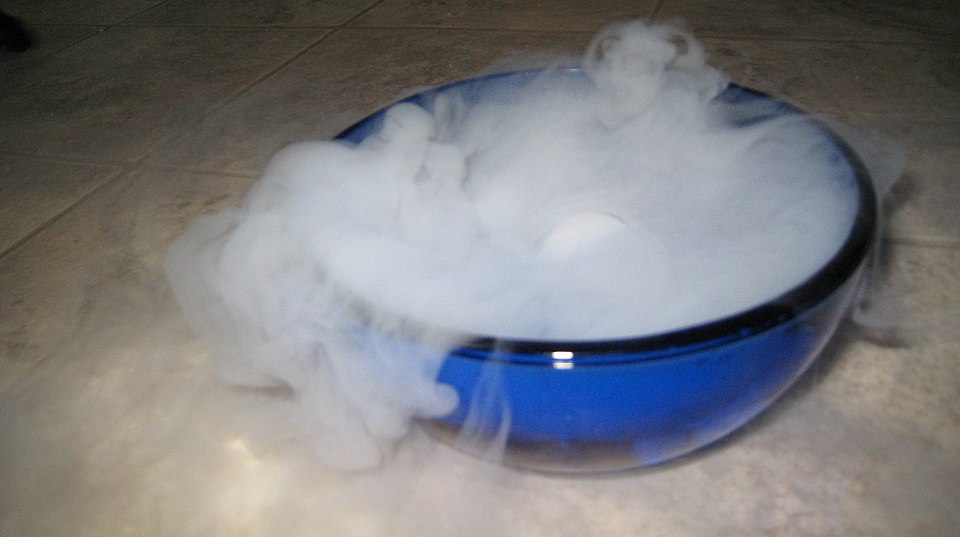
Correct — A, Sublimation. Sublimation is the direct change of a solid into vapour without any liquid stage in between. Camphor, naphthalene (the old mothball) and dry ice are the three textbook examples, and each disappears in open air without ever leaving a puddle behind. Camphor and naphthalene are molecular solids held together by weak van der Waals forces, so even at room temperature enough molecules escape from the surface for the block to shrink away. Dry ice is solid carbon dioxide, and its behaviour is decided by pressure: the triple point of CO2 lies at about 5 atmospheres, so at ordinary atmospheric pressure liquid carbon dioxide cannot exist at all — the solid must go straight to gas, which it does at about minus 78 degrees Celsius. The observation the question describes, a solid vanishing with no liquid ever forming, is the definition of sublimation.
- (b)Evaporation — Evaporation is the escape of molecules from the surface of a LIQUID into vapour below its boiling point. It needs a liquid phase to start with — water in an open glass, petrol from a spill. Camphor, naphthalene and dry ice never melt into a liquid under ordinary room conditions, so what happens to them cannot be called evaporation.
- (c)Diffusion — Diffusion is the spreading of one substance through another down a concentration gradient — it is why the smell of camphor reaches the far corner of the room. But diffusion only moves vapour that already exists; it does not convert the solid into vapour. It explains the smell, not the shrinking of the block.
- (d)Radiation — Radiation is the transfer of energy as electromagnetic waves, the way the Sun heats the Earth across empty space. It is a mode of heat transfer, not a change of state, and no material is lost from a body by radiating heat.
Matter changes state along a set of named routes: melting and freezing between solid and liquid, vaporisation and condensation between liquid and gas, and sublimation and deposition directly between solid and gas. Which route a substance takes depends on temperature and pressure together. Whether a liquid stage is even available is decided by the triple point — the unique combination of temperature and pressure at which all three phases coexist. If the surrounding pressure is below the triple-point pressure, as it is for carbon dioxide in open air, there is no liquid stage available and the solid must sublime. Substances such as camphor, naphthalene, iodine, ammonium chloride and anthracene sublime readily at ordinary pressure because their molecules are weakly held and their vapour pressure is high.
Read the clue in the question: the solid 'disappears' — nothing is said about it melting first. That single word rules out evaporation, which needs a liquid. Diffusion is the tempting distractor because you certainly smell naphthalene spreading through a cupboard, but diffusion describes the journey of the vapour after it forms, not the loss of mass from the solid. Radiation is not a phase change at all. The reverse of sublimation, vapour turning straight back into solid, is called deposition — that is how frost forms on a cold window and how the white ring of ammonium chloride reappears at the top of a test tube.
- Sublimation: solid changes directly into vapour without becoming liquid. The reverse process, vapour to solid, is called deposition.
- Common subliming solids: camphor, naphthalene, iodine, ammonium chloride, anthracene and dry ice.
- Dry ice is solid carbon dioxide; because the triple point of CO2 is at about 5 atmospheres, liquid CO2 cannot exist at atmospheric pressure and the solid sublimes at roughly minus 78 degrees Celsius.
- Sublimation absorbs latent heat, so dry ice cools without wetting — hence its use for transporting frozen food and medical material, and for stage fog.
- Sublimation is used in the laboratory to purify camphor, iodine or ammonium chloride by separating them from non-volatile impurities such as sand or salt.
- Freeze-drying (lyophilisation) of instant coffee, food and vaccines works by sublimating the ice out of a frozen sample under vacuum; in cold dry mountain air, snow and glacier ice lose mass the same way.
- Calling it evaporation. Evaporation begins from a liquid surface; here there is never any liquid.
- Choosing diffusion because you can smell the substance. Diffusion spreads the vapour that sublimation has already produced.
- Assuming every solid melts before it vaporises. Under ordinary atmospheric pressure some solids, dry ice above all, have no liquid stage available at all.
State PCS papers ask for the name of the phenomenon or for a list of substances that sublime; UPSC prefers the application — freeze-drying, dry ice in cold chains, or separating a mixture — but the underlying idea is the same solid-to-vapour route.
No directly related past PYQ was found.
- practice — not a real PYQ
The direct change of a vapour into a solid, without passing through the liquid state, is called
- (a)Condensation
- (b)Deposition
- (c)Fusion
- (d)Vaporisation
Answer(b) Deposition — it is the reverse of sublimation, and it is how frost forms directly on a cold surface from water vapour in the air.
- practice — not a real PYQ
Freeze-drying, used to make instant coffee and to preserve vaccines, depends mainly on
- (a)Sublimation of ice under reduced pressure
- (b)Boiling of water at high pressure
- (c)Diffusion of gases through a membrane
- (d)Radiation of heat from the sample
Answer(a) Sublimation of ice under reduced pressure — the sample is frozen and the pressure lowered so the ice turns straight to vapour, leaving the solid material dry and its structure intact.