
Match List - I with List - II and select the correct answer from the codes given below the lists : List - I A. Kevlar B. Taxol C. Zinc Phosphide D. Nitrocellulose List - II 1. Explosive 2. Synthetic fibre 3. Anticancer drug 4. Rodenticide Codes :
- (a)A-2, B-4, C-3, D-1
- (b)A-2, B-3, C-4, D-1
- (c)A-4, B-3, C-1, D-2
- (d)A-3, B-1, C-2, D-4
Correct — B, A-2, B-3, C-4, D-1. Kevlar is a synthetic fibre: an aramid (aromatic polyamide) developed by Stephanie Kwolek at DuPont in 1965, whose stiff, closely packed polymer chains make it, weight for weight, stronger than steel — hence its use in bullet-resistant vests, helmets, ropes and tyre reinforcement. Taxol (paclitaxel) is an anticancer drug, originally isolated from the bark of the Pacific yew and used against ovarian, breast and lung cancers; it works by locking microtubules in place so that a dividing cell cannot pull its chromosomes apart. Zinc phosphide is a rodenticide: eaten in bait, it meets the acid of the rodent's stomach and releases the highly toxic gas phosphine. Nitrocellulose is an explosive — 'guncotton', made by nitrating cotton or wood cellulose with nitric and sulphuric acid, and the basis of smokeless propellant powders. Only option (b) puts all four in their right places.
- (a)A-2, B-4, C-3, D-1 — This is the near-miss and the intended trap: it gets Kevlar and nitrocellulose right but swaps the middle pair, making Taxol a rodenticide and zinc phosphide an anticancer drug. Taxol is a plant-derived chemotherapy agent; zinc phosphide is a rat poison and has no medical use.
- (c)A-4, B-3, C-1, D-2 — Only Taxol is placed correctly. Kevlar becomes a rodenticide, zinc phosphide an explosive and nitrocellulose a synthetic fibre — all wrong. (Nitrocellulose was in fact used for the very first artificial silk in the 1880s, but in exam terms it is the explosive, and the fibre in this list is Kevlar.)
- (d)A-3, B-1, C-2, D-4 — Every pairing is wrong. It turns Kevlar into a drug, Taxol into an explosive, zinc phosphide into a fibre and nitrocellulose into a rat poison — a shuffled option that can be eliminated the moment you know any one of the four substances.
This is a 'substance to use' matching question, the commonest chemistry format in state PCS papers. The four items are drawn from four different applied fields — polymer engineering, pharmacology from natural products, pest control and explosives chemistry — so no single subject textbook covers all of them. What makes them memorable is that each name carries its own clue: Kevlar belongs to the aramid family of high-strength fibres; Taxol takes its name from the genus Taxus, the yew; zinc phosphide is a phosphide, and phosphides release phosphine on contact with acid; nitro- prefixes in organic chemistry (nitroglycerine, trinitrotoluene, nitrocellulose) almost always signal an explosive.
In a four-pair matching question you rarely need all four facts. Fix the one you are surest of and eliminate. If you know only that Taxol is an anticancer drug, options (a) and (d) fall away at once; if you also know Kevlar is a fibre, only (b) survives. That habit — anchor on the certain pair, then eliminate — is worth more marks in the exam hall than trying to recall every item.
- Kevlar is an aramid (aromatic polyamide) fibre developed at DuPont in 1965 by Stephanie Kwolek; it is used in body armour, helmets, ropes and tyre reinforcement.
- Taxol (paclitaxel) is an anticancer drug first obtained from the bark of the Pacific yew, Taxus brevifolia; it stabilises microtubules and so blocks cell division.
- The Himalayan yew, Taxus wallichiana, is India's source of the same compound and is a threatened species, which is why unregulated bark collection is a conservation concern.
- Zinc phosphide is a rodenticide; in the stomach's acid it liberates phosphine (PH3), which is the actual poison. Aluminium phosphide tablets work the same way as a grain fumigant.
- Nitrocellulose, or guncotton, is made by nitrating cellulose; besides its use as a propellant and explosive it was the base of early photographic film and of celluloid — notoriously inflammable.
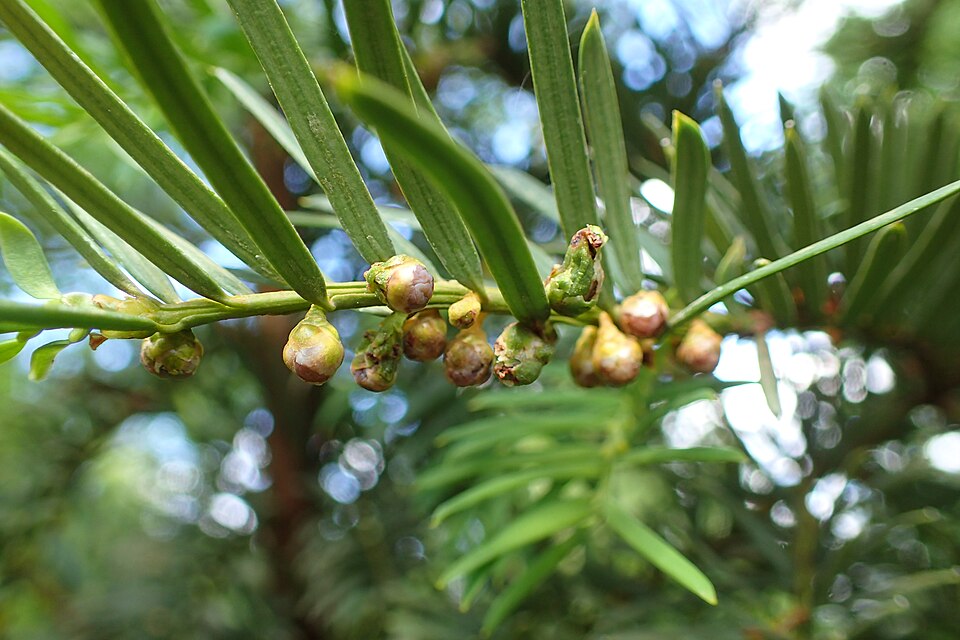
- Confusing Taxol (an anticancer drug) with a toxin because the yew tree itself is poisonous.
- Swapping zinc phosphide and Taxol, which is exactly what the near-miss option (a) does.
- Assuming that anything called a 'nitro' compound must be a fertiliser. Nitrates fertilise; nitrate ESTERS like nitrocellulose (cellulose nitrate) and nitroglycerine (glyceryl trinitrate) explode. Note the chemistry: these are R-O-NO2 esters, not true nitro compounds - a nitro compound has the nitrogen bonded straight to carbon (C-NO2), as in TNT.
Both commissions use the substance-to-use matching format; UPPSC repeats the same substances across papers (zinc phosphide appeared again in 2020), while UPSC prefers to build a statement question around one of them, such as the Taxus tree and taxol.
Consider the following statements: 1. The Taxus tree naturally found in the Himalayas. 2. The Taxus tree is listed in the Red Data Book. 3. A drug called “taxol” is obtained from Taxus tree is effective against Parkinson’s disease. Which of the statements given above is/are correct?
- (a) 1 only
- (b) 1 and 2 only
- (c) 2 and 3 only
- (d) 1, 2 and 3
Answer(b) 1 and 2 only
UPSC tested the very same fact from the other side — statement 3 is false precisely because taxol is an anticancer drug, not a Parkinson's drug, which is what List-II pairs it with here.
Match List-I with List-II and select the correct answer from the codes given below the lists: List-I (Substance) A. Blue Vitriol B. Eosin C. Silver iodide D. Zinc phosphide List-II (Use) 1. Artificial rain 2. Fungicide 3. Red ink 4. Rodenticide
- (a) A-2, B-3, C-4, D-1
- (b) A-2, B-1, C-3, D-4
- (c) A-2, B-3, C-1, D-4
- (d) A-2, B-4, C-1, D-3
Answer(c) A-2, B-3, C-1, D-4
The identical substance-to-use format from the very next UPPSC paper, and it repeats zinc phosphide with the same tag — rodenticide. Learning this small chemistry list pays off across UPPSC years.
- practice — not a real PYQ
The anticancer drug Taxol (paclitaxel) is obtained from which of the following?
- (a)The bark of the yew tree (Taxus)
- (b)The bark of the cinchona tree
- (c)The latex of the opium poppy
- (d)The roots of sarpagandha
Answer(a) The bark of the yew tree (Taxus) — cinchona gives quinine, the opium poppy gives morphine and sarpagandha gives reserpine.
- practice — not a real PYQ
Zinc phosphide acts as a rodenticide because inside the rodent's stomach it releases
- (a)Phosphine gas
- (b)Hydrogen sulphide
- (c)Carbon monoxide
- (d)Chlorine
Answer(a) Phosphine gas — the stomach acid reacts with the phosphide to liberate PH3, which is the actual toxic agent; aluminium phosphide fumigation tablets work on the same reaction with moisture.