
The phenomenon used in optical fibre for transmission of light energy is
- (a)Total internal reflection
- (b)Diffraction
- (c)Scattering
- (d)Refraction
Correct — A, Total internal reflection. An optical fibre is a thin thread of glass or plastic built in two layers: an inner core of higher refractive index and an outer cladding of lower refractive index. Light that enters the fibre within its acceptance cone strikes the core-cladding boundary at an angle greater than the critical angle for that pair of media. At such angles no light is refracted out into the cladding; the entire beam is thrown back into the core. Repeating this thousands of times, the signal zig-zags along the fibre — even round bends — with very little loss, which is why fibre carries telephone and internet traffic across continents and under oceans. The confinement is total, and that is precisely what the word 'total' in total internal reflection means: unlike an ordinary mirror, which absorbs a few per cent at every bounce, this reflection returns all the light.
- (b)Diffraction — Diffraction is the bending and spreading of waves as they pass an obstacle or a narrow opening — it explains the coloured bands on a CD, the pattern from a grating and the limit on a telescope's resolving power. It plays no part in guiding light down a fibre.
- (c)Scattering — Scattering is the redirection of light by particles or molecular irregularities, as in the blue sky and the red sunset. In a fibre scattering is actually the enemy: residual scattering inside the glass is one of the main causes of signal loss, so fibres are manufactured to minimise it, not to rely on it.
- (d)Refraction — This is the intended trap, and it is half-right for the wrong reason. Refraction — the bending of light when it crosses between media of different refractive index — is what happens as light enters the fibre's end face, and the difference in refractive index between core and cladding is what makes total internal reflection possible at all. But if light were merely refracted at the core-cladding wall it would pass out of the fibre and be lost. Transmission along the fibre works because refraction is prevented and the light is totally reflected.
When light travels from an optically denser medium to a rarer one, it bends away from the normal. Increase the angle of incidence and the refracted ray bends further, until at one particular angle — the critical angle — it grazes along the boundary itself. Beyond that angle, refraction is impossible and all the light is reflected back into the denser medium. That is total internal reflection, and it requires two conditions together: the light must be going from denser to rarer, and the angle of incidence must exceed the critical angle. The critical angle depends on the pair of media: roughly 42 degrees for ordinary glass to air, about 48.6 degrees for water to air, and only about 24.4 degrees for diamond to air, which is why a cut diamond traps and returns so much of the light entering it.
The phrase 'transmission of light energy' in the question is the clue. Ask what has to happen at the wall of the fibre for the signal to keep going: the light must not be allowed to leak out. Refraction lets light out, scattering throws it sideways, diffraction merely spreads a wavefront. Only total internal reflection keeps every bit of the beam inside. The same phenomenon explains endoscopes, the shimmering fibre lamps sold at fairs, right-angled prisms in periscopes and binoculars, the sparkle of a diamond, and the shimmering false water of a road mirage.
- Total internal reflection needs two conditions: light travelling from a denser to a rarer medium, and an angle of incidence greater than the critical angle.
- An optical fibre has a core of higher refractive index surrounded by a cladding of lower refractive index; the light bounces along the core by repeated total internal reflection.
- Approximate critical angles with air: diamond about 24.4 degrees, ordinary glass about 42 degrees, water about 48.6 degrees.
- Fibre-optic communication carries far more information than copper, is immune to electromagnetic interference and loses very little signal over long distances — it is the backbone of undersea cables and of India's rural broadband network.
- Other everyday examples of total internal reflection: endoscopy and laparoscopy, the brilliance of a cut diamond, the optical mirage on a hot road, and the right-angled prisms used in periscopes and binoculars.
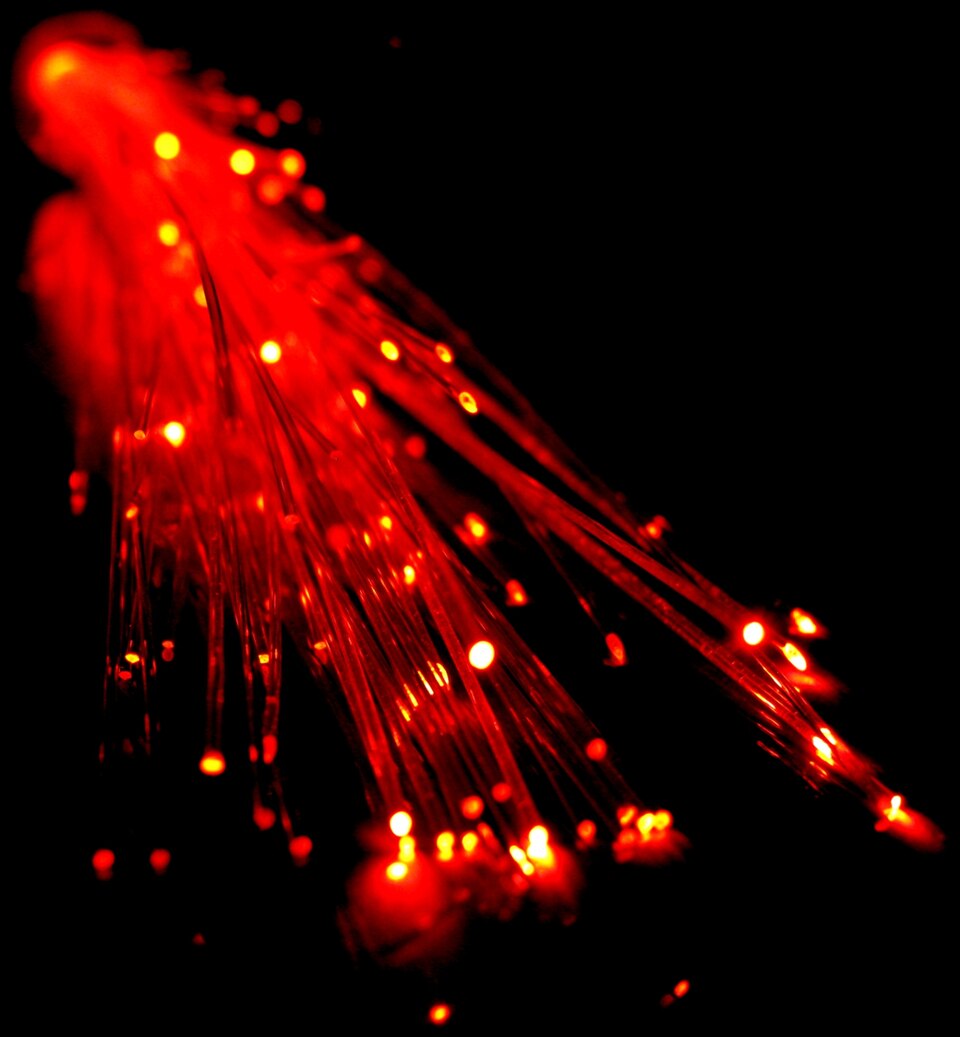
- Choosing refraction because refractive index is involved. Refraction is the mechanism that is being prevented at the fibre wall, not the one doing the transmitting.
- Forgetting the denser-to-rarer condition. Total internal reflection cannot occur when light goes from air into glass or water.
- Mixing up scattering and diffraction with total internal reflection. Scattering explains the blue sky; diffraction explains the colours on a CD.
This is one of the most repeated one-liners in Indian competitive exams. UPSC has asked it directly as 'optical fibre works on the principle of', and again through endoscopy; UPPSC keeps to the direct form, so learn the phrase 'total internal reflection' with its two conditions attached.
Optical fibre works on the principle of
- (a) total internal reflection
- (b) refraction
- (c) scattering
- (d) interference
Answer(a) total internal reflection
Word for word the same question, asked by UPSC decades earlier — and with the same refraction and scattering distractors. Proof that this one-liner is worth locking down permanently.
Endoscopy, a technique used to explore the stomach or other inner parts of the body is based on the phenomenon of
- (a) total internal reflection
- (b) interference
- (c) diffraction
- (d) polarisation
Answer(a) total internal reflection
The same principle wearing an application's clothes — an endoscope is a bundle of optical fibres, so the phenomenon that carries light down it is exactly the one this question asks about.
Total internal reflection can take place when light travels from
- (a) diamond to glass
- (b) water to glass
- (c) air to water
- (d) air to glass
Answer(a) diamond to glass
The condition behind the phenomenon: light must pass from the denser medium to the rarer one. Knowing this is what lets you rule out refraction as the fibre's transmitting mechanism.
- practice — not a real PYQ
Total internal reflection of light can take place only when light travels
- (a)from a denser medium to a rarer medium at an angle greater than the critical angle
- (b)from a rarer medium to a denser medium at any angle
- (c)from a denser medium to a rarer medium at an angle smaller than the critical angle
- (d)along the normal to the boundary of two media
Answer(a) from a denser medium to a rarer medium at an angle greater than the critical angle — both conditions must hold together; light entering glass from air can never undergo total internal reflection at that surface.
- practice — not a real PYQ
The brilliance and sparkle of a properly cut diamond is chiefly due to
- (a)Total internal reflection
- (b)Interference of light
- (c)Polarisation of light
- (d)Absorption of light
Answer(a) Total internal reflection — diamond's very high refractive index gives it a critical angle of only about 24 degrees, so light entering the stone is repeatedly reflected inside before escaping through the top facets.