
Match List-I with List-II and select the correct answer from the codes given below the lists: List-I (Substance) A. Blue Vitriol B. Eosin C. Silver iodide D. Zinc phosphide List-II (Use) 1. Artificial rain 2. Fungicide 3. Red ink 4. Rodenticide
- (a)A-2, B-3, C-4, D-1
- (b)A-2, B-1, C-3, D-4
- (c)A-2, B-3, C-1, D-4
- (d)A-2, B-4, C-1, D-3
Correct — C, A-2, B-3, C-1, D-4. Blue Vitriol (copper sulphate pentahydrate, CuSO4·5H2O) is a fungicide — it is the copper source in Bordeaux mixture sprayed on crops and vines (A-2). Eosin is a bright red synthetic dye used to make red ink (and as a biological stain), so it maps to red ink (B-3). Silver iodide is seeded into clouds to trigger artificial rain: its crystal lattice resembles that of ice, so it nucleates ice crystals that grow into raindrops (C-1). Zinc phosphide is a rodenticide (rat poison) — in the rodent's acidic stomach it releases toxic phosphine gas (D-4). Only option (c) maps all four correctly.
- (a)A-2, B-3, C-4, D-1 — It swaps C and D — silver iodide is used for artificial rain (not as a rodenticide), and zinc phosphide is a rodenticide (not for artificial rain). Only its A-2 and B-3 are right.
- (b)A-2, B-1, C-3, D-4 — It wrongly makes Eosin the artificial-rain agent and Silver iodide the red ink. In fact Eosin is the red dye (red ink) and Silver iodide is the cloud-seeding agent (artificial rain).
- (d)A-2, B-4, C-1, D-3 — It wrongly makes Eosin a rodenticide and Zinc phosphide the red ink. Eosin is the red dye, while Zinc phosphide is the rodenticide (rat poison).
Several chemicals are known better by common/trade names than by their formulae, and each has a signature use. 'Blue Vitriol' is copper sulphate pentahydrate (CuSO4·5H2O), a fungicide (the copper in Bordeaux mixture). Eosin is a red dye used in red ink and in histological staining. Silver iodide (AgI) is the classic cloud-seeding agent for artificial rain because its crystal structure mimics ice. Zinc phosphide (Zn3P2) is a rodenticide that liberates poisonous phosphine gas in the stomach.
Every option already fixes A-2 (Blue Vitriol = fungicide), so the real work is placing the other three. Eosin is a red dye, so it goes to red ink; that immediately kills options (b) and (d). Between silver iodide and zinc phosphide, remember silver iodide 'seeds' clouds for rain while zinc PHOSPHide releases PHosphine to kill pests — so silver iodide = artificial rain and zinc phosphide = rodenticide, which fixes option (c).
- Blue Vitriol = copper sulphate pentahydrate (CuSO4·5H2O); a fungicide — the copper source in Bordeaux mixture (CuSO4 + slaked lime)
- Eosin = a red synthetic dye; used in red ink and as a biological (H&E) stain
- Silver iodide (AgI) → cloud seeding for artificial rain (ice-like crystal nucleates raindrops)
- Zinc phosphide (Zn3P2) → rodenticide; releases toxic phosphine (PH3) on contact with stomach acid
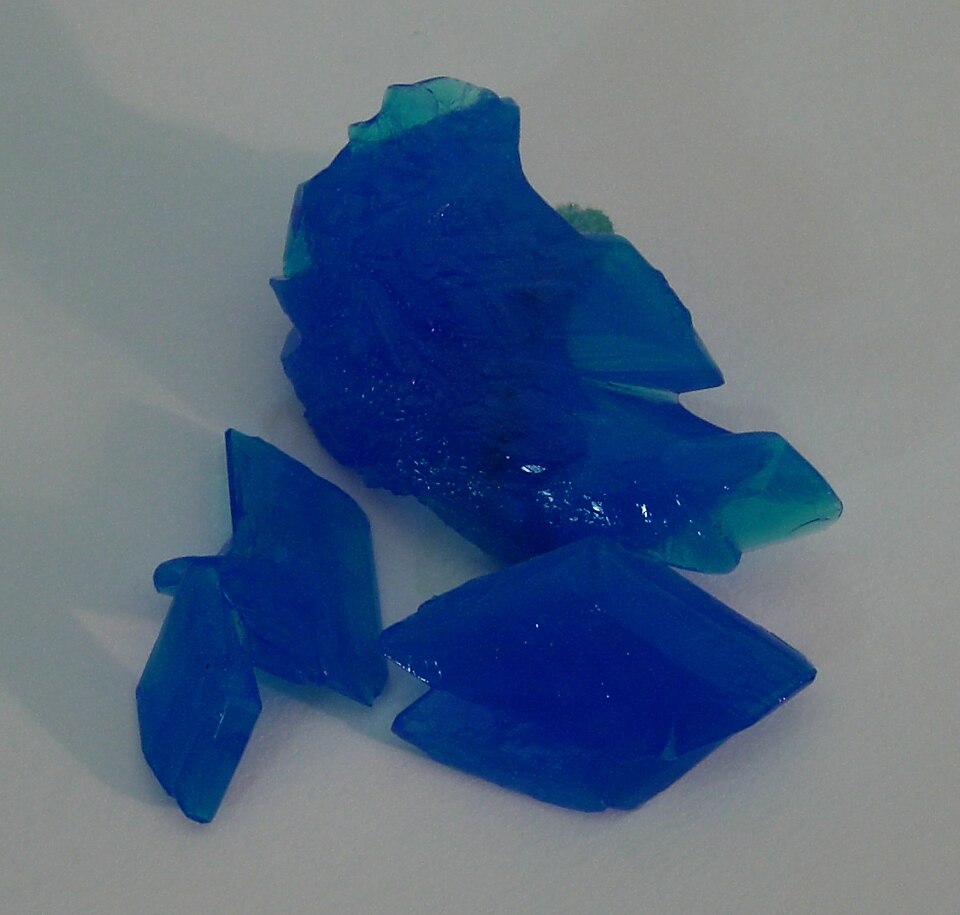
- Confusing green vitriol (ferrous sulphate) or white vitriol (zinc sulphate) with blue vitriol (copper sulphate)
- Swapping silver iodide (artificial rain) with zinc phosphide (rat poison)
UPPSC/UPSC ask you to match a chemical's common name with its formula or use — the reliable route is to fix the compound's identity (blue vitriol = CuSO4) and then attach its signature application.
Match List I (I. Blue vitriol, II. Epsom salt, III. Baking soda, IV. Caustic soda) with List II (A) Sodium bicarbonate, B) Sodium hydroxide, C) Magnesium sulphate, D) Copper sulphate) and select the correct answer.
- (a) I-C, II-D, III-B, IV-A
- (b) I-D, II-C, III-A, IV-B
- (c) I-C, II-D, III-A, IV-B
- (d) I-D, II-A, III-B, IV-A
Answer(b) I-D, II-C, III-A, IV-B — Blue vitriol = Copper sulphate, Epsom salt = Magnesium sulphate, Baking soda = Sodium bicarbonate, Caustic soda = Sodium hydroxide.
Same concept — matching chemicals by common name. It explicitly tests 'Blue vitriol = Copper sulphate', the very identity (CuSO4) that anchors the fungicide match in this UPPSC question.
An aqueous solution of copper sulphate is acidic in nature because the salt undergoes
- (a) dialysis
- (b) electrolysis
- (c) hydrolysis
- (d) photolysis
Answer(c) hydrolysis — CuSO4 (strong acid + weak base salt) undergoes cationic hydrolysis, releasing H+ and making the solution acidic.
Same substance — copper sulphate (blue vitriol). It reinforces the identity and behaviour of the compound whose fungicidal use (A-2) is the fixed match in this question.
- practice — not a real PYQ
Which of the following is commonly used as a nucleating agent for cloud seeding (artificial rain)?
- (a)Silver iodide
- (b)Zinc phosphide
- (c)Blue vitriol
- (d)Eosin
Answer(a) Silver iodide — its ice-like crystal structure nucleates ice crystals in clouds, triggering rain. - practice — not a real PYQ
'Green Vitriol' is the common name of which of the following?
- (a)Ferrous sulphate (FeSO4·7H2O)
- (b)Copper sulphate (CuSO4·5H2O)
- (c)Zinc sulphate (ZnSO4·7H2O)
- (d)Magnesium sulphate (MgSO4·7H2O)
Answer(a) Ferrous sulphate — green vitriol is FeSO4·7H2O; copper sulphate is blue vitriol and zinc sulphate is white vitriol.