
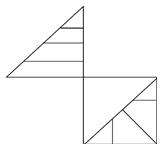
How many triangles are there in the figure given below?
- (a)8
- (b)10
- (c)12
- (d)14
Answer
Why
Correct — B. Split the figure at the long horizontal, count each half, then add.
Left half is a right triangle cut by three lines parallel to its base.
Each parallel closes a triangle with the apex above it: 3.
The base closes the whole triangle: 1. Left half = 4.
Right half is a rectangle split corner to corner by a diagonal.
Above the diagonal the region is empty: 1 triangle.
Below it, the lower half is itself a triangle: 1.
The slanting spur to the far bottom corner cuts that lower half in two: 2 more.
The horizontal spur closes a small triangle at the top: 1.
The vertical spur closes a small triangle at the bottom left: 1. Right half = 6.
4 + 6 = 10, which is option (b).
Why the others are wrong
- (a)8 — 8 falls two short. It is what you get by taking the four apex triangles on the left and the four largest on the right, missing the two small ones the horizontal and vertical spurs cut off.
- (c)12 — 12 over-counts by two. Below the diagonal on the right sit exactly two four-sided cells; sweep those in with the triangles and 10 becomes 12. A region counts only when three drawn lines close it.
- (d)14 — 14 overshoots by four, and the drawing does not support it — a cell-by-cell tally of the whole figure yields only nine regions. With the left half fixed at four and the right at six, there is nothing further to find.
Concept
Counting figures is bookkeeping, not spotting. Two habits keep it honest.
First, split the figure at any line no triangle can cross. The long horizontal here separates the left triangle from the right rectangle completely, so the two counts are independent and simply add.
Second, count by generating line rather than by eye. On the left every triangle shares the apex, so there is exactly one per parallel plus one for the base. On the right, name the three spurs off the diagonal and see what each of them closes.
A region is a triangle only when three drawn lines close it. Trapeziums are what inflate a count.
The keyed count of 10 is what the drawn lines support: four on the left, six on the right. Count the four-sided bands as well and you reach a larger figure, which is why the options run 8, 10, 12, 14.
Key facts
- The left half contributes four triangles, one for each of the three parallels plus the whole.
- Lines parallel to a triangle's base create no triangles among themselves, only nested ones sharing the apex.
- The right half contributes six: one above the diagonal and five below it.
Study next
Common traps
- Counting each visible cell once and assuming every cell is a triangle
- Missing the large triangles that are made of several cells together
- Counting across the join between the two halves, where no third closing line exists
The task is constant; the wording is not. This item asks it as 'How many triangles are there in the figure given below?'
'How many triangles are there in the given figure?' is the form at Reasoning Q.1 on 9 Sep 2024 (12:30), Reasoning Q.8 on 9 Sep 2024 (16:00) and Reasoning Q.5 on 17 Sep 2024 (09:00).
'In the figure shown below' is a third variant, at Reasoning Q.17 on 18 Sep 2024 (09:00).
Related PYQs
No directly related past PYQ was found.