
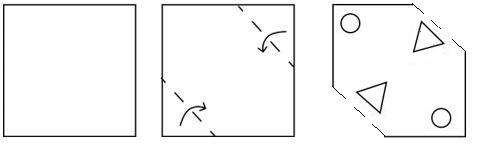
A sheet of paper is folded along the dotted line successively along the directions shown and is then punched in the last. How would this paper look when unfolded?
- (a)
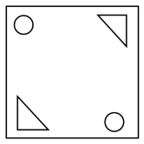
- (b)
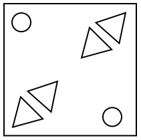
- (c)
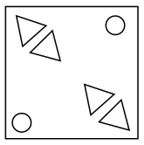
- (d)
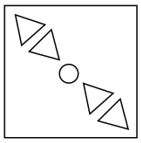
Answer
Why
Correct — B. Only the punches that landed on a folded flap are doubled.
Rule: a punch through two layers opens two holes, and the second is the mirror image of the first in the crease it was folded along.
Both creases here are corner folds. The top-right corner is turned inward, then the bottom-left corner is turned inward, leaving a six-sided sheet.
The two circles sit on plain single-layer paper, so each stays one circle. Both triangles sit on folded-over flaps, so each opens into a mirrored pair straddling its own crease.
Unfolded that is two circles and four triangles, arranged as option (b) shows.
Why the others are wrong
- (a)Leaves both triangles single. That is the picture for a sheet punched flat — it ignores the two layers under each triangle where the corner had been folded over.
- (c)Carries the right inventory of two circles and four triangles but in the wrong corners, with circles where the triangle pairs belong. Unfolding reflects a punch across its own crease, it does not move it to the opposite side of the sheet.
- (d)Puts a single circle at the centre and stacks all four triangles along one diagonal. The folded sheet plainly shows two separate circles well away from the middle.
Concept
Paper folding and punching is a mirror problem worked backwards, one crease at a time, in the reverse of the folding order.
Ask of every punch: how many layers is it sitting on? A punch on plain single paper stays one hole. A punch on a folded-over flap goes through two, and unfolding reflects the extra hole across that crease.
Here the two creases cut off opposite corners, so the folded sheet is a hexagon. The triangles lie inside the flap regions and the circles do not — which is the whole question.
Counting marks first is still worth doing. Two circles and four triangles rules out any picture with a different tally.
The stem here reads 'A sheet of paper' where the same item elsewhere prints 'A square sheet of paper'. The first panel settles it — the sheet drawn is a square.
Key facts
- A punch through two layers opens two holes when the sheet is unfolded.
- The extra hole is the reflection of the original in the crease, not a copy shifted sideways.
- The folded sheet carries four punches, two circles and two triangles, so the flat sheet carries six marks.
Study next
Common traps
- Doubling every punch, including those that never sat on a flap
- Sliding the extra hole across the sheet instead of reflecting it in the crease
- Deciding on the count of marks alone, when a wrong option can carry the right tally in the wrong corners
The near-identical wording 'A square sheet of paper is folded along the dotted line successively along the directions shown and is then punched in the last' opens Reasoning Q.23 on 13 Sep 2024 (09:00), Reasoning Q.4 on 18 Sep 2024 (09:00) and Reasoning Q.6 on 23 Sep 2024 (12:30).
The stem drifts a little — this item drops the word square, and Reasoning Q.20 on 9 Sep 2024 (12:30) reads 'the dotted lines successively in the directions shown' — but the task behind it does not change.
Related PYQs
No directly related past PYQ was found.