
Six numbers 5, 3, 6, 7, 9 and 2 are written on different faces of a dice. Two positions of this dice are shown in the figure below. Find the number on the face opposite to the one having 5.
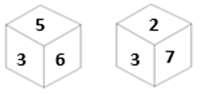
- (a)2
- (b)9
- (c)3
- (d)6
Answer
Why
Correct — A. The face 3 shows in both views, so the cube has only been turned about it.
Rule: rotate about a shared face and the other four faces run round it in one fixed cycle.
View 1 shows top 5 and right 6, so 5 is followed by 6 round that axis.
View 2 shows top 2 and right 7, so 2 is followed by 7.
Stitching the two pairs gives the loop 5 → 6 → 2 → 7 → 5.
In a loop of four, opposite faces sit two steps apart. So 5 pairs with 2 and 6 pairs with 7, leaving 3 opposite 9.
The face opposite 5 is therefore 2 — option (a).
Why the others are wrong
- (b)9 — 9 is opposite 3, not opposite 5. It never appears in either view, which is exactly the signature of the partner of the face that shows in both.
- (c)3 — 3 is drawn beside 5 in view 1, so the two meet along an edge. Faces that are visible together in a single view can never be opposite each other.
- (d)6 — 6 sits next to 5 in view 1 and is therefore adjacent. In the loop round the 3-axis, 6 is two steps from 7, so 7 is its opposite.
Concept
Two views of a dice are read through what they share. Here 3 appears in both, so nothing has changed except a turn about the 3-face and its hidden partner.
Four faces ride round that axis — 5, 6, 2 and 7 — and each view hands you a consecutive pair of them: 5 then 6, and 2 then 7. Join the pairs into one loop and you get 5, 6, 2, 7.
In a loop of four, a face's opposite is the one two steps away. That gives 5 with 2 and 6 with 7, and the axis pair is 3 with 9 — the only number never shown.
Only two views are given, so the cube is not fully pinned down by inspection alone. The shared 3 supplies the axis, and that is enough to fix all three opposite pairs.
Key facts
- A face visible alongside another in the same view can never be opposite it.
- Four faces surround any chosen axis, and in that four-cycle opposite faces sit two steps apart.
- The three pairs here are 5 with 2, 6 with 7, and 3 with 9.
Study next
Common traps
- Assuming the two views show the shared face in the same orientation because both display a 3
- Reading the two pairs in opposite rotational senses and stitching the loop backwards
- Answering 9 because it is the number never shown, when 9 is opposite 3 rather than 5
The stem is a template with the six symbols swapped — 'Six letters ... are written on different faces of a dice.
Two positions of this dice are shown' opens Reasoning Q.3 on 9 Sep 2024 (09:00) and Reasoning Q.12 on 10 Sep 2024 (09:00). A three-view version, which fixes the cube outright, is at Reasoning Q.18 on 9 Sep 2024 (09:00).
Related PYQs
No directly related past PYQ was found.