
A paper is folded and cut as shown below. How will it appear when unfolded?
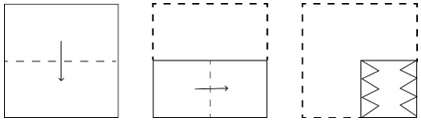
- (a)
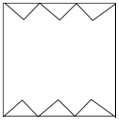
- (b)
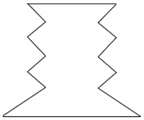
- (c)
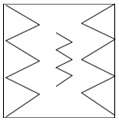
- (d)
Answer
Why
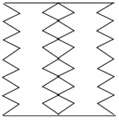
Correct — D. Work the two folds backwards.
Rule: every unfold mirrors the packet across the crease it was folded on.
The first fold brings the top half down, the second brings the left half across to the right, so the packet is the bottom-right quarter — its left edge and its top edge are creases.
The cuts are triangular notches biting into the packet's left edge (the vertical crease) and into its right edge (the sheet's own border).
Undo the vertical fold: the crease-side notches meet their mirror images and close into a column of diamonds on the centre line, while the border notches reappear on the far left edge.
Undo the horizontal fold and the whole pattern repeats above the centre.
A zigzag down each side edge and a diamond chain down the middle — option (d).
Why the others are wrong
- (a)The zigzags here sit on the top and bottom edges. The cuts run down the packet's two vertical edges, and unfolding reflects them sideways and upwards — it never lays a vertical cut on its side.
- (b)There is no diamond chain on the centre line. A notch cut into the vertical crease must reappear mirrored on the other side of that crease, and two facing triangles close into a diamond.
- (c)The centre carries a single zigzag line, not closed diamonds, and it stops short of the top and bottom edges. Facing crease notches meet in pairs, and the cut runs the packet's full height.
Concept
A paper-cutting item is two questions in one: where the packet ends up, and what a cut through it means.
Fold the sheet in your head and mark which edges of the packet are creases and which are raw borders. A notch cut on a crease opens into a closed hole; a notch cut on a border stays a notch on the border.
Each fold you undo doubles the pattern by reflecting it in that crease, so two folds leave four copies of every cut.
The third box draws the packet solid in the bottom-right with the rest of the sheet dashed. That dashed outline is what tells you which quarter survived, and therefore which two of its edges are creases.
Key facts
- The first fold is horizontal (top down) and the second vertical (left across), leaving the bottom-right quarter as the packet.
- A notch cut into a crease opens into a closed shape when that fold is undone.
- A notch cut into a raw outer edge stays a notch on the finished sheet's border.
- Two folds mean every cut appears four times on the opened sheet.
Study next
Common traps
- Unfolding in the order the folds were made instead of reversing that order.
- Reading the two crease-side notches as separate holes rather than halves of one diamond.
- Picking a figure whose cut shapes are right but which places them on the wrong pair of edges.
This shift also sets a picture series at Reasoning Q.18 and Q.20, and the mirror-at-MN stem at Reasoning Q.7 and Q.23. A folding item asks you to apply a reflection; those ask you to recognise one.
Related PYQs
No directly related past PYQ was found.