
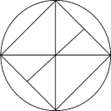
How many triangles are there in the given figure?
- (a)16
- (b)12
- (c)10
- (d)14
Answer
Why
Correct — B. Label the points first. O is the centre and T, R, B, L are the square's top, right, bottom and left corners. The slanting line runs from P, the midpoint of side TR, through O to Q, the midpoint of side LB.
Count in size order:
Upper-right quadrant, cut by OP: OTP, OPR and the whole OTR = 3
Lower-left quadrant, cut by OQ: OLQ, OQB and the whole OLB = 3
Upper-left and lower-right quadrants, uncut: OTL and ORB = 2
Half-square triangles standing on a full diameter: TLB, TRB, LTR, LBR = 4
3 + 3 + 2 + 4 = 12 → option (b).
Why the others are wrong
- (a)16 — 16 is the count for a figure carrying both diagonals. Only one slanting line crosses the centre here; drawing the other would split the upper-left and lower-right quadrants too and add exactly four more.
- (c)10 — 10 drops the two quadrants the slanting line divides. OTR and OLB are triangles in their own right as well as being made of two smaller ones each.
- (d)14 — 14 counts two figures that are not triangles. Inside the half-square TRB the slanting line leaves the piece PRBO, and that has four sides.
Concept
Counting triangles is bookkeeping, not spotting. Name every intersection, then count by size: the smallest regions first, then the ones built from two of them, then from four.
The circle is scenery. An arc cannot be a triangle's side, so it only fixes where the square's corners sit.
Working quadrant by quadrant is what stops the double counting that costs the mark.
The square's corners lie on the circle at the top, right, bottom and left, so the square's own diagonals are the two diameters and the four quadrants are congruent.
Key facts
- A triangle needs three straight sides, so an arc of the circle can never close one.
- Each of the four half-square triangles uses two sides of the square and one full diameter.
- The slanting line ends at the midpoints of sides TR and LB and never reaches a corner.
Study next
Common traps
- Logging a four-sided piece as a triangle because a slanting line cuts across it.
- Assuming symmetry and doubling one quadrant's count when only two of the four are divided.
- Supplying the second diagonal the figure does not draw, which lifts the count to 16.
SSC builds figure-counting items on a skeleton like this one, where the extra line is short and easy to miss. Trace every line to both of its endpoints before you start counting.
Related PYQs
No directly related past PYQ was found.