
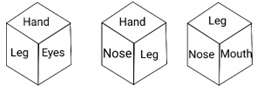
Six words Hand, Leg, Eyes, Nose, Mouth and Ear are written on different faces of a dice. Three positions of this dice are shown in the figure. Find the word on the face opposite to Hand.
- (a)Ear
- (b)Nose
- (c)Mouth
- (d)Leg
Answer
Why
Correct — C. The three views read Hand-Leg-Eyes, Hand-Nose-Leg and Leg-Nose-Mouth.
Rule: two faces seen together are adjacent, so they can never be opposite.
Hand appears with Leg and Eyes in view 1 and with Nose and Leg in view 2, so Hand touches Leg, Eyes and Nose. That leaves Mouth and Ear as candidates for its opposite face.
Now settle Leg. It appears with Hand and Eyes, with Hand and Nose, and with Nose and Mouth — four neighbours, so the remaining face, Ear, is opposite Leg.
Ear is spoken for, so the face opposite Hand is Mouth, option (c).
Why the others are wrong
- (a)Ear — Ear appears in none of the three views, which makes it look like the hidden face. But Leg already has four neighbours, so Ear is opposite Leg, not opposite Hand.
- (b)Nose — View 2 shows Nose and Hand on the same cube, sharing an edge. Faces visible together are adjacent, so Nose is ruled out by the picture itself.
- (d)Leg — Views 1 and 2 both show Leg beside Hand. An adjacent face is never the opposite face, so Leg cannot be the answer.
Concept
A cube has six faces in three opposite pairs, and each face has exactly four neighbours.
That gives a clean elimination method. Collect every face you ever see beside the target face; when you have four of them, the one word you have not collected is the opposite.
Three views usually supply enough. If they do not, an indirect step works: fix some other face's opposite first, which removes a candidate from your target's shortlist. That is exactly what settles this question, because Hand is only ever seen with three of its neighbours.
The full pairing that follows from the three views is Hand with Mouth, Leg with Ear, and Eyes with Nose. Eyes and Nose never appear in the same view, which is consistent with their being an opposite pair.
Key facts
- Two faces visible in the same view are adjacent and cannot be opposite.
- Every face of a cube has four neighbours and one opposite, so four known neighbours identify the opposite by elimination.
- The three views here read Hand-Leg-Eyes, Hand-Nose-Leg and Leg-Nose-Mouth.
- The pairing they force is Hand-Mouth, Leg-Ear and Eyes-Nose.
Study next
Common traps
- Answering Ear because it is the one word that never appears in the views.
- Using only two of the three views, which leaves both Mouth and Ear open for Hand.
- Misreading the top face of view 3 as Hand when it is Leg, which breaks the elimination.
SSC sets the same six-faces-of-a-dice stem with words at Reasoning Q.13 on 12 Sep 2024, 09:00 (Eat, Cry, Play, Sleep, Run, Bath) and with letters at Q.16 on 10 Sep 2024, 16:00. Three views point to the neighbour-elimination route; two views point to the rotation route.
Related PYQs
No directly related past PYQ was found.