
A paper is folded and cut as shown below. How will it appear when unfolded?
- (a)
- (b)
- (c)
- (d)
Answer
Why
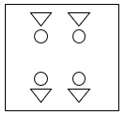
Correct — C.
Rule: undo the folds in reverse order, and treat every crease as a mirror, not a copier.
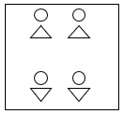
The right half went left onto the left half; then the top half came down onto the bottom half. What is left is the bottom-left quarter, four sheets thick, cut with a circle and, below it, a triangle pointing down.
Undo the downward fold first. The top-left quarter receives the pattern flipped top to bottom, so there the triangle points up and sits above the circle.
Undo the leftward fold next. Both left-hand quarters are mirrored across the vertical centre line onto the right half, which reverses them sideways and leaves the up-down sense untouched.
The opened sheet therefore shows four groups: triangles pointing outward towards the top and bottom edges, circles sitting nearer the middle. That is option (c).
Why the others are wrong
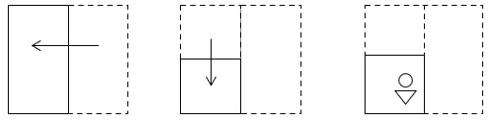
- (a)No mirroring anywhere. Option (a) prints the same circle-above-triangle group in all four quarters. A crease reflects the cut, so the two upper groups cannot be identical to the two lower ones.
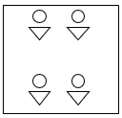
- (b)The order flips but the triangle does not. Option (b) correctly puts the triangle above the circle in the top row, then leaves it still pointing down; a top-to-bottom mirror has to invert the triangle as well as move it.
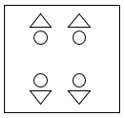
- (d)The triangle flips but the order does not. Option (d) correctly turns the upper triangles point-up, then keeps them below the circles; the same mirror that inverts a shape also swaps its position across the crease.
Concept
Each fold doubles the number of layers, so two folds give four, and one cut through the folded stack opens into four shapes.
The crease is a mirror line. Every point of the cut has a partner the same distance on the other side of the crease, and the shape itself is reversed in the direction perpendicular to the crease.
Undo the folds in the reverse of the order they were made. Doing them in the original order reflects across the wrong line and puts the shapes in the wrong quarters.
Key facts
- Two folds give four layers, so a single cut opens into four identical shapes.
- A horizontal crease reverses up and down and leaves left and right alone.
- A vertical crease reverses left and right and leaves up and down alone.
- A reflected copy is not a translated copy: the shape's own orientation changes, not just its position.
Study next
Common traps
- Copying the cut across the crease instead of reflecting it.
- Reflecting where the shapes sit but not which way they point.
- Undoing the folds in the order they were made rather than in reverse.
The stem is printed word for word on other dates — also at 9 Sep 2024, 12:30, Reasoning Q.19, at 11 Sep 2024, 09:00, Reasoning Q.15 and at 25 Sep 2024, 09:00, Reasoning Q.18.
SSC also runs a harder cousin in which a square sheet is folded along dotted lines and then punched, as at 18 Sep 2024, 09:00, Reasoning Q.4.
Related PYQs
No directly related past PYQ was found.