
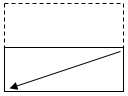
A transparent sheet with a pattern is given in the following figure. Identify from amongst the options as to how the pattern would appear when the transparent sheet is folded at the middle horizontal line.
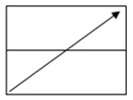
- (a)
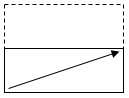
- (b)
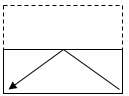
- (c)
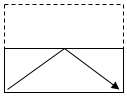
- (d)
Answer
Why
Correct — C.
Rule: the half that folds over is reflected across the crease, and because the sheet is transparent both halves are then seen one on top of the other.
The arrow runs from the bottom-left corner to the top-right corner, crossing the middle line exactly at its midpoint.
The lower half already holds the first stretch: bottom-left corner rising to that midpoint.
Now fold the top half down. The crossing point lies on the crease, so it does not move; the tip at the top-right corner reflects straight down to the bottom-right corner.
The second stretch therefore runs from the midpoint of the crease down to the bottom right, arrowhead included.
Together the two read as an inverted V with its peak on the crease and the arrowhead at the bottom right — option (c).
Why the others are wrong
- (a)Nothing has been reflected. Option (a) leaves the arrow as one unbroken stroke rising to the right with its tip on the crease, which is the sheet squashed to half height rather than folded.
- (b)Right shape, wrong end. Option (b) draws the inverted V correctly but puts the arrowhead at the bottom left. The tip started at the top-right corner, and a horizontal crease moves a point straight down, never sideways.
- (d)Reversed, not folded. Option (d) keeps a single straight stroke and merely turns the head back to the bottom left; a fold produces two stretches meeting at a peak on the crease, because the halves arrive at it on opposite slopes.
Concept
The word transparent is the instruction. Nothing is hidden by the fold: the pattern that travels over stays visible, superimposed on the pattern that stayed put.
So the answer is always a union of two things — the half that never moved, drawn unchanged, and the other half drawn as its mirror image in the crease.
Any point actually sitting on the crease is its own reflection and stays exactly where it is. Here that is the arrow's crossing point, which becomes the peak of the finished figure.
Key facts
- The sheet is transparent, so the folded half remains visible and the two halves are seen superimposed.
- A horizontal crease mirrors height and leaves left-right position unchanged.
- A point lying on the crease does not move when the sheet is folded.
- The arrow crosses the middle line at its midpoint, which is why the folded figure peaks in the centre.
Study next
Common traps
- Treating the fold as a shrink and squeezing the whole pattern into half the height.
- Mirroring left to right when the crease is horizontal.
- Drawing only the reflected half and dropping the half that never moved.
The same idea appears with slightly different wording at 17 Sep 2024, 09:00, Reasoning Q.15 and at 23 Sep 2024, 09:00, Reasoning Q.13.
Read the crease line before you mirror anything: it may be horizontal or vertical, and that is what decides which way the pattern turns over.
Related PYQs
No directly related past PYQ was found.