
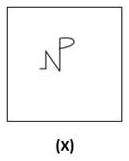
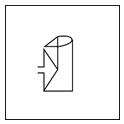
Select the option figure in which the given figure (X) is embedded (rotation is NOT allowed).
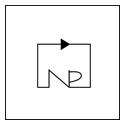
- (a)
- (b)
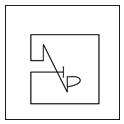
- (c)
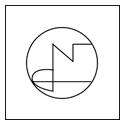
- (d)
Answer
Why
Correct — D.
Rule: no rotation, no reflection, no resizing — figure X must sit inside the option at its own size and its own tilt, with extra lines allowed around it.
X is five strokes: a short tick pointing left, a vertical rising from the tick's right end, a diagonal falling to the right, a taller vertical rising from that diagonal's foot, and a loop hung on the top of the taller vertical.
Two proportions pin it down. The right-hand vertical rises clearly higher than the left-hand one — about half as tall again — and the loop occupies only its top third.
Option (d) supplies all five at that scale: the cylinder's left wall is the short vertical, a tick on it is the foot, the inner zigzag is the diagonal, the line climbing to the ellipse is the tall vertical, and the ellipse's right-hand arc closes the loop on its upper part.
Why the others are wrong
- (a)The right-hand stroke is too short. In option (a) both verticals end level at the top and the loop fills almost the whole of the right one; in X that stroke rises well above the left one and the loop takes only its upper part.
- (b)Stretched. Option (b) has the same five strokes, but its diagonal drops far further than X's, so the whole shape is taller than the target — an embedded figure has to match X's size, not merely its outline.
- (c)Mirrored. In option (c) the tall stroke stands to the left of the diagonal and the loop hangs low and opens leftwards, where X keeps the tall stroke on the right with the loop at its top; the stem rules reflection out.
Concept
An embedded-figure item asks whether the target is present as drawn, buried among lines that have nothing to do with it. The lines around it are camouflage and never disqualify an option.
Working by outline alone fails, because all four options here carry a shape that reads as the same squiggle. What separates them is proportion.
So pick one measurable feature of X — the ratio of its two verticals, or how far down the stem the loop reaches — and test each option against that single number.
Key facts
- The stem's phrase rotation is NOT allowed means the target must appear at the same tilt, so a turned copy is wrong even when every stroke is present.
- Scale is part of the match: an enlarged or stretched copy of the target does not count as embedded.
- In figure X the right-hand vertical is about half as tall again as the left-hand one, and the loop sits on its top third.
Study next
Common traps
- Matching the shape's outline and never checking its proportions.
- Accepting a mirror image because every stroke of the target is present.
- Ruling an option out because it carries extra lines the target does not have.
The identical stem runs at Reasoning Q.20 of 17 Sep 2024, 12:30, at 11 Sep 2024, 12:30, Reasoning Q.18 and at 9 Sep 2024, 16:00, Reasoning Q.6.
The rider about rotation is printed in the stem, so read it: it is what makes a mirrored option wrong rather than merely awkward.
Related PYQs
No directly related past PYQ was found.