
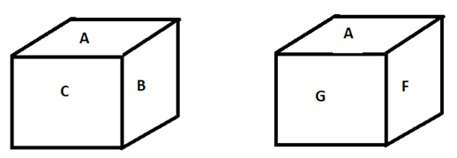
Six letters A, B, C, E, F and G are written on different faces of a dice. Two positions of this dice are shown in the figure below. Find the letter on the face opposite to A.
- (a)F
- (b)G
- (c)E
- (d)C
Answer
Why
Correct — C. The two drawings show the same die twice:
View 1 — A on top, C on the front-left face, B on the right face.
View 2 — A on top, G on the front-left face, F on the right face.
A sits on top in both views, and every face drawn beside it in the same picture must touch it. So A is adjacent to C, B, G and F.
The die carries six letters: A, B, C, E, F and G. A cannot face itself and already touches four of the others, so the face opposite A is the one letter left over — E, option (c).
Why the others are wrong
- (a)F — F is the right-side face in the second view while A is on top. Two faces visible in the same drawing share an edge, so they can never be opposite.
- (b)G — G is the front-left face in the second view, drawn directly below A. It touches A rather than facing it.
- (d)C — C is the front-left face in the first view, again with A above it, so C is another of A's four neighbours.
Concept
Two views of a die settle the question outright whenever a face repeats between them. Here A repeats, and that repetition is the shortcut.
Every letter appearing in the same drawing as A is touching A. Collect those neighbours, remove them and A itself from the six letters, and whatever remains is the opposite face.
This is faster than any rotation argument, and it does not depend on working out how the die was turned between the two pictures.
Had no face repeated, you would have had to rotate one view onto the other. Two views here hand you four neighbours straight away.
The six symbols are A, B, C, E, F and G — the paper skips D. Do not carry the ordinary A-to-F set into this question and start hunting for a letter that is not on the die.
Key facts
- The six faces carry A, B, C, E, F and G, with no D anywhere on the die.
- In the first view the visible faces are A on top, C at the front-left and B on the right.
- In the second view they are A on top, G at the front-left and F on the right.
- Faces visible together in one view are adjacent, so A touches B, C, F and G.
Study next
Common traps
- Assuming the six symbols run A to F and looking for a D that is not there
- Rotating the die mentally when the repeated top face has already settled it
SSC gives two or three positions of a die and asks for the face opposite a named one. Spatial reasoning also appears in this shift at Reasoning Q.22 (mirror image), Q.23 (paper folding) and Q.25 (embedded figure).
Related PYQs
No directly related past PYQ was found.