
Identify the figure given in the options which when put in place of ? will logically complete the series.
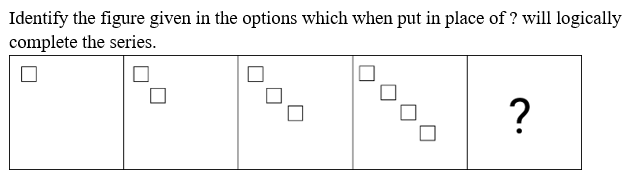
- (a)
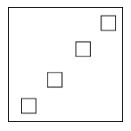
- (b)
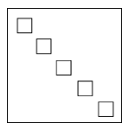
- (c)
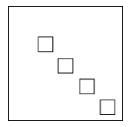
- (d)
Answer
Why
Correct — B. The instruction and the four panels are printed as one picture: identify the figure from the options which, put in place of the ?, logically completes the series.
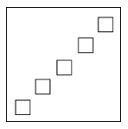
Each panel holds small identical outline squares placed on a diagonal that starts at the top-left corner and steps down and to the right.
Rule: one more square in each panel, always on the same falling diagonal.
Panel 1 holds 1 square, panel 2 holds 2, panel 3 holds 3 and panel 4 holds 4.
The fifth panel therefore needs 5 squares on that same top-left to bottom-right diagonal, which is option (b).
Why the others are wrong
- (a)Option (a) shows four squares, so the count fails to advance. Its diagonal also climbs from the bottom left to the top right, the opposite of the printed panels.
- (c)Option (c) has the falling diagonal right but shows only four squares. It also starts one step inside the panel rather than at the top-left corner.
- (d)Option (d) has the right count of five, but its diagonal rises from the bottom left to the top right. Direction is fixed across all four printed panels.
Concept
A figure series usually carries two things at once: how many and where. Check both before choosing.
Here the count is a plain +1 and the placement never varies — every square sits on one line running from the top-left corner down to the bottom right, each a step below and to the right of the last.
The options are built to fail one test while passing the other. One has the right direction and the wrong count; another has the right count and the wrong direction.
Say the rule out loud in two clauses — five squares, falling diagonal — and the option that satisfies both is quick to pick out.
The panels print small and the squares are outlines rather than solids, so four and five are easy to miscount on a phone. Count the fourth panel first, confirm it is four, then add one.
Key facts
- The four printed panels hold 1, 2, 3 and 4 small squares.
- Every square lies on a diagonal running from the top-left corner towards the bottom-right corner.
- Option (b) holds five squares on that same falling diagonal.
Study next
Common traps
- Counting the squares correctly and then missing the reversed diagonal
- Choosing the option that starts one step inside the panel instead of at the corner
The instruction and the panels are printed as a picture, so nothing in this item can be read from text alone. A letter-based version of the same continue-the-series task appears in this shift at Reasoning Q.8.
Related PYQs
No directly related past PYQ was found.