
If , then the numerical value of is:
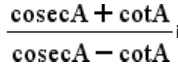
- (a)1
- (b)0
- (c)13
- (d)−13
Answer
Why
Correct — C. The two images in the stem carry the condition 7 cosA = 6 and the expression (cosecA + cotA)⁄(cosecA − cotA).
Write both terms over sinA:
cosecA + cotA = (1 + cosA)⁄sinA
cosecA − cotA = (1 − cosA)⁄sinA
The sinA cancels, leaving (1 + cosA)⁄(1 − cosA)
cosA = 6⁄7, so the value is (1 + 6⁄7) ÷ (1 − 6⁄7) = (13⁄7) ÷ (1⁄7) = 13 → option (c).
Why the others are wrong
- (a)1 — The ratio reaches 1 only when cotA = 0, which needs cosA = 0. Here 7 cosA = 6, so cosA is 6⁄7 and the two terms are nowhere near equal.
- (b)0 — A value of 0 needs the numerator to vanish, so cosecA = −cotA and cosA = −1. The stated condition fixes cosA at the positive 6⁄7.
- (d)−13 — The size is right and the sign is not. With cosA = 6⁄7 both 1 + cosA and 1 − cosA come out positive, so their ratio cannot be negative.
Concept
Behind this sits the identity cosec²A − cot²A = 1, which is sin²A + cos²A = 1 divided through by sin²A. It makes cosecA + cotA and cosecA − cotA exact reciprocals of one another.
So the whole expression is simply (cosecA + cotA)², and it is equally the tidier (1 + cosA)⁄(1 − cosA) once both terms are written over sinA.
The condition 7 cosA = 6 never requires sinA. Computing sinA = √13⁄7 first still reaches 13, but it is the longer road and it invites a surd slip.
Both the condition and the expression reach the page as images, so the question text reads with two gaps in it. The condition is 7 cosA = 6 and the expression is (cosecA + cotA)⁄(cosecA − cotA).
Key facts
- cosec²A − cot²A = 1, so cosecA + cotA and cosecA − cotA multiply to 1.
- (cosecA + cotA)⁄(cosecA − cotA) simplifies to (1 + cosA)⁄(1 − cosA).
- If cosA = 6⁄7 then sinA = √13⁄7, because 49 − 36 = 13.
- With cosA = 6⁄7 the expression comes to 13.
Study next
Common traps
- Computing sinA and then dividing surds, where the √13 in both places is easy to cancel wrongly.
- Reading 7 cosA = 6 as cosA = 7⁄6, a value cosine can never take.
- Reaching for sec²A − tan²A = 1 on an expression built from cosec and cot.
One ratio is given and a conjugate expression is asked, so the work is in spotting that the sine cancels rather than in grinding out values. Plain trigonometric values are asked directly at 12 Sep 2024, 16:00, Quant Q.17, which wants the exact value of sin 150°.
Related PYQs
No directly related past PYQ was found.