
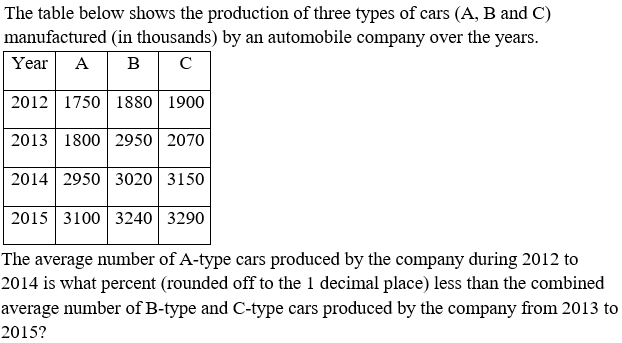
The table below shows the production of three types of cars (A, B and C) manufactured (in thousands) by an automobile company over the years. Year → A | B | C 2012 — 1750 | 1880 | 1900 2013 — 1800 | 2950 | 2070 2014 — 2950 | 3020 | 3150 2015 — 3100 | 3240 | 3290 The average number of A-type cars produced by the company during 2012 to 2014 is what percent (rounded off to the 1 decimal place) less than the combined average number of B-type and C-type cars produced by the company from 2013 to 2015?
- (a)36.6%
- (b)26.6%
- (c)28.4%
- (d)25.5%
Answer
Why
Correct — B. The table gives A-type output of 1750, 1800 and 2950 for 2012 to 2014, and for 2013 to 2015 gives B as 2950, 3020, 3240 and C as 2070, 3150, 3290.
Average of A, 2012–2014 = 6500 ÷ 3 = 2166.67
B and C, 2013–2015, total 9210 + 8510 = 17720
Their combined average over those six entries = 17720 ÷ 6 = 2953.33
Shortfall = 2953.33 − 2166.67 = 786.67
Percent less divides by the larger figure: 786.67 ÷ 2953.33 = 0.2664 = 26.6% → option (b).
Why the others are wrong
- (a)36.6% — To be 36.6% below 2953.33, A's three-year average would have to be about 1872. It is 6500 ÷ 3 = 2166.67, well above that.
- (c)28.4% — 28.4% less than 2953.33 is roughly 2115, and A's average is 2166.67. Close, but the division does not round down to 28.4%.
- (d)25.5% — 25.5% less would put A's average near 2200. The real 2166.67 is lower still, so the gap is wider than 25.5%.
Concept
Two averages over two different windows, and the whole item turns on the base. X percent less than Y always divides by Y, the larger quantity being compared against.
A runs 2012 to 2014 and totals 6500, averaging 2166.67. B and C run 2013 to 2015, six entries totalling 17720, averaging 2953.33.
Combined average means one mean over all six numbers, not the two column means added. Here both routes agree, because each column contributes three entries.
The table is headed in thousands, but the answer is a percentage, so the unit cancels and nothing needs multiplying by 1000.
Key facts
- Percent less is computed on the larger quantity: (larger − smaller) ÷ larger × 100.
- A-type production for 2012, 2013 and 2014 was 1750, 1800 and 2950 thousand, averaging 2166.67.
- B and C over 2013 to 2015 total 17720 thousand across six entries, averaging 2953.33.
- 786.67 ÷ 2953.33 = 26.64%, which rounds to 26.6%.
Study next
Common traps
- Dividing the 786.67 gap by A's own 2166.67, which gives about 36.3% and answers percent more instead.
- Dividing the 17720 by 3 rather than 6, which treats two columns as if they were one.
- Sliding the year window: A is asked for 2012 to 2014, B and C for 2013 to 2015.
The arithmetic is one subtraction and one division. The item is won or lost on the reading — which years, and which quantity is the base. Chart reading also appears at 12 Sep 2024, 16:00, Quant Q.7 in ratio form and at Quant Q.9 as a pie chart wanting one decimal place.
Related PYQs
No directly related past PYQ was found.