
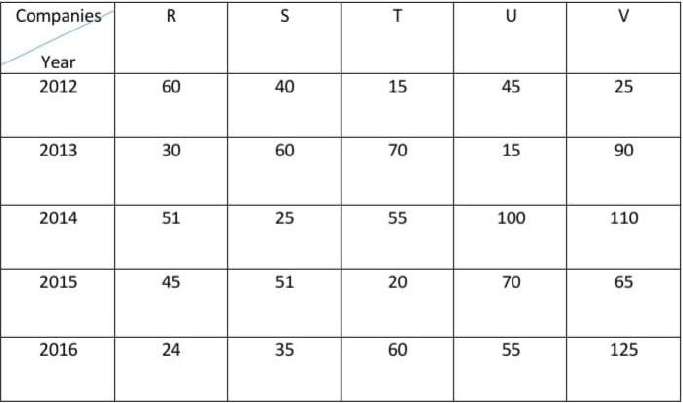
Consider the given table for total imports of goods of 5 companies over 5 years (in lakhs), and answer the question that follows. If the total exports of all companies together in the year 2013 is ₹300 lakh, then the profit/loss of all companies together in year 2013 is: (Assume: Profit = Exports – Imports)
- (a)loss of ₹27 lakh
- (b)loss of ₹18 lakh
- (c)profit of ₹35 lakh
- (d)profit of ₹30 lakh
Answer
Why
Correct — C. Read the 2013 row of the imports table: R 30, S 60, T 70, U 15, V 90.
Total imports 2013 = 30 + 60 + 70 + 15 + 90 = ₹265 lakh
Exports given = ₹300 lakh
Profit = 300 − 265 = ₹35 lakh → option (c)
The sign follows from the stem's own definition, Profit = Exports − Imports. Exports exceed imports, so 2013 is a profit and not a loss.
Why the others are wrong
- (a)loss of ₹27 lakh — A loss of ₹27 lakh needs 2013 imports of ₹327 lakh. The row totals 265, which is below the ₹300 lakh of exports, so the year cannot be a loss at all.
- (b)loss of ₹18 lakh — A loss of ₹18 lakh needs imports of ₹318 lakh. Adding the 2013 row gives 265, and any import total under 300 makes Exports − Imports positive.
- (d)profit of ₹30 lakh — ₹30 lakh profit needs imports of ₹270 lakh, five above the true 265. Re-add the row — 30, 60, 70, 15, 90 — and the profit comes to ₹35 lakh.
Concept
This is a one-row read, not a table analysis. The five columns R to V are the companies and the five rows are the years, so the year named in the question fixes the row and every company in it is summed.
The stem supplies the only definition that matters: Profit = Exports − Imports. The other four rows are not used here.
Exports are given as one combined figure of ₹300 lakh for all companies together, which is why the imports must also be combined before subtracting.
The header cell is split by a diagonal, with Companies written above the line and Year below it. So R to V run across the top and 2012 to 2016 run down the side, and reading it the other way round makes the 2013 row look like a company.
Key facts
- In the 2013 row the five import figures are 30, 60, 70, 15 and 90, totalling ₹265 lakh.
- The stem defines profit as exports minus imports, so any import total under ₹300 lakh is a profit.
- All figures in the table are in lakhs of rupees, so the answer stays in lakhs without conversion.
Study next
Common traps
- Summing a column of five years instead of the 2013 row of five companies.
- Answering with the imports total of ₹265 lakh rather than the difference from exports.
- Choosing a loss because the import figures look large, without adding the row.
Table reading also carries Quant Q.17 here, where a distance table is turned into an average speed for athlete Y. At 26 Sep 2024, 09:00, Quant Q.22 the table holds a percentage distribution of students across four schools instead of raw figures.
Related PYQs
No directly related past PYQ was found.