
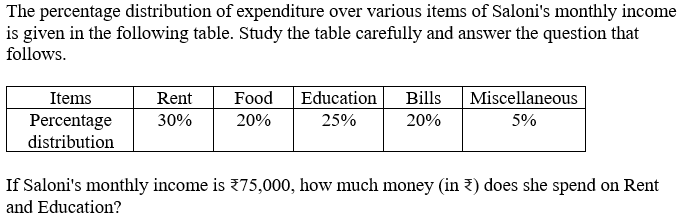
The percentage distribution of expenditure over various items of Saloni's monthly income is given in the following table. Study the table carefully and answer the question that follows. Items → Rent | Food | Education | Bills | Miscellaneous Percentage distribution — 30% | 20% | 25% | 20% | 5% If Saloni's monthly income is ₹75,000, how much money (in ₹) does she spend on Rent and Education?
- (a)43,250
- (b)41,250
- (c)40,150
- (d)42,150
Answer
Why
Correct — B. The image gives Saloni's monthly income as ₹75,000 and splits her expenditure as Rent 30%, Food 20%, Education 25%, Bills 20%, Miscellaneous 5%.
Rent + Education = 30% + 25% = 55%
1% of ₹75,000 = ₹750
55 × 750 = ₹41,250 → option (b)
Why the others are wrong
- (a)43,250 — ₹43,250 is ₹2,000 too high. It works out to 57.7% of ₹75,000, while Rent and Education together come to 55%.
- (c)40,150 — ₹40,150 is 53.5% of ₹75,000. It falls short of the 55% that Rent at 30% and Education at 25% add up to, which is ₹41,250.
- (d)42,150 — ₹42,150 is ₹41,250 with the 1 and the 2 swapped. It reads as 56.2% of the income, a share those two rows do not make.
Concept
A percentage-table question is two moves: add the shares the question names, then take that single combined share of the base once.
Adding first keeps the arithmetic clean. 30% + 25% = 55%, and 55% of ₹75,000 is one multiplication rather than two.
The 1% unit makes it faster still. 1% of ₹75,000 is ₹750, so any row is that row's number times 750: Rent alone is 30 × 750 = ₹22,500 and Education is 25 × 750 = ₹18,750, which add back to ₹41,250.
The five shares in the table add to 100%, and the question treats them as shares of the ₹75,000 income, so there is no unspent remainder to set aside before taking a share.
Key facts
- Rent is 30% and Education is 25% in the table, so together they take 55% of the income.
- 1% of ₹75,000 is ₹750, which turns every row of the table into a one-step multiplication.
- Rent ₹22,500 plus Education ₹18,750 is ₹41,250, the same figure the combined 55% gives.
Study next
Common traps
- Taking 30% of ₹75,000 and then 25% of what remains, which multiplies the shares instead of adding them.
- Picking up Bills at 20% as Education, since Food and Bills carry the same figure.
- Adding Rent and Food, the two leftmost columns, rather than Rent and Education.
Share-of-a-total reading also runs at 26 Sep 2024, 09:00, Quant Q.22, where a table gives the percentage distribution of students across four schools. At 23 Sep 2024, 12:30, Quant Q.3 the same distribution idea is put as a pie chart and the answer wanted is a central angle.
Related PYQs
No directly related past PYQ was found.