
Simplify the following expression. (3⁄a + 3a)(9⁄a² − 9 + 9a²) if a = 1
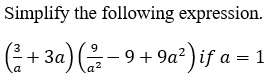
- (a)54
- (b)81
- (c)63
- (d)27
Answer
Why
Correct — A. The stem is an image: simplify (3⁄a + 3a)(9⁄a² − 9 + 9a²) when a = 1. Substitute before doing anything clever.
First bracket = 3⁄1 + 3(1) = 6
Second bracket = 9⁄1 − 9 + 9 = 9
Product = 6 × 9 = 54 → option (a)
The identity route agrees. With x = 3⁄a and y = 3a the second bracket is x² − xy + y², so the product is x³ + y³ = 27⁄a³ + 27a³, which is 54 at a = 1.
Why the others are wrong
- (b)81 — 81 is 9 × 9, the second bracket squared. The first bracket is 3⁄1 + 3(1) = 6, not 9, so the product is 54.
- (c)63 — 63 is 7 × 9, which needs a first bracket of 7. At a = 1 that bracket is 3 + 3 = 6.
- (d)27 — 27 is one of the two cubes. The expression equals (3⁄a)³ + (3a)³ = 27 + 27, so taking a single cube halves the answer.
Concept
The bracket pair is the x³ + y³ factorisation in disguise: (x + y)(x² − xy + y²) = x³ + y³.
Here x = 3⁄a and y = 3a, so x² = 9⁄a², xy = 9 and y² = 9a². Those are exactly the three terms of the second bracket, in order and with the minus sign on the middle one.
Recognising it gives 27⁄a³ + 27a³ for any non-zero a. But the stem hands you a = 1, and direct substitution reaches 54 in two lines, so the identity is worth seeing and not worth waiting for.
The middle term is where the pattern is confirmed. It is −9 in the printed bracket, and (3⁄a)(3a) = 9 whatever a is, so the factorisation holds for every non-zero a and not only for a = 1.
Key facts
- x³ + y³ = (x + y)(x² − xy + y²), with a minus sign on the middle term.
- This product equals 27⁄a³ + 27a³ for any non-zero a, and 54 when a = 1.
- (3⁄a)(3a) = 9 for every non-zero a, which is why the second bracket's middle term is a constant.
Study next
Common traps
- Expanding both brackets term by term when a = 1 has been handed to you.
- Mis-signing the middle term as x² + xy + y², which factorises nothing.
- Reading 9⁄a² − 9 + 9a² as the square (3⁄a − 3a)², whose middle term would be −18, not −9.
SSC heads quite different tasks with the same line, "Simplify the following expression." At 13 Sep 2024, 09:00, Quant Q.15 and at 26 Sep 2024, 12:30, Quant Q.19 it introduces a BODMAS chain built on the word of, not an identity, so read the expression before choosing a method.
Related PYQs
No directly related past PYQ was found.