
Which of the following facts about the Adamgarh archaeological site in Narmadapuram district of Madhya Pradesh is false?
- (a)This archaeological site is located on the bank of the Narmada River.
- (b)The oldest evidences of animal husbandry have been found here.
- (c)Archaeological excavations were carried out at this site by V. S. Wakankar.
- (d)A large number of palaeolithic tools and bone remains have been found here.
Correct — C, 'Archaeological excavations were carried out at this site by V. S. Wakankar.' The question asks for the FALSE statement, and this is the one that does not hold. The excavation of Adamgarh is credited to R. V. Joshi of the Archaeological Survey of India, who dug the hill in the 1960s and used its stratified deposits to work out the Acheulian-to-Mesolithic sequence of central India. Dr. Vishnu Shridhar Wakankar's name belongs to Bhimbetka in Raisen district — he spotted those rock shelters in 1957-58 and led the study of their painted caves for the rest of his life. Wakankar is the most quoted archaeologist in Madhya Pradesh, and the paper exploits exactly that reflex by attaching his name to a neighbouring but different site. The other three statements are all true of Adamgarh.
- (a)This archaeological site is located on the bank of the Narmada River. — This statement is TRUE, so it cannot be the answer. Adamgarh is a low hill just outside Hoshangabad town — now Narmadapuram — on the southern side of the Narmada, and the river is the reason the site was occupied at all.
- (b)The oldest evidences of animal husbandry have been found here. — This statement is TRUE. The Mesolithic layer at Adamgarh yielded bones of cattle, buffalo, sheep, goat, pig and dog, and standard textbooks cite Adamgarh together with Bagor in Rajasthan as the earliest evidence of animal domestication in India. The claim is about India, not the world, and that is how MPPSC uses it.
- (d)A large number of palaeolithic tools and bone remains have been found here. — This statement is TRUE. Below the microlithic (Mesolithic) levels the hill has yielded Lower Palaeolithic Acheulian tools — hand-axes and cleavers — along with a rich collection of animal bone, which is precisely what makes the site's sequence valuable.
Adamgarh is a rock-shelter site on a hill near Hoshangabad (Narmadapuram), close to the Narmada. Its shelters carry prehistoric paintings, and the deposits under them run from Lower Palaeolithic (Acheulian) hand-axes and cleavers up through a thick Mesolithic microlithic layer. That Mesolithic layer is the famous part: alongside the tiny stone blades came the bones of cattle, buffalo, sheep, goat, pig and dog — animals kept, not merely hunted. Adamgarh is therefore quoted with Bagor (Rajasthan) as the earliest evidence of animal domestication in India, around the middle of the sixth millennium BCE. What Adamgarh is not is a Wakankar site.
The trap is a true-sounding attribution. Every MP-focused GK list repeats 'V. S. Wakankar' next to 'rock shelters in Madhya Pradesh', so an option carrying his name reads as safe — but his site is Bhimbetka, roughly 60 km away in Raisen district, and the two sites are constantly swapped in question papers. The discipline a 'which is false' question demands is to read all four options as claims and mark the one you can positively disprove, rather than stopping at the option that merely feels unfamiliar. Here, statements (a), (b) and (d) are all standard Adamgarh facts, so the odd one out is the excavator.
- Adamgarh: prehistoric rock-shelter site on a hill near Hoshangabad (Narmadapuram), close to the Narmada
- Excavated by R. V. Joshi of the Archaeological Survey of India in the 1960s — not by V. S. Wakankar
- Its Mesolithic layer gave bones of cattle, buffalo, sheep, goat, pig and dog — the earliest evidence of animal domestication in India, along with Bagor in Rajasthan
- Lower Palaeolithic (Acheulian) tools occur below the microlithic levels, so the site spans a long stretch of the Stone Age
- V. S. Wakankar's site is Bhimbetka in Raisen district, noticed by him in 1957-58 and inscribed as a UNESCO World Heritage Site in 2003
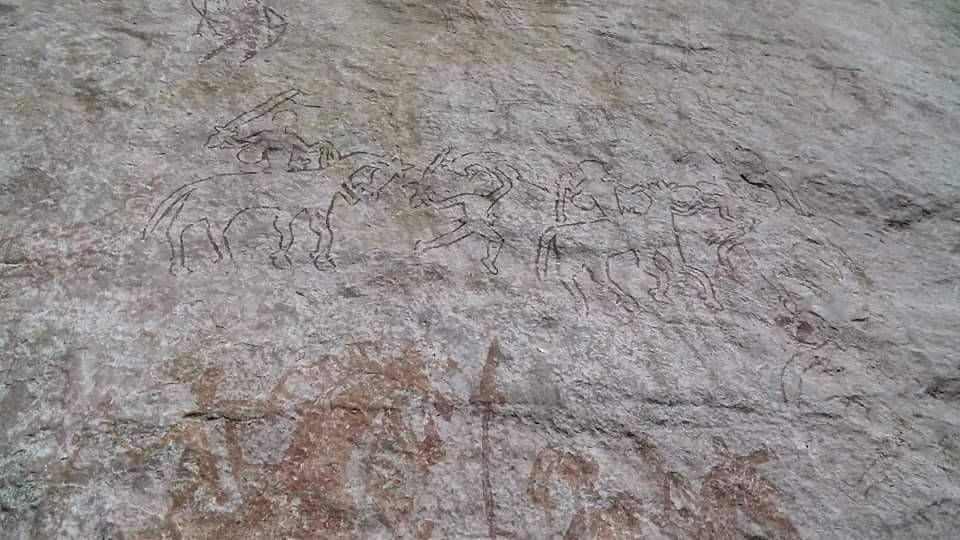
- Attaching V. S. Wakankar to any prehistoric site in Madhya Pradesh — his site is Bhimbetka, not Adamgarh
- Confusing Adamgarh with Bhimbetka: different districts (Narmadapuram vs Raisen) and different excavators
- Reading 'oldest evidence of animal husbandry' as a world claim — the statement is about India
MPPSC asks this area either as 'which statement about site X is false' or as a straight site-to-discoverer question; UPSC prefers the 'Historical place : Well-known for' pairing format. Either way, store every prehistoric site with one distinguishing find and one name attached to it.
Consider the following pairs: (Historical place) : (Well-known for) 1. Burzahom : Rock-cut shrines 2. Chandraketugarh : Terracotta art 3. Ganeshwar : Copper artefacts Which of the pairs given above is/are correctly matched?
- (a) 1 only
- (b) 1 and 2
- (c) 3 only
- (d) 2 and 3
Answer(d) 2 and 3 — Burzahom is known for pit dwellings, not rock-cut shrines.
Same skill in UPSC's own format — spot the archaeological site whose 'well-known for' label has been switched, exactly what the Adamgarh-Wakankar option does.
When did Dr. Vishnu Shridhar Wakankar discover the rock shelters of Bhimbetka ?
- (a) 1951 - 1952
- (b) 1954 - 1955
- (c) 1960 - 1961
- (d) 1957 - 1958
Answer(d) 1957 - 1958
MPPSC returned to the Wakankar-Bhimbetka link the very previous year — proof that the commission builds questions around this single attribution.
- practice — not a real PYQ
The earliest evidence for the domestication of animals in India comes from which pair of Mesolithic sites?
- (a)Adamgarh and Bagor
- (b)Burzahom and Gufkral
- (c)Chirand and Koldihwa
- (d)Hallur and Paiyampalli
Answer(a) Adamgarh (Madhya Pradesh) and Bagor (Rajasthan) — animal bones in their Mesolithic layers indicate herding. - practice — not a real PYQ
The Bhimbetka rock shelters, brought to scholarly attention by V. S. Wakankar, lie in which district of Madhya Pradesh?
- (a)Raisen
- (b)Narmadapuram
- (c)Sehore
- (d)Vidisha
Answer(a) Raisen — the shelters are in the Raisen district, south of Bhopal, and are a UNESCO World Heritage Site.